Educator Insight: Tatiana on the Elisarion
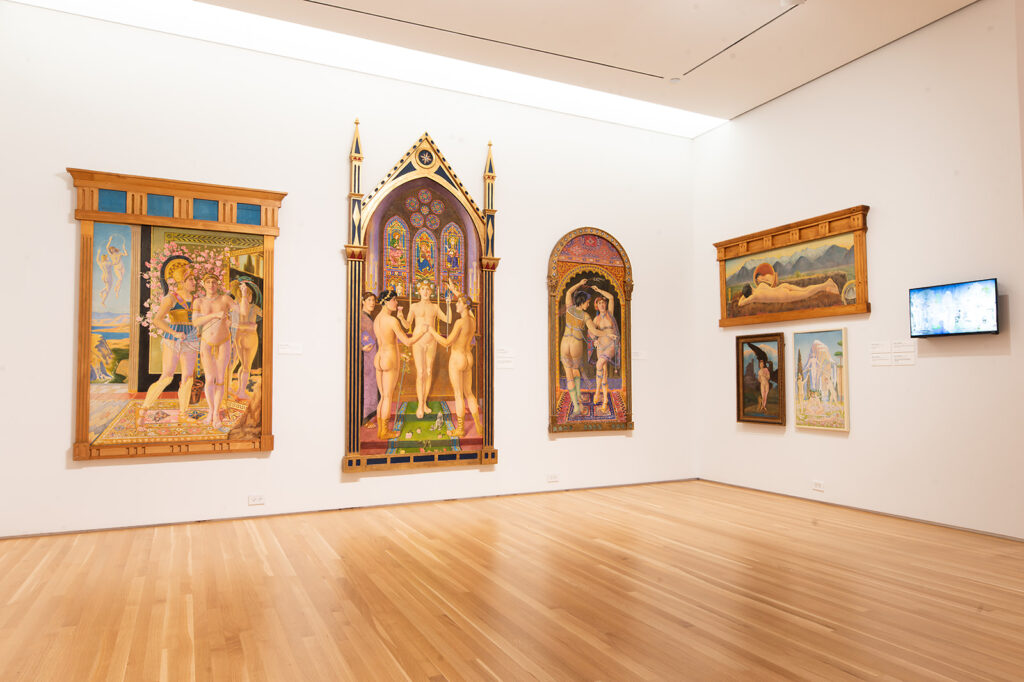
Installation view of "The First Homosexuals: The Birth of a New Identity, 1869-1939", at Wrightwood 659, 2025. Photo courtesy of Daniel Eggert (@DesigningDan).
In 1927, Elisar Von Kupffer completed a cyclorama to honor the artist’s new religion, Clarism, in a temple called Sanctuarium Artis. Accompanying the 33 panels of this immersive curved mural is a poem written by Von Kupffer that narrates each scene.
Elisar Von Kupffer’s visionary works elude categorization. His paintings are not merely gay liberationist depictions, early representations of gender fluidity or dream-like propaganda to join his spiritual group. Instead, the vast body of work Von Kupffer left behind leaves us in the murkiness of contradictory ideas and otherworldly realms which make it hard to digest and neatly ascribe a label to.
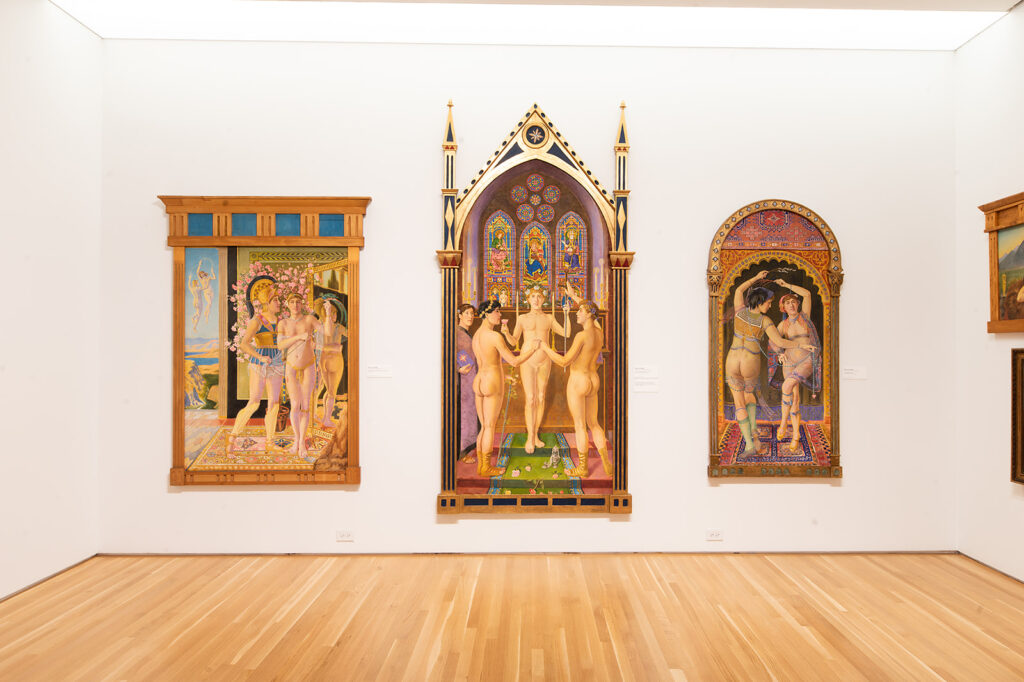
Installation view of "The First Homosexuals: The Birth of a New Identity, 1869-1939", at Wrightwood 659, 2025. Photo courtesy of Daniel Eggert (@DesigningDan).
Elisar Von Kupffer’s upbringing as a Baltic-German aristocrat in the late 1800s introduced him to theories about biological racism, antisemitism and sexism. (1) Later in life, in opposition to popular breakthroughs in sexual sciences which were trying to define same-sex attraction as a ‘third sex’, Kupffer published a book of gay poetry called Lieblingminne und Freundesliebe in der Weltliteratur. In the introduction to the text, Von Kupffer advocates for gay liberation and the end of anti-sodomy laws but he also cautions his readers against the ‘cult of the feminine’ and encourages gay men to ‘maintain their masculinity’. (2) In addition to his published writings, historians also note that Von Kupffer wrote many unanswered letters of support to Hitler and the Nazi regime, which solidified his flagrantly bigoted, misogynistic views despite being a vocal gay activist. (3)
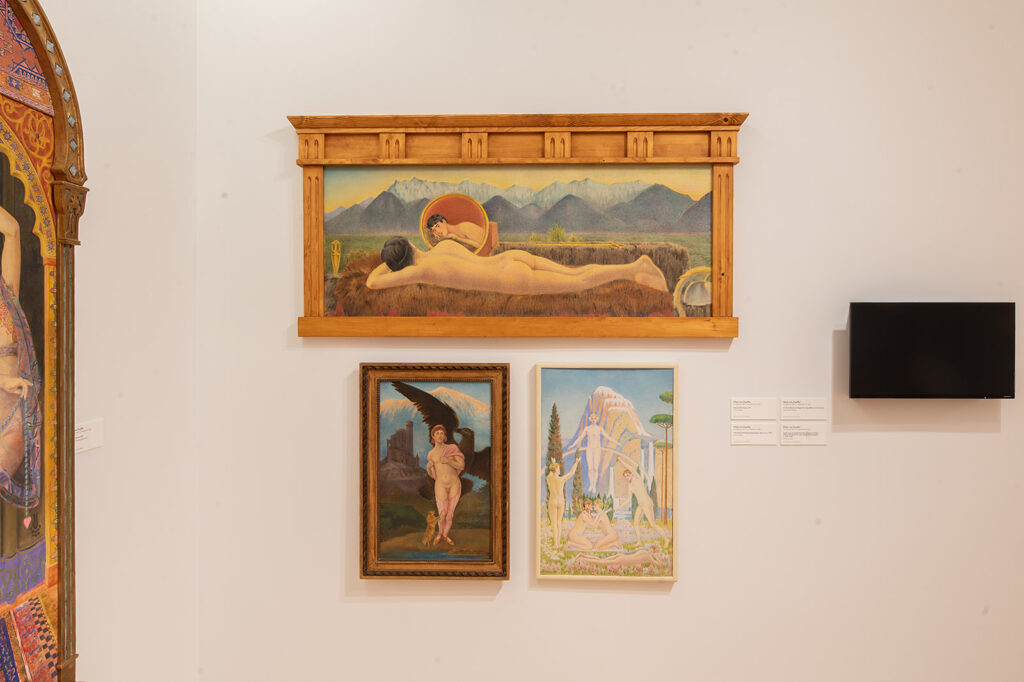
Installation view of "The First Homosexuals: The Birth of a New Identity, 1869-1939", at Wrightwood 659, 2025. Photo courtesy of Daniel Eggert (@DesigningDan).
In viewing Von Kupffer’s artwork, we are left to decipher what at first glance appears to be a contradiction. Von Kupffer’s paintings do not depict men as muscular and aggressive which would have been more aligned with popular fascist imagery at the time. Instead we find figures that are soft and languid, often basking in the sun with crowns of flowers and butterflies flitting around them. They are also always White with calm, composed facial expressions. It is worth noting that the faces in the work look almost identical to each other. They are modeled after Von Kupffer himself, his life partner Edvaud Von Mayer and a local model named “Gino” Luigi Taricco, who bore similar resemblance to the couple. The figures rendered in the artworks speak to Von Kupffer’s unique personal definition of masculinity. He felt that to be masculine was to exhibit strength through composure and internal self-mastery. Von Kupffer writes, “Masculinity means the preservation of self-determination, personal freedom, and the common good.” Von Kupffer goes on to quote a ‘Greek sage’ by saying, “It is certainly a sign of manliness to command sensual pleasures without succumbing to them, but not to abstain from them.” Therefore, the paintings represent his personal ethos about an ideal human form and way of behaving. Von Kupffer’s emphasis on perfectionism and purity underscores his association to Nazism in that they both sought to create a perfect race of people and eliminate any deviation from that conceived ideal.
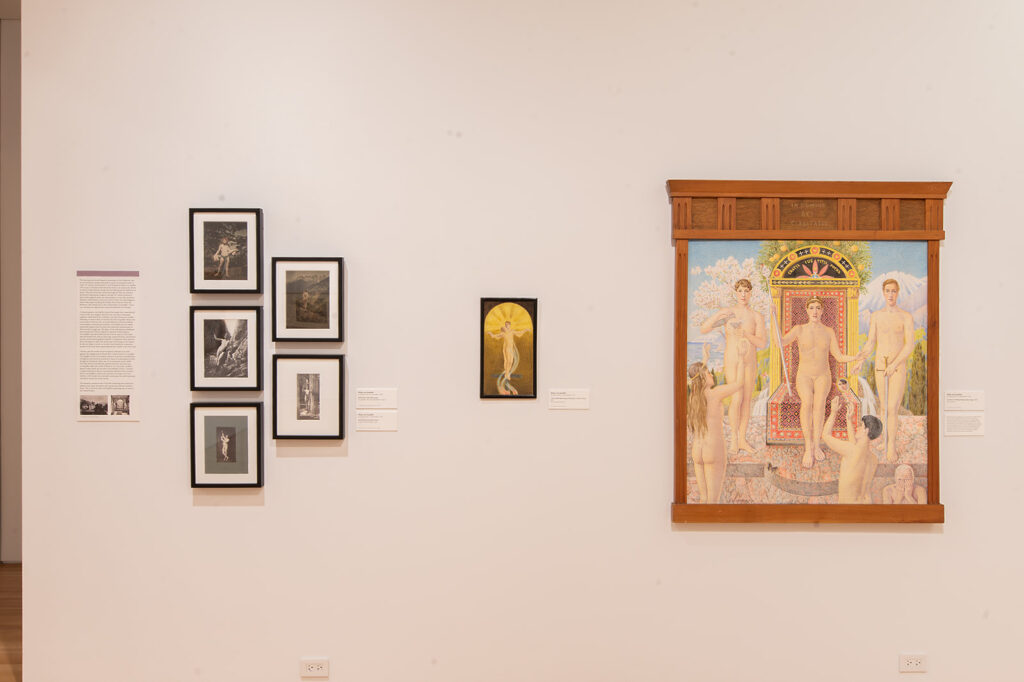
Installation view of "The First Homosexuals: The Birth of a New Identity, 1869-1939", at Wrightwood 659, 2025. Photo courtesy of Daniel Eggert (@DesigningDan).
The development of these distinct figurative elements in Von Kupffer’s artworks also emerged from the neo-spiritualist group he founded called Clarism . This new religion promised a utopia to all of its followers if they assumed a sort of transcendental optimism and left the ‘confused’ or ‘chaotic’ world for the world of clarity. (4) Many neo-spiritualist groups were emerging during the 19th century as a rejection of the breakthroughs in human evolution and biological sciences. (5) Clarism followed this cultural trend and was Von Kupffer’s assertion of a new belief system that combined Roman/Greek aesthetic influences, orientalism and occultism to promote an uncanny gay paradise. Therefore, we can also understand the figures in Von Kupffer’s work as symbolic embodiments of Clarist principles. The paintings depict a fantasy in which a cult of young, White androgynous men have returned to nature and found harmony through the exclusion of women and anyone racially, sexually or ideologically different from them.
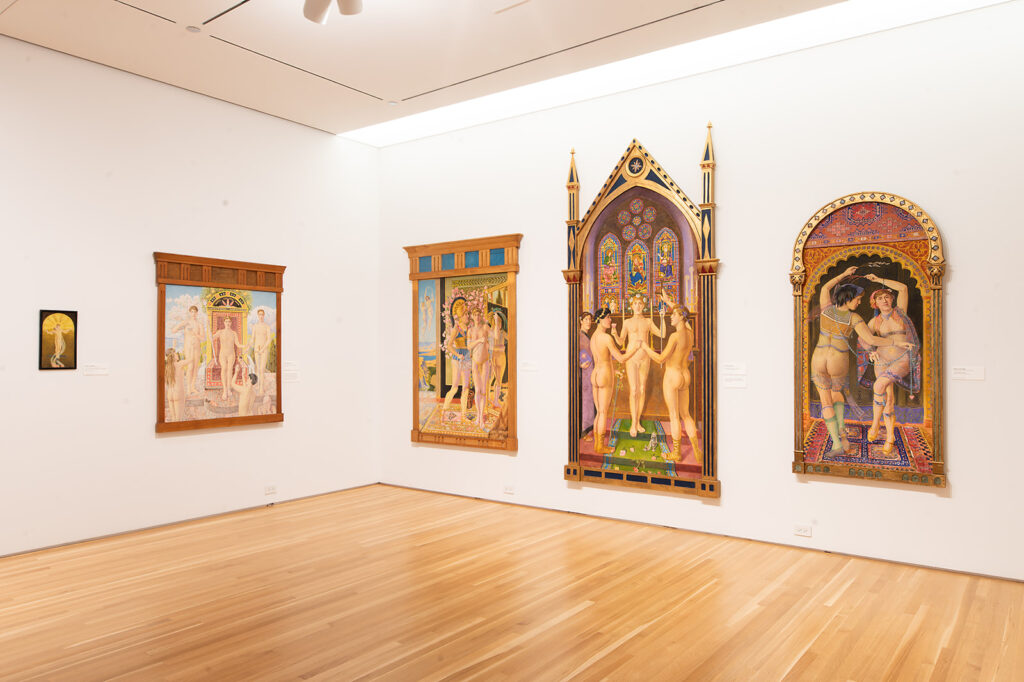
Installation view of "The First Homosexuals: The Birth of a New Identity, 1869-1939", at Wrightwood 659, 2025. Photo courtesy of Daniel Eggert (@DesigningDan).
Though the creative cultural contributions of Elisar Von Kupffer are numerous, we would be remiss to ignore how this artwork promotes a fascist model of perfection, control and attraction to same-ness. In parsing through the haze of an uninhibited artist who sought to realize his vision for the world, Von Kupffer’s personal beliefs, identity and sexuality complicate how institutions may historicize his role in queer history. In critically engaging with Elisar Von Kupffer’s bigotry we are cautioned against reframing artists’ narratives so that their work fits neatly into a certain historical context. Von Kupffer’s work is a reminder that art can be a powerful tool to promote a vision for a better world but that true a utopia cannot exist without liberation for all people.
Endnotes
- Kuusik, Aet. “The ‘Fascist Femboys’ of Baltic German Artist Elisàr von Kupffer. Interview with Historian Ben Miller.” Feministeerium, September 9, 2024. https://feministeerium.ee/en/the-fascist-femboys-of-baltic-german-artist-elisar-von-kupffer-interview-with-historian-ben-miller/#easy-footnote-bottom-7-41142.
- Kupffer, Elisàr von. “Lieblingminne und Freundesliebe in der Weltliteratur: Love between Friends and Lovers in World Literature, The Foreword by Elisàr von Kupffer.” Essay, n.d.
- Miller, Ben. “Rejecting the Klarwelt: How Elisàr von Kupffer Complicates Queer History.” PhD research, for the Munich Center for the Documentation of the History of National Socialism about the gay artist Elisàr von Kupffer’s queer fascist masculinity, 2023.
- Gerhard Lob, Ascona. “LGBT Pioneer’s Spectacular Painting Returns to Monte Verità.” SWI swissinfo.ch, January 28, 2024. https://www.swissinfo.ch/eng/culture/lgbt-pioneer-s-spectacular-painting-returns-to-monte-verit%C3%A0/46557428.
- Damien Delille. “Queer Mysticism: Elisàr von Kupffer and the Androgynous Reform of Art.” Between Light and Darkness– New Perspectives in Symbolism Research, Studies in the Long Nineteenth Century, vol. I, pp.45-57, 2014. halshs-01796704
Tatiana is an educator at Wrightwood 659 and an artist based in Chicago. She received her Bachelors of Fine Arts from the School of the Art Institute of Chicago in 2020.