Educator Insight: Jesse on Mei Lan Fang
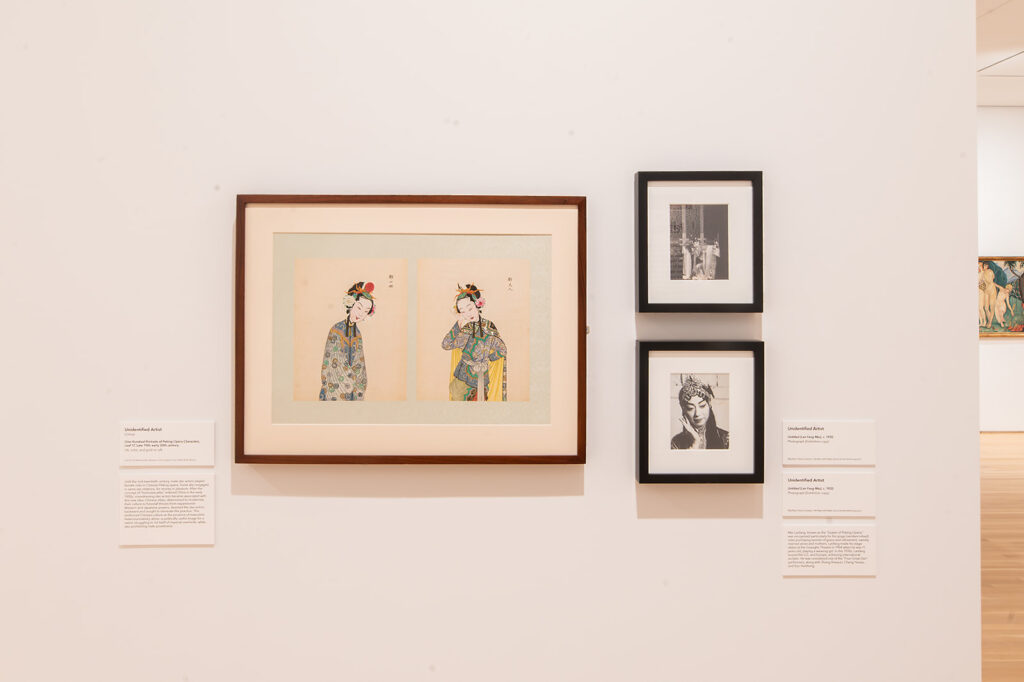
Installation view of The First Homosexuals: The Birth of a New Identity, 1869-1939, at Wrightwood 659, 2025. Photo courtesy of Daniel Eggert (@DesigningDan).
These 1920s photographs of Mei Lan Fang, archived by the New York Public Library and exhibited in The First Homosexuals, are not neutral documents of a Peking Opera tradition. (1) (2) They are composed images that render gender performance legible through national optics and imperial desire. By looking at these photographs, we witness the aesthetic and political conditions that made Chinese male femininity visible, consumable, and permissible to a globalizing gaze.

Unidentified Artist, "Untitled (Lan Fang Mei)," c. 1920, Photograph, Billy Rose Theatre Division, The New York Public Library for the Performing Arts.
In one image, Mei crouches on a stage in layers of lightweight luxury fabrics, arms elegantly outstretched as if mid-performance. The stark contrast of the black-and-white photograph pushes his figure beyond an ornate screen, presenting him as the image’s only legible subject. Its theatricality does not aim to persuade us of Mei’s womanhood; instead, it displays his mastery of Peking Opera’s codified artifice. Coiffed hair, flowing sleeves, and stylized gestures signify the high-class femininity of the dan, or principal female role. (3) Amongst the increasing scrutiny of dan actors as perpetrators of male same-sex relations, Mei’s collaborator Qi Rushan argued that this choreographed gender performance was an art form capable of expressing more complex emotions and narratives than Western realism. Through Qi’s work, the male-acted dan role was framed as technically virtuous, rather than sexually perverse—its restrained, symbolic exaggeration exemplified the superiority of Chinese aesthetics. (4) As a result, Mei’s performance of femininity was not simply tolerated; it became a symbol of national sophistication.

Unidentified Artist, "Untitled (Lan Fang Mei)," c. 1920, Photograph, Billy Rose Theatre Division, The New York Public Library for the Performing Arts.
As Peking Opera was positioned as a refined art form, Mei’s image as the emissary of Chinese tradition approached iconization. The careful construction of a publicized private life is reflected in a second photograph, which crops tightly around Mei’s face to isolate his feminized features: elongated eyeliner, a jeweled headpiece, and straight black hair. While the first photograph evokes theatrical performance, this portrait displaces Mei from the stage and invokes a fantasy of intimacy. His averted gaze suggests a calibrated passivity, underscoring the asymmetry of the viewer’s desire. In Mei’s lifetime, this appearance of vulnerability was carefully managed. Offstage, Mei cultivated a public masculinity by marrying, fathering children, and aligning with Confucian ideals. (5) By forming an image of his private life built through heteronormative respectability, Mei affirmed his legitimacy as a representative of Chinese cultural power.
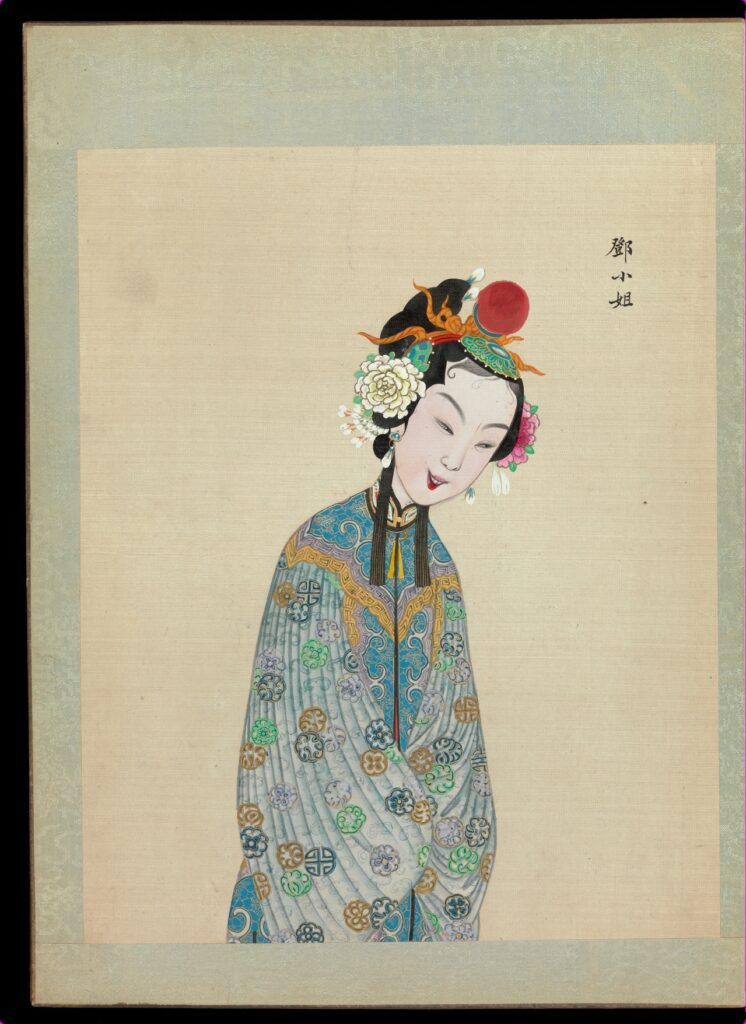
Unidentified Artist, "One Hundred Portraits of Peking Opera Characters;" Leaf 17, Late 19th–early 20th Century. Ink, color, and gold on silk; The Metropolitan Museum of Art, Alfred Stieglitz Collection, 1949, 49.55.50. Image copyright © The Metropolitan Museum of Art. Image source: Art Resource, NY.
These photographs do not simply capture Mei, they manufacture his legibility through gender performances, cultural diplomacy, and global spectatorship. This was particularly important in the aftermath of the Qing Dynasty’s collapse, as Chinese reformers sought to fortify a weakened nation amid the pressures of Western imperialism. (6) Strategic composition and circulation rendered the femininity of Mei and other dan actors politically serviceable; that is, markers of Chinese refinement rather than deviance, crafted to recalibrate the Western imagination.
As archival artifacts, these photographs do more than record a performance. They compel us to question the conditions under which visibility becomes possible, permissible, and even desirable. Looking at Mei Lan Fang, we must remember that an image is never neutral: it is always shaped by the camera’s gaze, the viewer’s expectations, and the cultural conditions that make it legible.
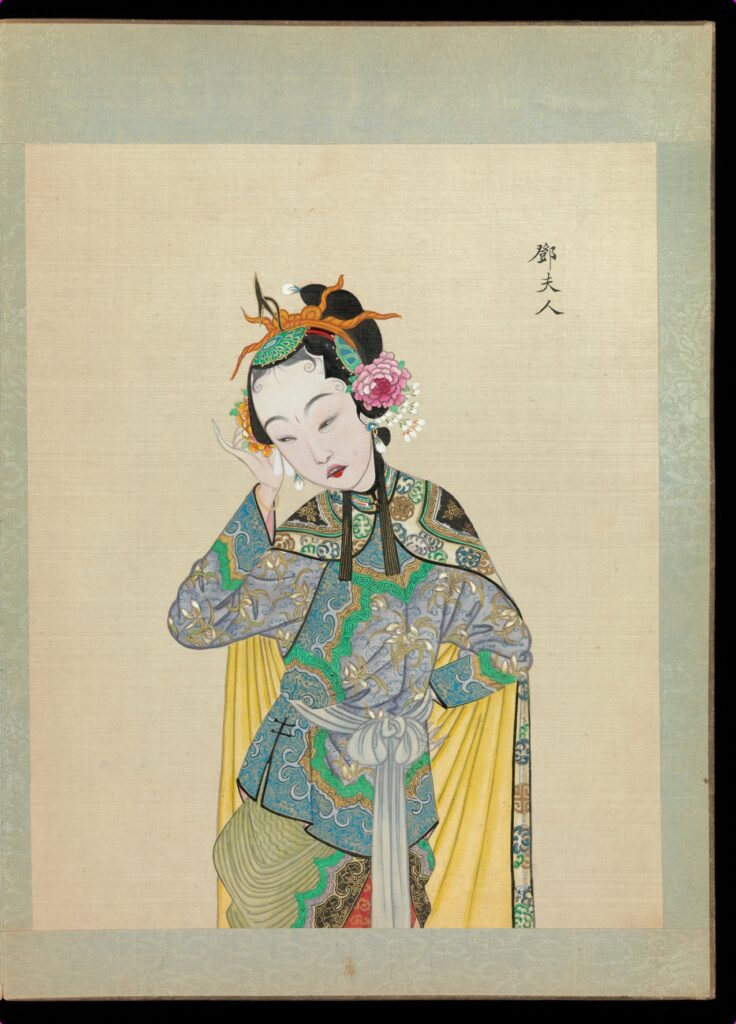
Unidentified Artist, "One Hundred Portraits of Peking Opera Characters;" Leaf 17, Late 19th–early 20th Century. Ink, color, and gold on silk; The Metropolitan Museum of Art, Alfred Stieglitz Collection, 1949, 49.55.50. Image copyright © The Metropolitan Museum of Art. Image source: Art Resource, NY.
Endnotes
- Unknown, Untitled (Mei Lan Fang), 1920, Photography, New York Public Library.
- Unknown, Untitled (Mei Lan Fang), 1920, Photography, New York Public Library.
- Alexandra B. Bonds, “Chapter 6: The Costume Compendium,” in Beijing Opera Costumes: The Visual Communication of Character and Culture (Honolulu: University of Hawai’i Press, 2008), 113–202.
- Wenqing Kang. “Male Favorites and Fragrant Companions: Graphic Depictions of Same-Sex Intimacy in China.” in The First Homosexuals: ed. Jonathan Katz, Johnny Willis (Chicago: Monacelli Press, 2026), 275-278.
- Yangzhou Bian, “Mei Lan-Fang: The Masculinist Idealization of Femininity,” Theatre Student Scholarship, January 1, 2022, https://orb.binghamton.edu/theatre_student/2.
- Kang, “Male Favorites and Fragrant Companions,” 275–78.
Jesse is an educator at Wrightwood 659 and an artist working with the interplay of text, image, and sound. They hold a B.A. in Visual & Critical Studies from the School of the Art Institute of Chicago.