Interview with Parallax Printing
Q: For those who are not familiar with lenticular printing, could you explain what it is and how it works?
Parallax: Lenticular is a process that uses an optical surface and specially prepared imagery to create illusionary effects. It is known for producing two different kinds of experiences, holographic 3D illusions and animation or change-based effects. Basically, an optical lens array filters out interlaced imagery and presents it to the viewer in a way that collaboratively creates the effect. It’s a very viewer-centric medium.
Q: How is creating a lenticular print different from other types of printing? What materials are used in the process?
P: Lenticular uses the same kinds of printing equipment you would expect to find in a commercial print shop, but it’s the combination of optical lenticular plastics and the special preparation of the imagery that makes it possible. The optical plastics are a unique item in the print world. They are notoriously difficult to manufacture in large sizes and, for that reason, rather scarce and expensive. Some people have been successful in making their own, using varied materials like glass. As long as the basic optical principles are observed, there is no real limitation in what could technically be used.
Q: Can you talk about the process of creating the three large-scale prints for our current exhibition Kongkee: Warring States Cyberpunk?
P: The process begins by finding the relationship between the print resolution and the resolution of the lenticular plastic, which can change based on factors such as humidity, temperature, and the intended final viewing distance of the print. With this information in hand, Kongkee’s imagery was sliced into thin strips and interlaced together so that the pairs of images used in each piece became one interleaved image. Looking at the image at this stage would show a largely indecipherable mess of vertical lines, a latent lenticular image. A 4’x6’ lenticular sheet is then carefully aligned on the bed of the printing press and the image data is sent to the printer. The printer uses a UV light source to harden the ink as it is placed on the lenticular sheet and the final print is ready for display moments later.
Q: How has the advancement of digital imaging impacted the creation and evolution of lenticular printing? How does it relate to innovative practices such as augmented reality and virtual reality?
P: The main impact is one of reach. Lenticular images are more common now than they ever have been—though they are still a very small percentage of printed material. It is also possible to produce very large lenticular prints, like those made for Kongkee, which simply wasn’t an option when everything was done photographically in the darkroom. Lenticular and VR or AR are both hacks that make use of our stereoscopic vision to create illusionary experiences. They require an external apparatus to trick our brains into seeing something that doesn’t actually exist. The advantage that traditional lenticular has over VR is that it is apocalypse-proof, so when we are eating cans of beans we have chiseled open with rocks we can still enjoy animated scenes of Tiger Woods swinging a golf club or the Queen Elizabeth in 3D.
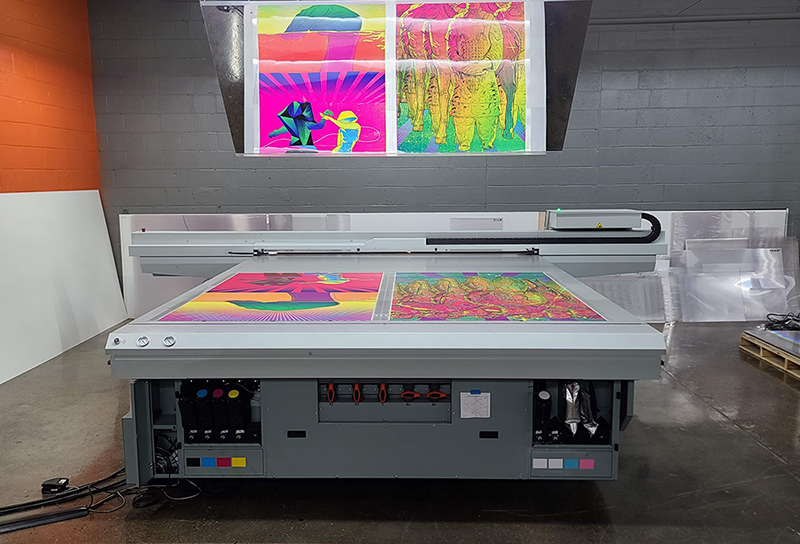
Courtesy of Parallax Printing