Educator Insight: Shane on Queer Codes: Fauns and Satyrs
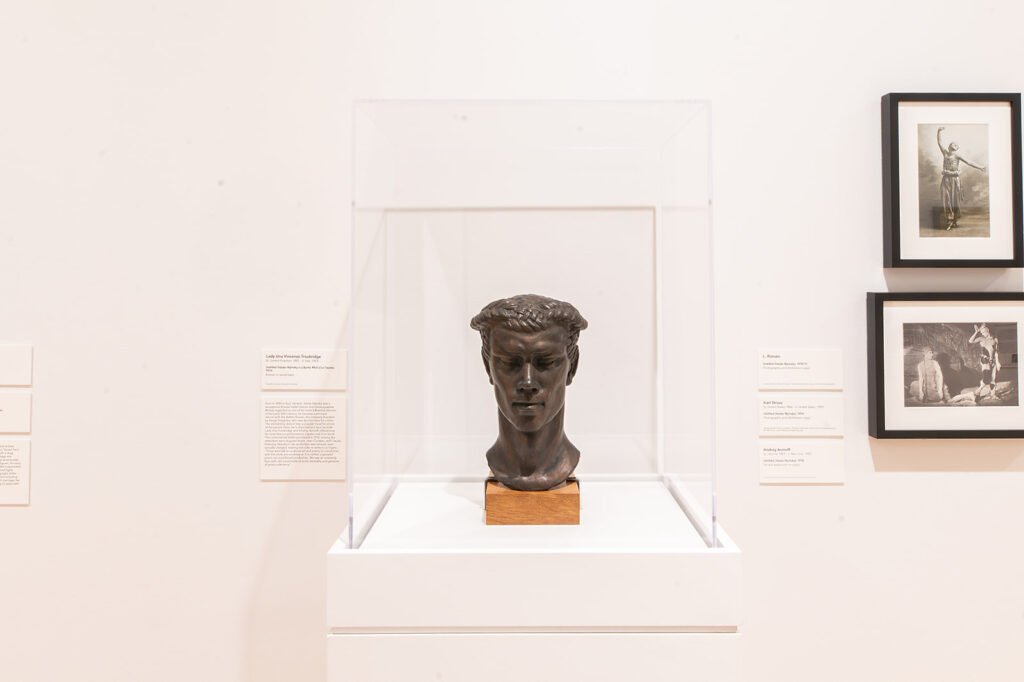
Installation view of The First Homosexuals: The Birth of a New Identity, 1869-1939, at Wrightwood 659, 2025. Photo courtesy of Daniel Eggert (@DesigningDan).
Fauns and satyrs have long been depicted as being sexually forward and curious entities. However, it was Vaslav Nijinsky’s performance in L’Apres-midi d’un faune (Afternoon of a Faun) that cemented the creature as a queer symbol in the 20th century.
In antiquity, Greek mythology portrayed satyrs as brutish seducers with a penchant for wine, whereas early Roman mythos generally spoke of fauns as being gentle and naive nature spirits. (1) As the satyr and faun gradually became interchangeable, their characteristics began to meld. This made the satyr less threatening and the faun more risque.
The quintessence of this blended creature exists in Vaslav Nijinsky’s 1912 ballet, L’Après-midi d’un faune. The famed Russian dancer brought the faun into the 20th century with sharp choreography and a strong sexual charge. The performance created great controversy among its Parisian audiences because of its overt eroticism — all punctuated with a simulated act of masturbation in its final sequence. (2) Despite the backlash, the ballet was clearly beloved to many others as it inspired a number of commemorative artworks.
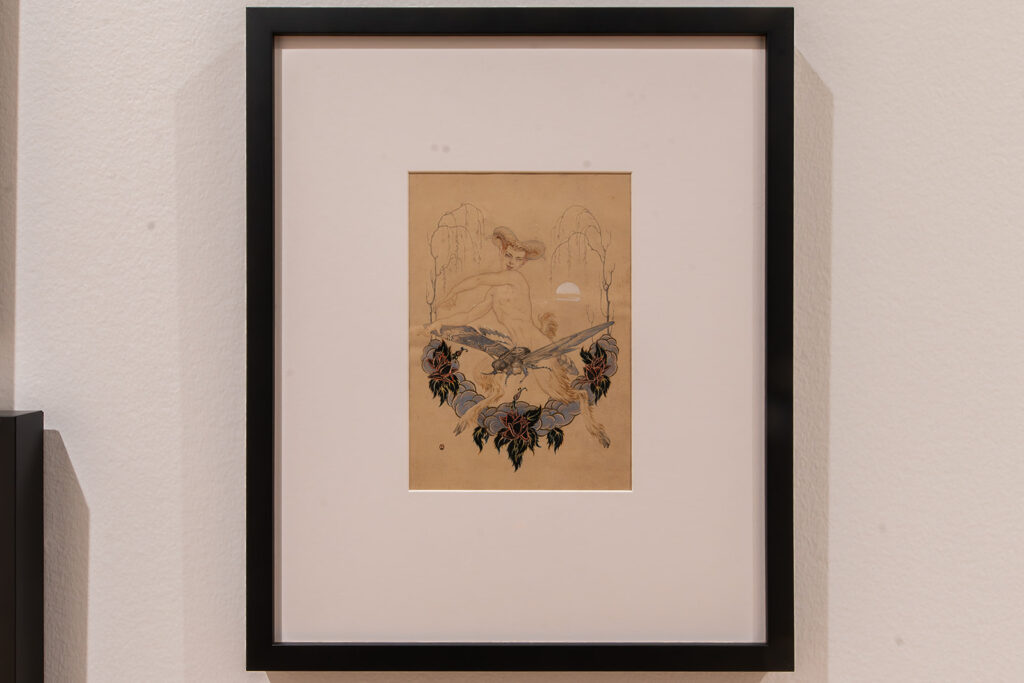
Among its appreciators was Andrey Avinoff, a respected Ukrainian painter and lepidopterist. In his painting Nijinsky as Faun, Avinoff presents the subject as an enchanting being. He honors the dancer’s skill with an effortless prance and elegant hand positions as the faun rides a moth in front of a delicate wreath of nature. The daintiness of the scene is gently contrasted by Nijinsky’s pronounced horns and proud facial features. His mischievous demeanor is played up by the cheeky placement of the moth over the faun’s genitals.
The reverence within such works attest to Nijinsky’s status as an icon and sex symbol at the time. In Afternoon of a Faun being his most famous work, (3) Nijinsky’s celebrity allowed the mythological figure to operate as a queer code for others to reference in years to come.
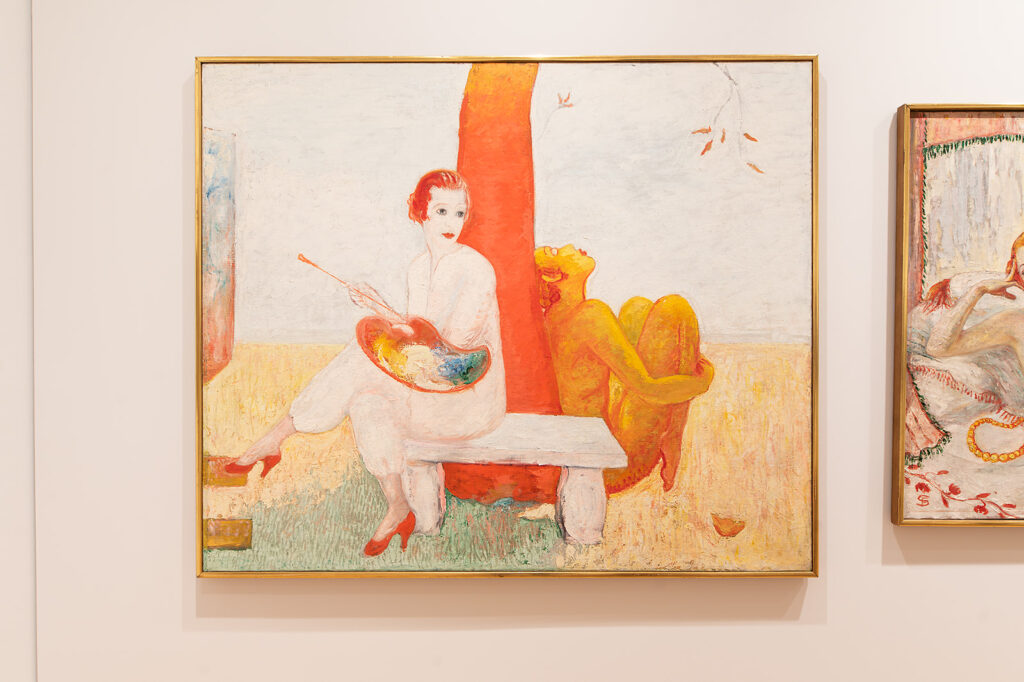
While the exact date of the painting is unknown, this lens adds rich context to Florine Stettheimer’s Self‐Portrait with Palette (Painter and Faun). Here, Stettheimer puts herself in opposition to a faun, who is given a more serene and idealistic attitude. With his eyes closed and head cast towards the sky, the creature seems capable of perception without sight. However, the faun’s hallmark flamboyance is maintained through a vibrant red color. The warm hues of the tree extend to the nude figure, both contrasting Stettheimer’s white outfit and pale complexion.
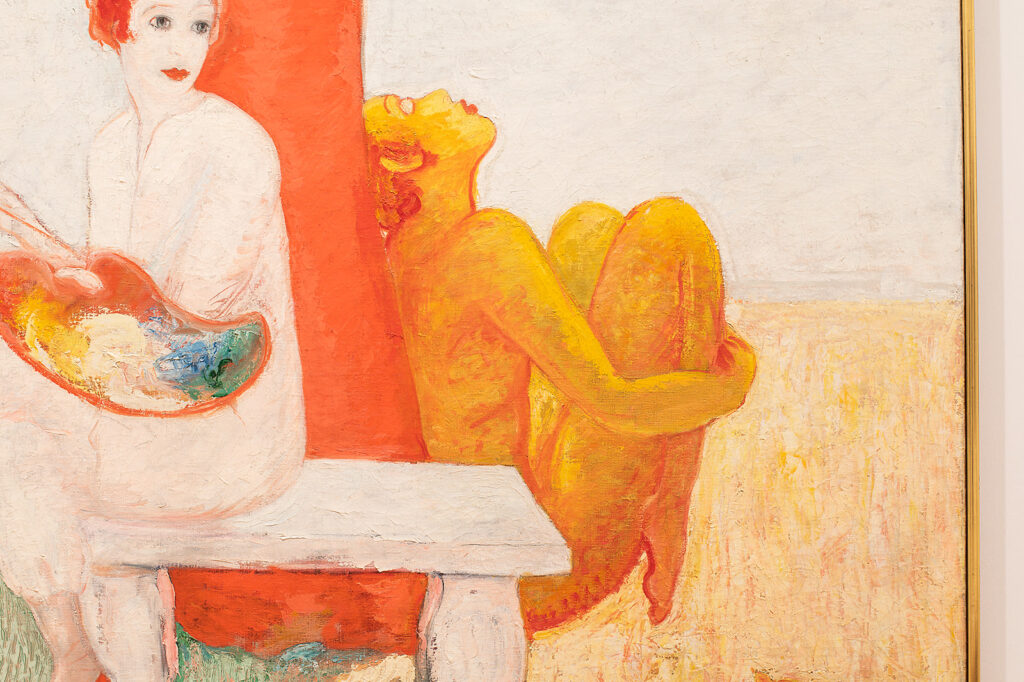
It is curious then that Stettheimer adorns herself with many red accents, such as her shoes, paintbrush, and palette. The inclusion of these accessories suggests an allegiance to the faun and thus an adjacency to queerness. This gesture of kinship was mirrored in Stettheimer’s life, as her social circle largely consisted of queer men of the Avant Garde (4).
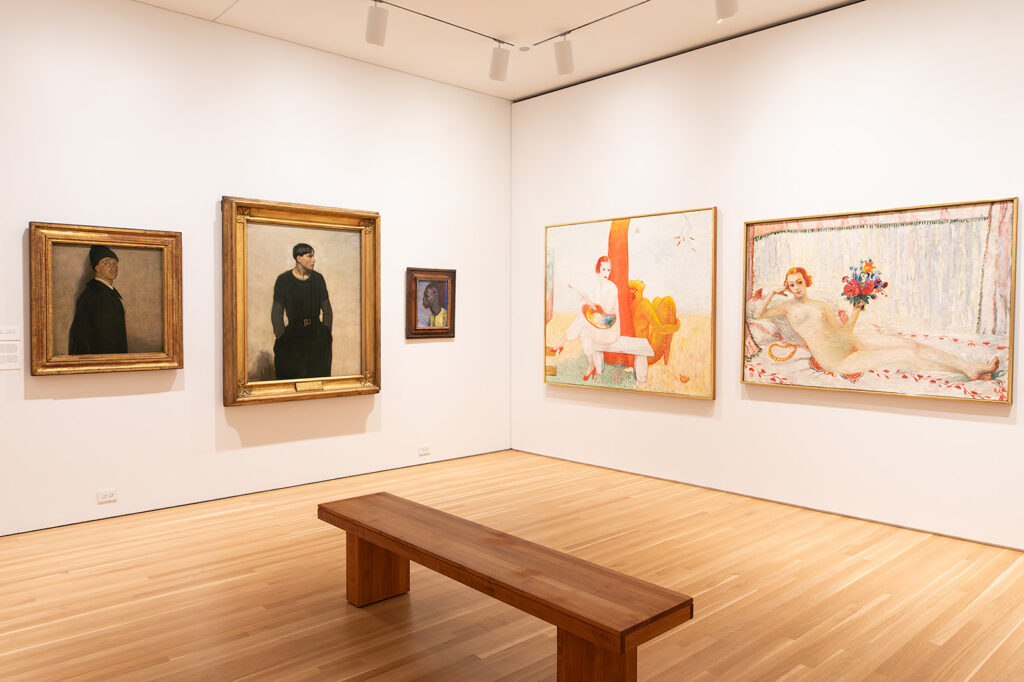
Installation view of The First Homosexuals: The Birth of a New Identity, 1869-1939, at Wrightwood 659, 2025. Photo courtesy of Daniel Eggert (@DesigningDan).
Together, these works reaffirm a longstanding code of sexual freedom. Throughout the show, we see how Greco-Roman mythology and its neoclassical reimagining set the stage for Nijinsky to solidify the faun as a queer icon for later generations to identify with.
Endnotes
- Miles, Geoffrey. “Other Gods.” Essay. In Classical Mythology in English Literature: A Critical Anthology, 30. New York, USA: Routledge, 2009.
- Farfan, Penny. “Man as Beast: Nijinsky’s Faun.” South Central Review 25, no. 1 (2008): 76. http://www.jstor.org/stable/40040020.
- Zielonka, Anthony. “‘L’Après-Midi d’un Faune’: Towards the Total Work of Art.” L’Esprit Créateur 40, no. 3 (2000): 14. http://www.jstor.org/stable/26288345.
- Whiting, Cécile. “Decorating with Stettheimer and the Boys.” American Art 14, no. 1 (2000): 25–49. http://www.jstor.org/stable/3109325.
Shane Fosse is an educator at Wrightwood 659 and interdisciplinary artist from Dallas, Texas. Through poetry and sound collage, their work examines the linkages between our physical and spiritual worlds with Black Southern gothic sensibilities.