Educator Insight: Rachel on Gerda Wegener's "Venus and Amor"
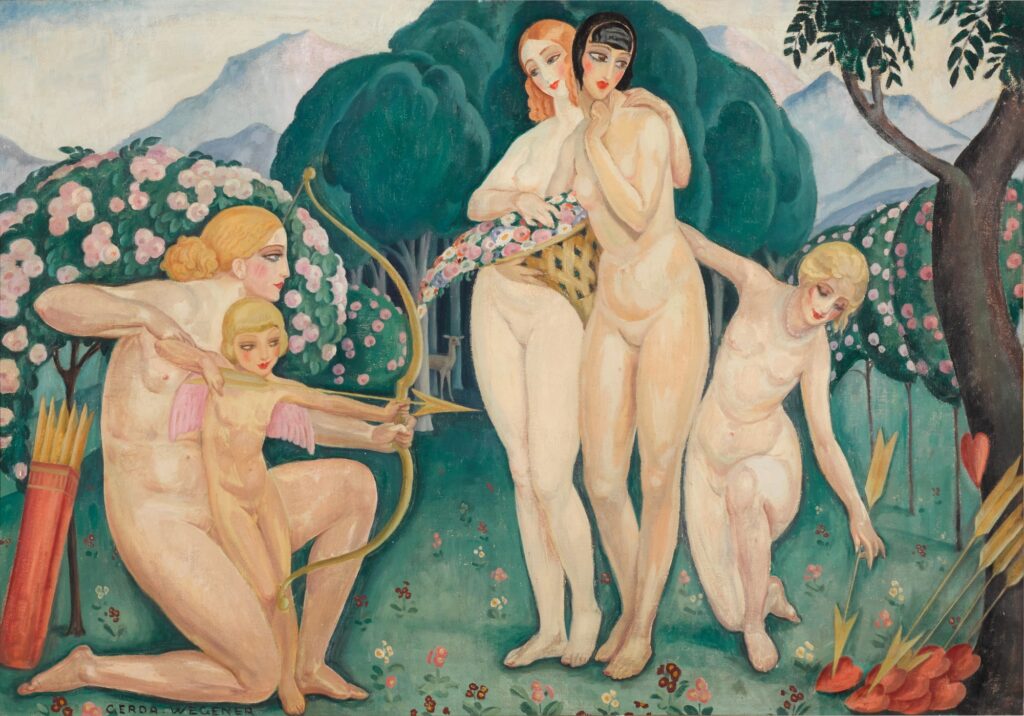
In Venus and Amor, Gerda Wegener (1885-1940) crafts a dreamy mythological scene of her own design. Painted in oils in a gentle wash of colors, it’s reminiscent of a Roman fresco that has existed for thousands of years. The styling of the art-deco figures modernizes this ancient feeling; the women sport the 20s beauty trends of bobbed hair and heart-shaped lips. (1) Venus, the Roman goddess of love, kneels with her child, Amor, guiding their arm as they stretch an arrow taught through a bow, ready to lovingly pierce the hearts of mortals. Like many lesbian artists before her, Wegener’s references to Greco-Roman mythology emphasize the fact that queerness (to use a contemporary term) is not new––it is ancient and innate. (2)
By reinterpreting the framework of established mythology through a female gaze, Wegener legitimizes her ethereal depiction of a lesbian utopia. This framework also helped Wegener to support her wife, fellow artist Lili Elbe, who first explored her gender identity by modeling for Wegener. (3) Painting Lili into her utopic world helped communicate and affirm Elbe’s identity as a trans woman, later becoming one of the first people to receive gender-affirming surgery in 1930. (4)
Across the painting, three women cluster, their arms tangled around each other. One woman looks down lovingly at Amor, her arm wrapped familiarly around the woman in the center. She holds a basket of flowers and gazes off in the opposite direction at the third woman, who holds onto one of them––both of them?––as she reaches down to pluck an arrow from the pile of used hearts at their feet, ready to return it for another round of practice. With the knowing, loving gazes between these women and the comfortable closeness of their bodies, they have the intimacy of friends or lovers, a family unit simply existing in their floral world. This is their daily life, and we just happen to be catching a glimpse of it.
But the artist’s utopia doesn’t extend to viewers’ interpretation of her work. As the women look at each other, we look at them, and a sharp line is drawn––viewers become voyeurs, looking in at a scene of lesbian domesticity and seeing only their nakedness. Context is twisted to fit whatever the viewer looking in wants it to mean, and this echo is still felt today in contemporary work about Wegener and Elbe’s lives, both in art criticism and in fictional adaptations of their story, like the 2015 movie The Danish Girl. (5) Whether it’s the constant misgendering of Elbe, or the blatant erasure of Wegener’s sexuality, their stories are distorted and rewritten, a common side effect of discussing sapphic artwork, especially when the artist can no longer speak for herself.
Wegener’s lesbian paintings are interpreted as erotic, exotic, mystical in the sense that they represent an imaginary reality. But this space is incredibly real, both for Wegener and for Elbe. While the media sensationalized Lili Elbe’s surgery, Wegener’s paintings gave her the space to simply be, free from the crude gaze of the public. So instead of fixating on voyeuristic projections, we should return to the original work. In Wegener’s painted world, these mythical women stand unbothered, unseen save for the female deer watching from the dark woods behind their nude bodies.
Endnotes
- Evans, Rhonda. “Flapper Fabulosity! Researching 1920s Fashion with Online Resources.” The New York Public Library, July 28, 2018. https://www.nypl.org/blog/2018/07/24/researching-1920s-fashion-online.
- Merjian, Ara H. “Paradise of Vice: Southern Italy in the Homosexual Imagination from the Fin De Siècle to Fascism.” Essay. In The First Homosexuals: The Birth of a New Identity 1869-1939, 119–25. Monacelli Press, 2025.
- Zarevich, Emily. “What Actually Happened to ‘The Danish Girl’ and Her Wife – Jstor Daily.” What Actually Happened to ‘The Danish Girl’ and Her Wife, November 18, 2023. https://daily.jstor.org/what-actually-happened-to-the-danish-girl-and-her-wife/.
- Merjian, Ara H. “Paradise of Vice: Southern Italy in the Homosexual Imagination from the Fin De Siècle to Fascism.” Essay. In The First Homosexuals: The Birth of a New Identity 1869-1939, 119–25. Monacelli Press, 2025.
- Zarevich, Emily. “What Actually Happened to ‘The Danish Girl’ and Her Wife – Jstor Daily.” What Actually Happened to ‘The Danish Girl’ and Her Wife, November 18, 2023. https://daily.jstor.org/what-actually-happened-to-the-danish-girl-and-her-wife/.
Rachel E Dohner is an educator at Wrightwood 659 and a Chicago artist. She plays with color and personification, queering quotidian objects and digital ephemera into their most maximal expression.
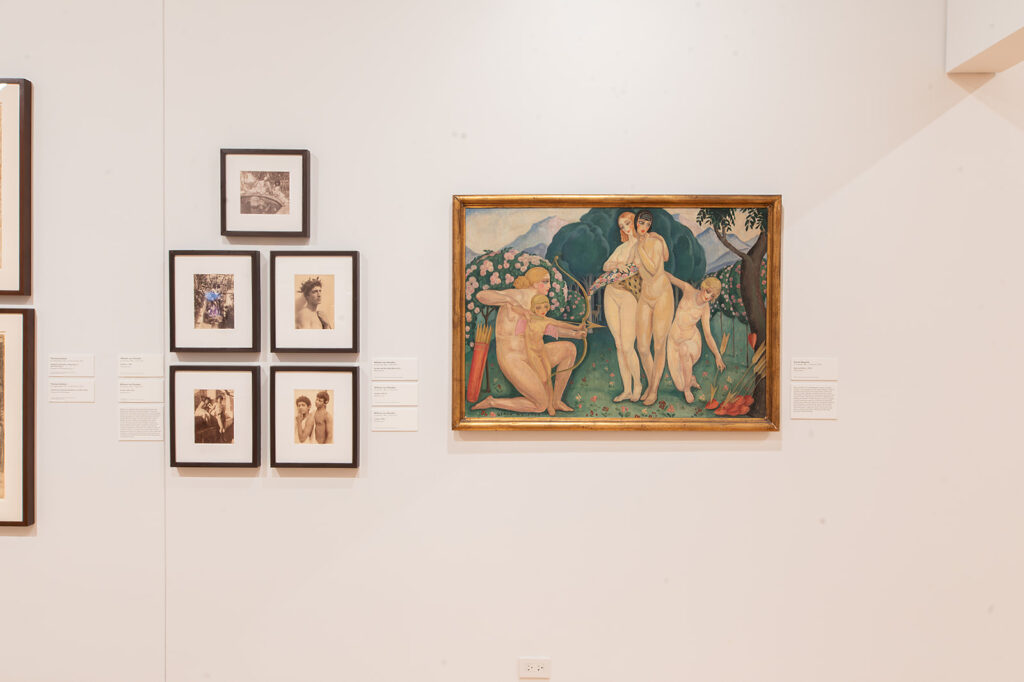
Installation view of The First Homosexuals: The Birth of a New Identity, 1869-1939, at Wrightwood 659, 2025. Photo courtesy of Daniel Eggert (@DesigningDan).
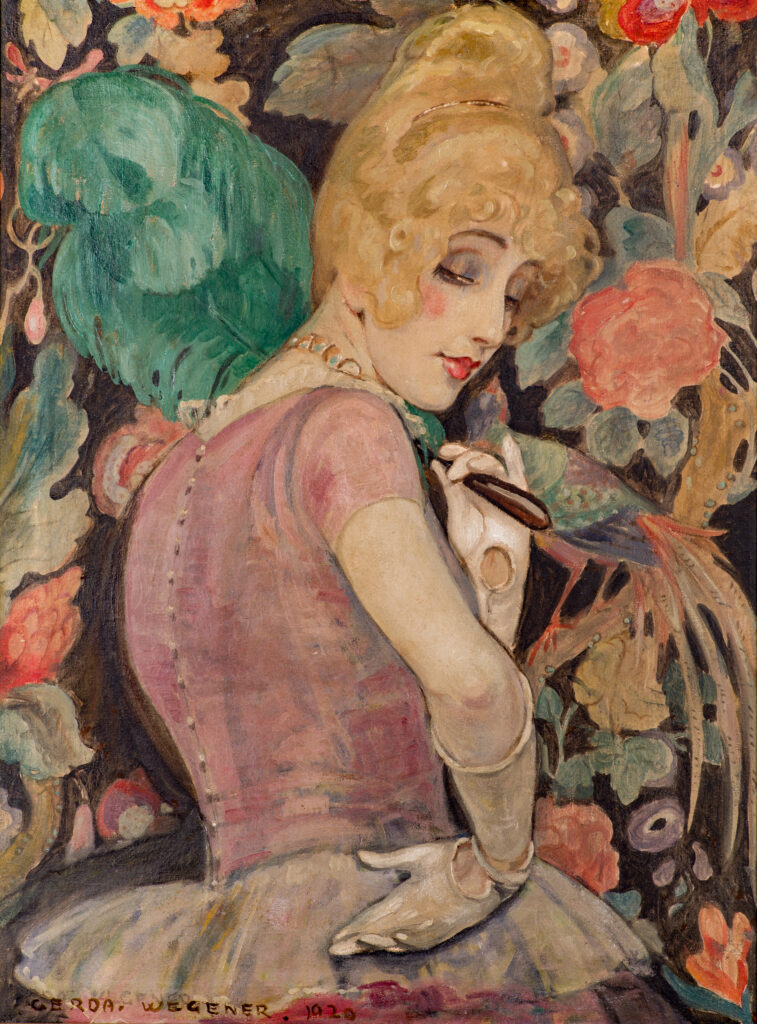
Gerda Wegener, "Lili with a feather fan," 1920, Oil on canvas, Oil on canvas, 79 x 59 cm, Private collection. Reproduction by Morten Pors Nielsen / © MORTEN PORS FOTOGRAFI. All Rights Reserved.
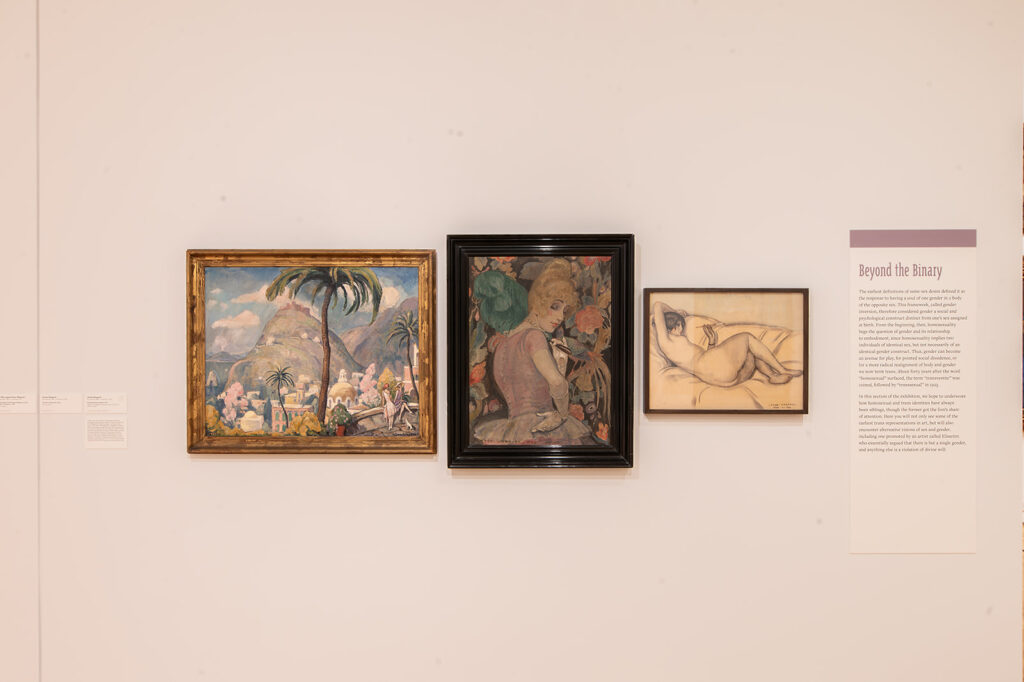
Installation view of The First Homosexuals: The Birth of a New Identity, 1869-1939, at Wrightwood 659, 2025. Photo courtesy of Daniel Eggert (@DesigningDan).