Educator Insight: Natalie on Indigenous Expressions of Gender and Sexuality
In Western visual culture, depictions of Indigenous bodies, lives, cultures, and identities rarely originate from Indigenous peoples themselves. Rather, historical images that foreground the popular Western notion of the “Indian” were created by non-Indigenous outsiders; first, colonists, and later, distanced anthropologists. As a result, these images are characterized by misrepresentation and violence, cementing the erasure Indigenous communities faced as their histories were reimagined to suit colonial and heteropatriarchal purposes.
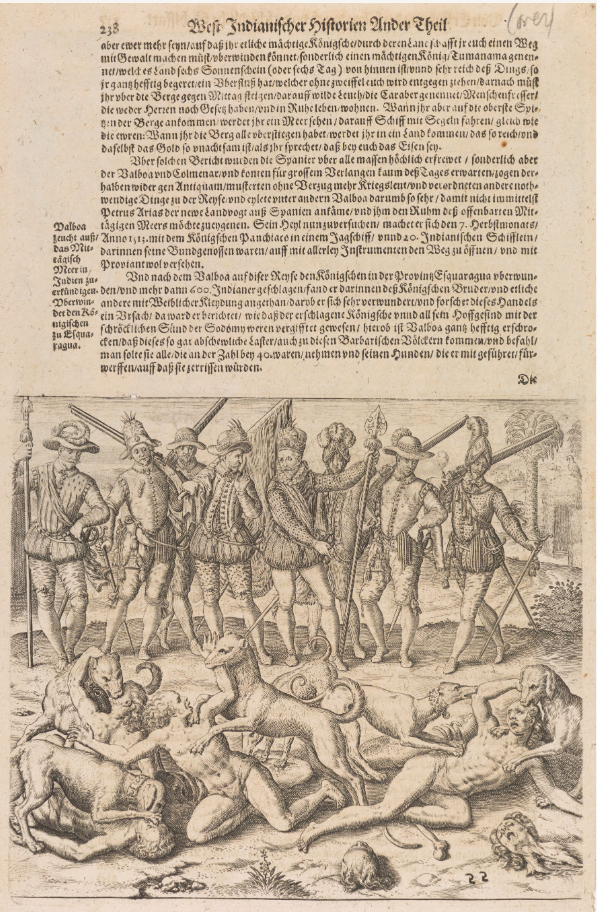
In Theodor de Bry’s 1655 engraving “Balboa’s Massacre of the Cueva,” colonial violence is explicit. Conquistador Vasco Núñez de Balboa stands along with a row of Spaniards whose expressions reflect disdain, boredom, and mild amusement. They leer down at their dogs brutally attacking a group of Indigenous peoples of modern-day eastern Panama (called Cueva by the Spanish). According to Italian historian Pietro Martir d’Anghera’s De orbe novo (1516), Balboa ordered the attack after encountering men “dressed as women,” or “berdache,” (1) a catch-all French term utilized by European colonizers to describe any Indigenous expressions of gender and sexuality that didn’t align with European heteropatriarchal norms. (2)
In the print, the Indigenous subjects appear passive, woefully meeting their tragic ends as hounds, some in ornate collars, chomp down on their limbs and faces. Two severed heads rest at the bottom of the composition, ideally placed to fill out the bottom corner of the image. Their dismemberment foreshadows the fate of the living Indigenous people being attacked in the image—gratuitous, as if it wasn’t already obvious. Two almost-nude Indigenous adults are prominently featured in the middle ground, muscled chests and legs bared to the viewer in lounging positions one would expect from the leisurely scenes of Baroque portraiture rather than in viscous dog attacks. In this way, Indigenous peoples are fetishized even as they are humiliated, violated, and attacked, their bodies rendered vulnerable for colonial viewing pleasure. These kinds of harmful depictions strongly influenced European understandings of Indigenous peoples, as “Balboa’s Massacre of the Cueva” was historicized forever in de Bry’s Grandes Voyages series, a published collection which gave many Europeans their first visual representations of North America. (3)
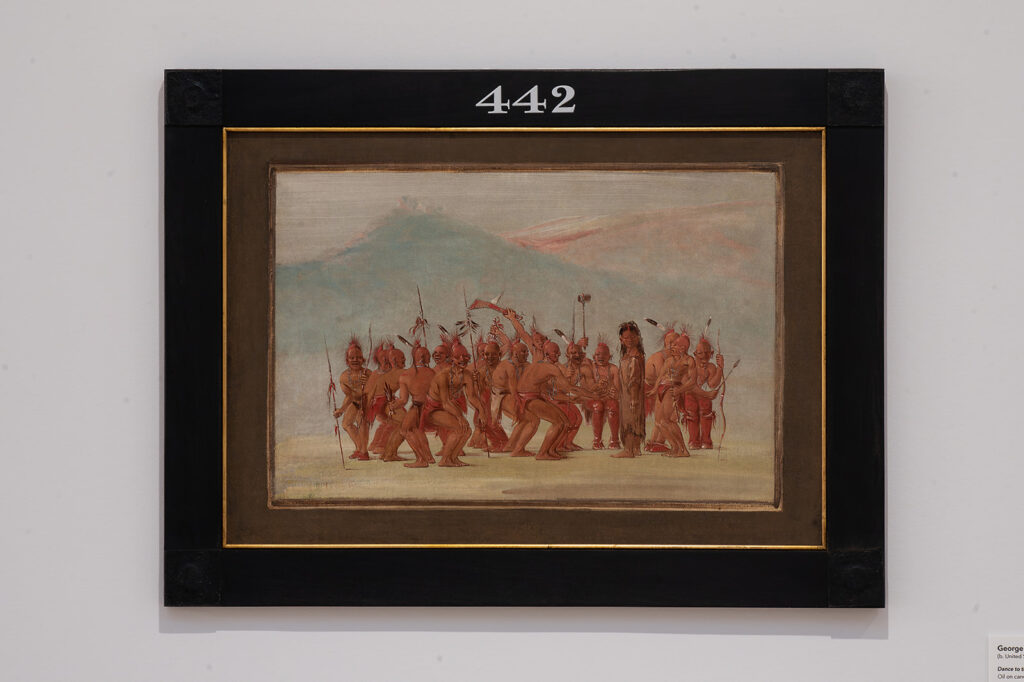
A later depiction of “berdache” can be found in George Catlin’s 1835-37 painting “Dance to the Berdash,” first sketched when Catlin visited a Sac and Fox village in 1835. (4) In a letter, Catlin describes the painting as “a very funny and amusing scene,” depicting the feast given to the “Berdashe,” “who is a man dressed in women’s clothes” and “driven to the most servile and degrading duties,” yet “looked upon as medicine and sacred.” (5)
Indigenous bodies are the sole focus of the painting, with only vague traces of grass and mountains composing a light background and foreground. Despite this focus, the people in the painting lack any indication of individual personality, thought, or action. All the depicted male Sac and Fox subjects stand in the same half-crouched position, retain the same facial expression with an open mouth, and wield various tools and weapons without any apparent context or active usage. The “Berdashe” stands lone and tall amongst the rest of the Sac and Fox subjects, head turned straight towards the viewer. The “Berdashe’s” positioning makes them stand out amongst their community members in the same way they must have stood out to Catlin, unaccustomed to Sac and Fox expressions of gender and sexuality. Catlin’s scene manufactures spectacle; ripped from place, Indigenous bodies for Catlin represent amusement, existing without context or agency and primed for the viewer to spot the odd one out.
These images make it abundantly clear how far their creators and audience were from the communities they sought to depict. Centering Indigenous thought is key to understanding and respecting Indigenous communities. Indigenous communities have rejected the dated and offensive term “berdache,” with some turning instead to the recently coined “Two-Spirit,” and many reclaiming diverse and culturally specific traditions and understandings. Ma-Nee Chacaby, a Two-Spirit Ojibwe-Cree elder, recalls being four years old and struggling with traditional concepts of femininity when her grandmother told her “Niizh-izhijaak gidaawaa (You have two spirits).” (6) Chacaby’s grandmother had been born before the creation of Canada and observed how forced conversions to Christianity had instilled strict ideas of gender and sexuality. (7) She also recalled how people like Chacaby were respected and celebrated before colonial violence: “‘Those kind of people are special people,’” Chacaby remembers her grandmother saying. “‘They know things that an ordinary person wouldn’t know.’” (8) Indigenous traditions of gender and sexuality disrupt colonial and anthropological knowledge—central to Indigenous sovereignty and decolonization.
Endnotes
1 “Balboa’s Massacre of the Cueva (recto); Balboa Reaches the Sea (verso),” Denver Art Museum, accessed March 20, 2025, https://www.denverartmuseum.org/en/object/2000.371.
2 “berdache,” Britannica, accessed March 20, 2025, https://www.britannica.com/topic/berdache.
3 “Theodor de Bry’s America,” University of Houston Digital Collections, last modified May 6, 2021, https://digitalcollections.lib.uh.edu/collections/r494vm244.
4 “Dance to the Berdash,” Smithsonian American Art Museum, accessed March 20, 2025, https://americanart.si.edu/artwork/dance-berdash-4023.
5 “Dance to the Berdash,” Smithsonian American Art Museum, accessed March 20, 2025, https://americanart.si.edu/artwork/dance-berdash-4023.
6 Ma-Nee Chacaby, “What is Two-Spirit? Part One: Origins,” interview by Scott de Groot, Canadian Museum for Human Rights, March 26, 2024, audio, 0:30, https://humanrights.ca/story/what-two-spirit-part-one-origins#edn2.
7 “What is Two-Spirit? Part One: Origins,” Scott de Groot, Canadian Museum for Human Rights, March 26, 2024, accessed May 6, 2025, https://humanrights.ca/story/what-two-spirit-part-one-origins#edn2.
8 Ma-Nee Chacaby, “What is Two-Spirit? Part One: Origins,” interview by Scott de Groot, Canadian Museum for Human Rights, March 26, 2024, audio, 1:49, https://humanrights.ca/story/what-two-spirit-part-one-origins#edn2.
Natalie Jenkins (she/her/hers) is an educator at Wrightwood 659 and a Chicago-based artist and arts writer.
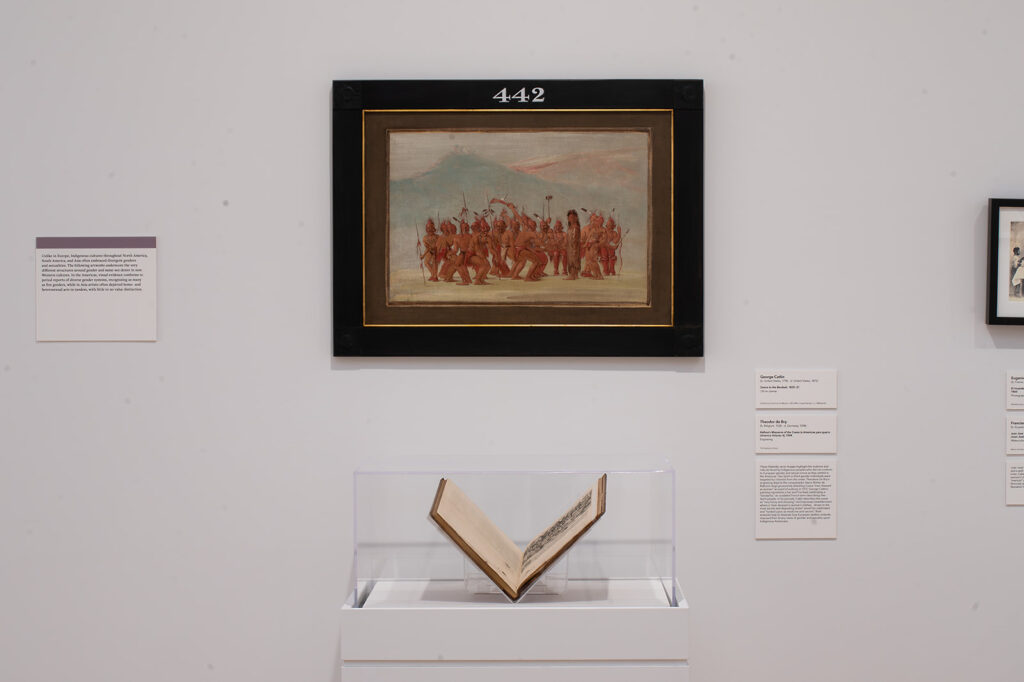
Installation view of The First Homosexuals: The Birth of a New Identity, 1869-1939, at Wrightwood 659, 2025. Photo courtesy of Daniel Eggert (@DesigningDan).