Educator Insight: Emma on Claude Cahun
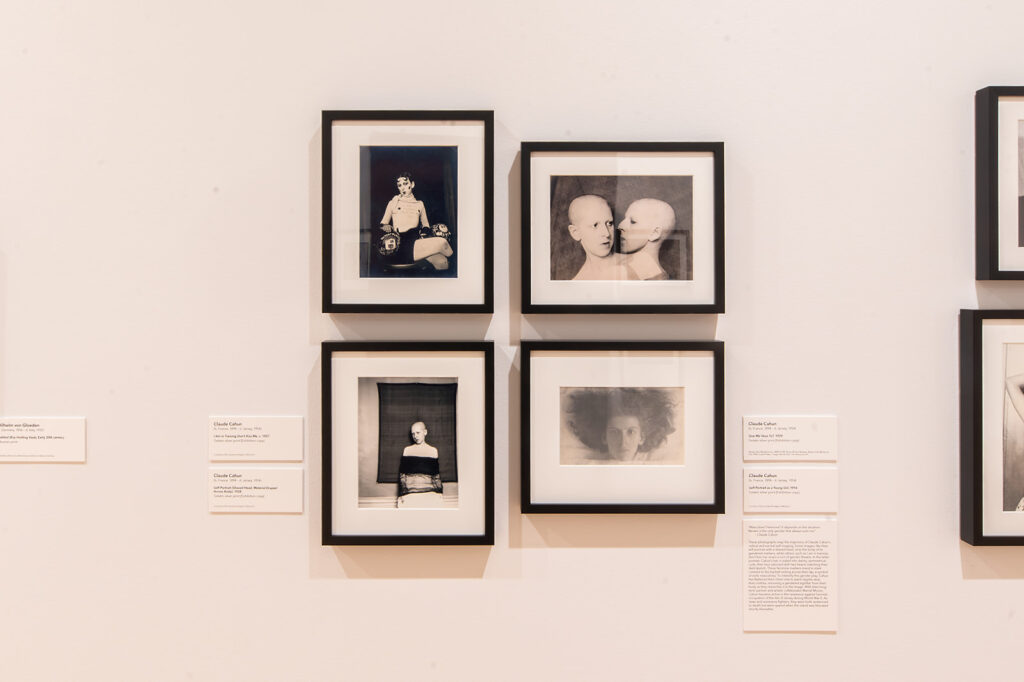
Installation view of The First Homosexuals: The Birth of a New Identity, 1869-1939, at Wrightwood 659, 2025. Photo courtesy of Daniel Eggert (@DesigningDan).
Claude Cahun was a shapeshifter. From altering her appearance for her self-portraits, to oscillating authorship between her and her partner, Marcel Moore, Cahun was constantly invoking the idiosyncratic facets of her identity.
A notable recurring theme in Cahun’s œuvre is reflection- (1), and we can notice it primarily in two of the four self-portraits by her that are featured in The First Homosexuals: Que me veux-tu (1929) and Self-portrait (shaved head, material draped across body) (1928).
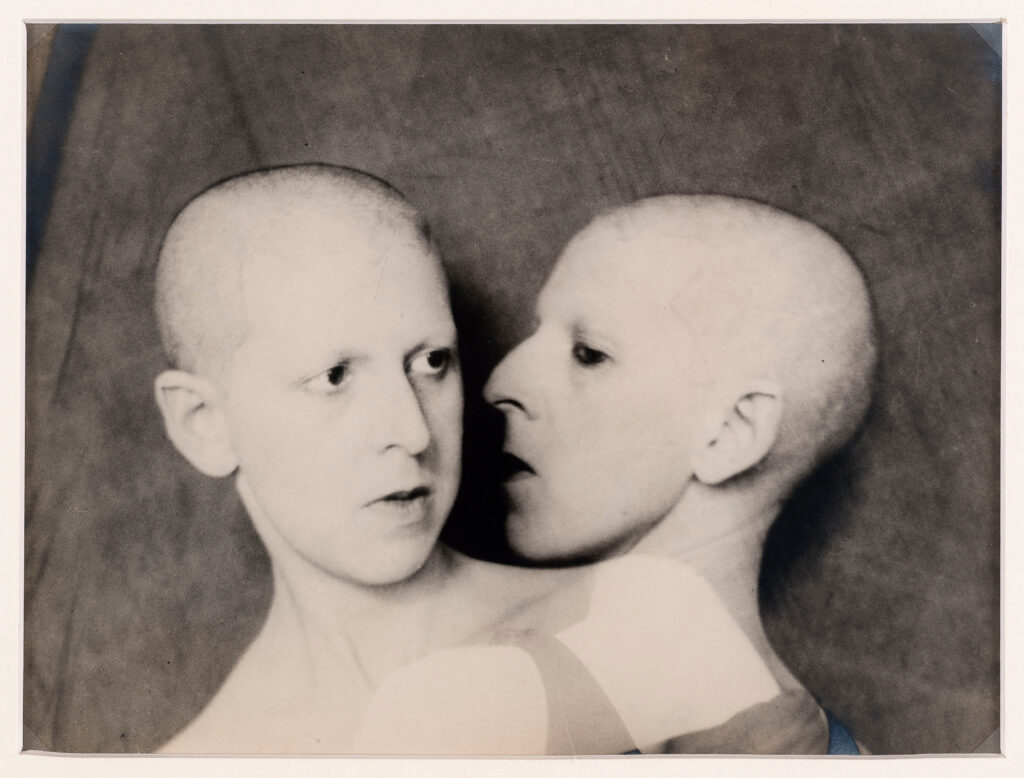
Claude Cahun, "Que me veux tu?," 1929, Gelatin silver print, Musée d'Art Moderne, Inv. AMVP 3338. Photo: © Paris Musées, musée d'Art moderne, Dist. RMN-Grand Palais / image ville de Paris/ Art Resource, NY.
In Que me veux-tu, reflection manifests in double exposure. To depict herself doubly, Cahun captured a photographic image twice on the same strip of film. We thus see two representations of her head that are similar yet subtly unidentical to each other. Both avert their gaze from the viewer at different angles, looking off to the side. The rightmost figure’s eyes are further accentuated by dark makeup. The resulting image is a gesture embracing the duality or numerous facets of the self, in lieu of a monotonous selfhood.
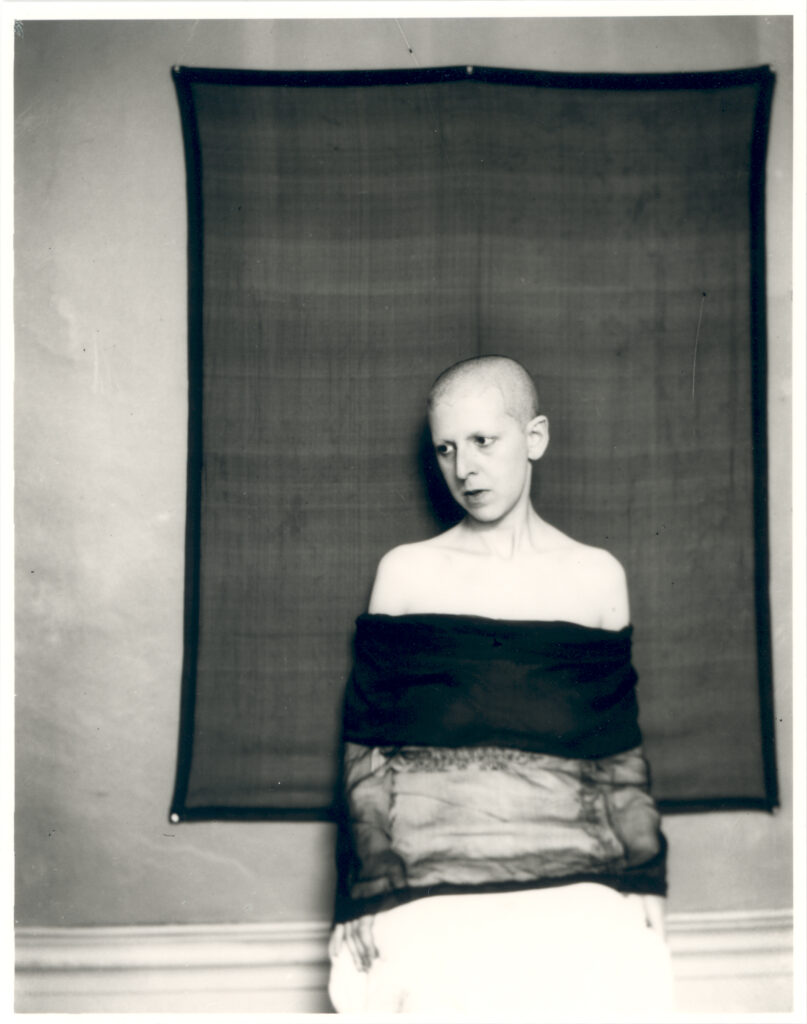
Claude Cahun, "Self-portrait (shaved head, material draped across body)," 1928. Gelatin silver print. Courtesy of the Jersey Heritage Collections.
While there is only one Cahun pictured in Self-portrait (shaved head, material draped across body), a multiplicity is present in this work, too. The black, sheer fabric that Cahun has draped across her body parallels the fabric hanging behind her, pinned up at each of its four corners. Though the fabric on Cahun is folded such that it is slightly more opaque than the one on the wall, the overt resemblance between the two gives the scene a sense of continuity. Cahun slightly blends into the background of the image, even. As such, she reflected herself—or extended her being, to some degree—through the combination of body and object.

Claude Cahun, "Self-portrait as a young girl," 1914. Gelatin silver print, Courtesy of the Jersey Heritage Collections.
Cahun’s artistic engagement with reflection demonstrates its importance in her aesthetic projects and even her life—particularly in her creative and romantic relationship with Moore. Besides often assisting with the production of Cahun’s self-portraits, Moore took several matching portraits with her. (2) Reflection among the two partners was an expression of their complementary identities, and overall, their quintessentially queer love. Reflection, therefore, was not just an aesthetic motif, but a central part of Cahun’s life.
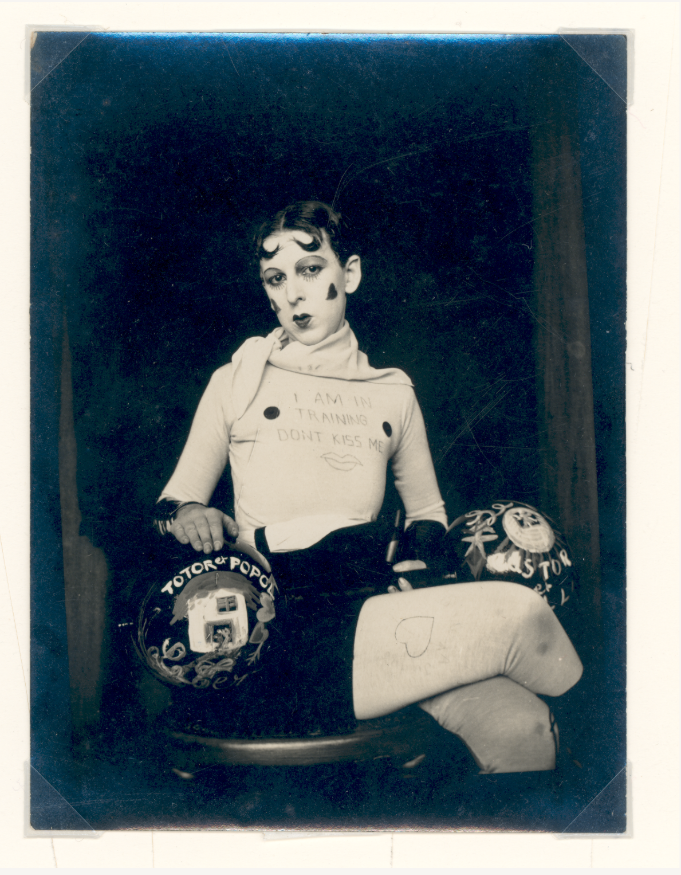
Claude Cahun, "I am in training don’t kiss me," c. 1927. Gelatin silver print, Courtesy of the Jersey Heritage Collections.
Cahun once wrote: “Under this mask, another mask. I will never be finished removing all these faces.” (3) And finish she never did; she rather duplicated, mirrored, and revealed her faces in an infinite proclamation of selfhood.
Emma Huerta is an educator at Wrightwood 659 and studies Art History and Philosophy at the University of Chicago. She perpetually investigates why artists do the things that they do, and consequently what we can do with them.
Endnotes:
- Gen Doy, “Masks, Masquerades, and Mirrors,” in Claude Cahun: A Sensual Politics of Photography (London: I. B. Tauris, 2007), 36-80. In the second chapter of Claude Cahun: A Sensual Politics of Photography, Doy discusses reflection at greater length in reference to additional photos by Cahun. She particularly elucidates Cahun’s reclamation of stereotypical norms associated with women regarding mirrors through her own unique, autonomous, and (perhaps most importantly) queer interpretation.
- Ibid., 58.
- Lucy R. Lippard, “Scattering Selves” in Inverted Odysseys: Claude Cahun, Maya Deren, Cindy Sherman (New York : North Miami : Cambridge, Mass.: Grey Art Gallery, New York University ; Museum of Contemporary Art ; MIT Press, 1999), 36.