Educator Insight: Emily on Neoclassicism and Sexuality
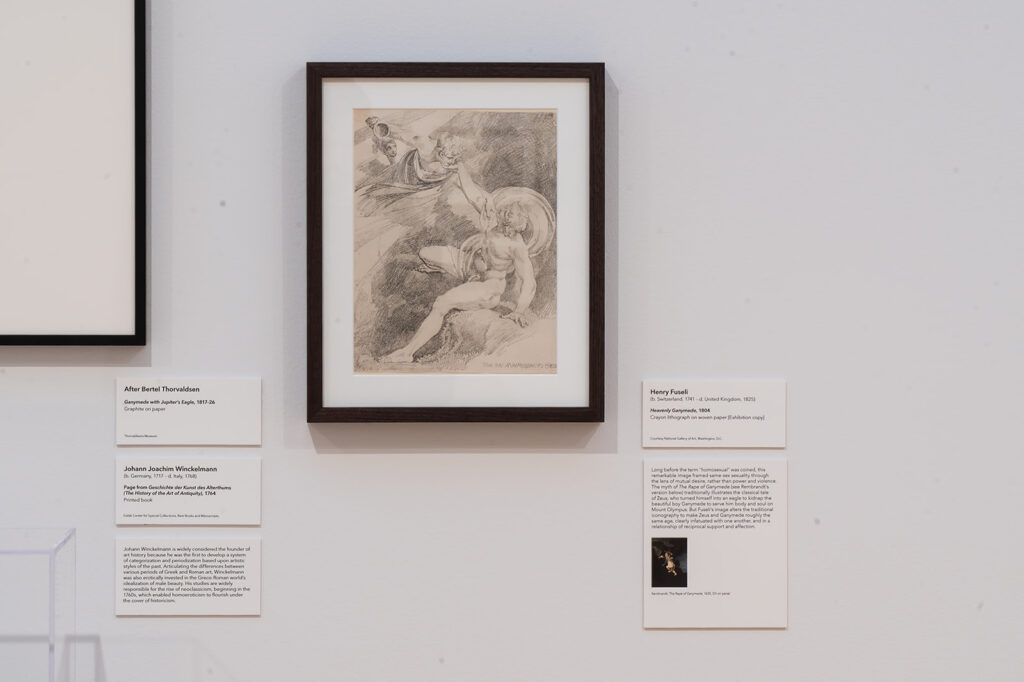
Installation view of The First Homosexuals: The Birth of a New Identity, 1869-1939, at Wrightwood 659, 2025. Photo courtesy of Daniel Eggert (@DesigningDan).
The neoclassicism movement, emerging in the 18th century as a reaction to the extravagance of Baroque and Rococo art, drew inspiration from the art and philosophy of ancient Greece and Rome. Artwork made in this style emphasized harmony, order, and the ideal human form, and often depicted specific stories from Greek and Roman mythology and history. While working decades before the introduction of the term homosexual, artists of the early 19th century who utilized this style often included quite overt expressions of same sex desire, publicly permissible considering the overarching normalization of same sex desire expressed by the ancient Greeks and Romans. (1) Pieces such as Heavenly Ganymede and Cupid and Anacreon bridged a communication gap created by the lack of appropriate language to describe same sex desire at the time and became early icons of positive representation of same-sex love.
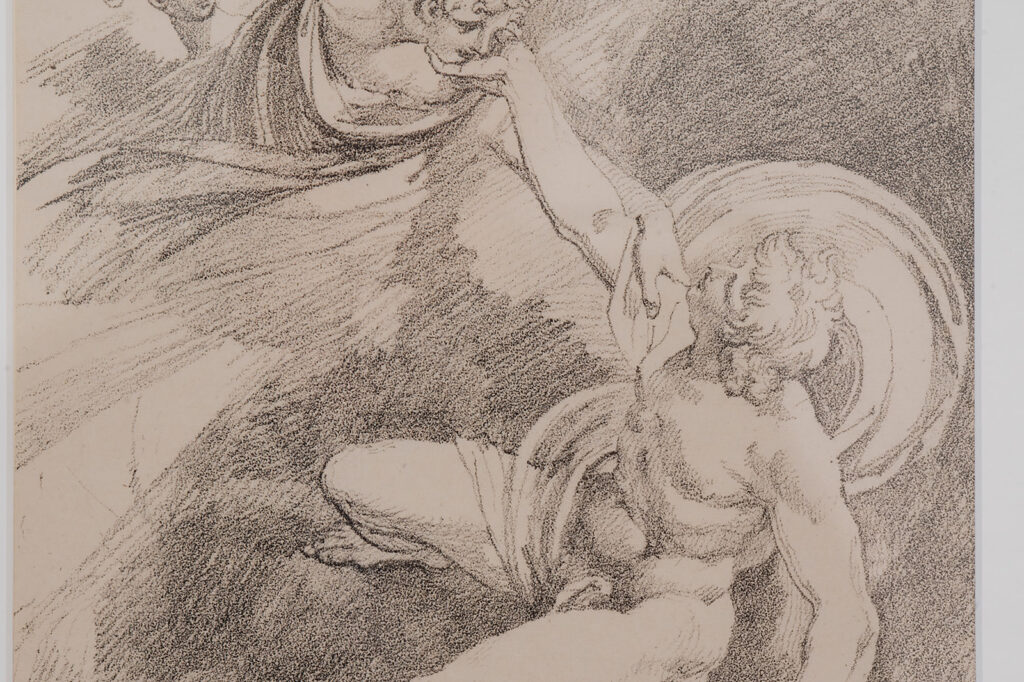
In the case of Henry Fuseli’s 1804 piece Heavenly Ganymede, the artist significantly modified a well known myth to make it a more appropriate representation of same-sex desire. The mythological scene associated with these characters is typically titled “The Rape of Ganymede” and features Zeus attacking a much younger shepherd boy. Peter Paul Rubens’ The Rape of Ganymede, completed in 1638, depicts this traditional myth, portraying Zeus as an eagle violently digging his claws into a young Ganymede and dragging him up into the sky. (2) However, in Fuseli’s work, Zeus appears in his human form, reaching up towards Ganymede instead of dragging him away, a consequential and poignant reversal of the usual dynamic between the two. In addition, Fuseli does not show Ganymede fighting against Zeus, rather, Ganymede wraps his own arm around Zeus as the god cradles his face in a gesture that implies a trusting, tender, and reciprocal love.
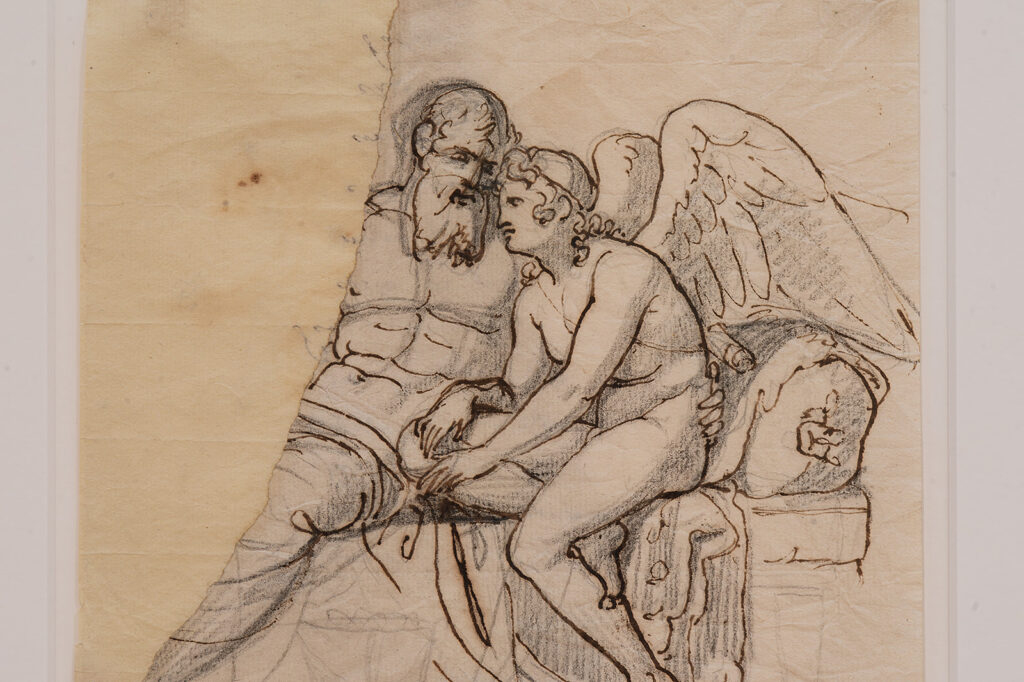
Bertel Thorvaldsen’s neoclassical sketch Cupid and Anacreon completed in 1806 also depicts a Greek myth meaningfully modified by the artist. (3) In this piece, we see a bearded man, Anacreon, cradling a younger man, the god Cupid. In customary depictions of the myth, Cupid is a young boy invited inside to “warm up” by the older Anacreon. In Thorvaldsen’s work, while still appearing younger than Anacreon, Cupid has visible muscles and a taller stature that implies a maturity not typically associated with the god. The two men lean into each other with their full bodies, and based on the conspiratorial tilt of their heads, appear to be having an intimate conversation. This scene could easily be passed off as a historical reference to the recognizable myth, but again tenderly depicted a same-sex relationship in a positive context all the same.
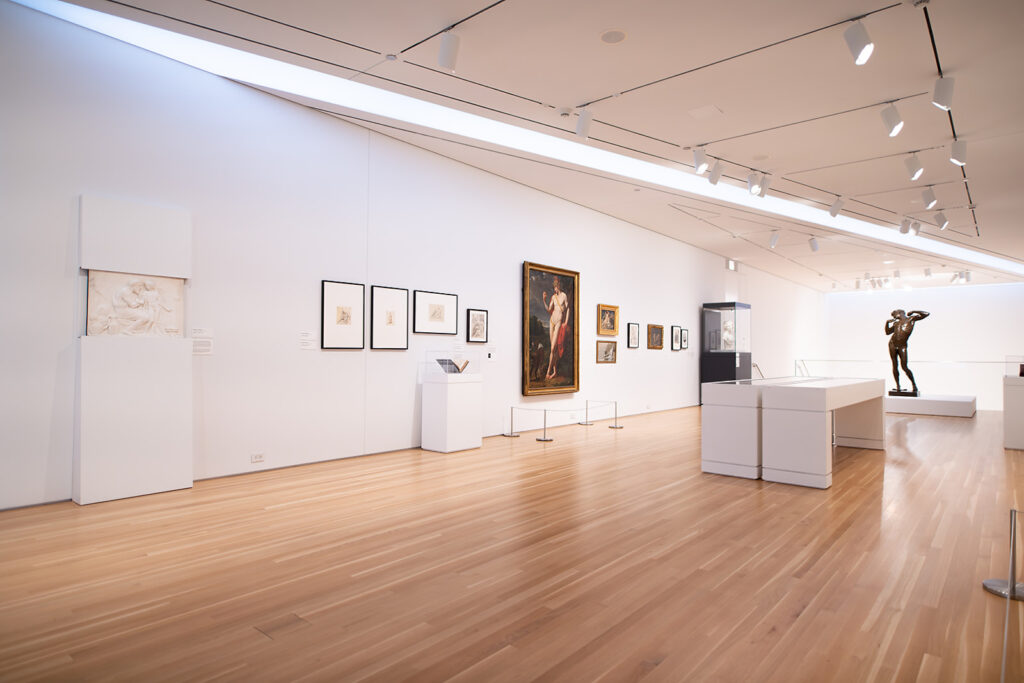
Installation view of The First Homosexuals: The Birth of a New Identity, 1869-1939, at Wrightwood 659, 2025. Photo courtesy of Daniel Eggert (@DesigningDan).
At a time when the Western world knew no appropriate language to describe same sex relationships grounded in mutuality and love, artists were able to utilize the popularity of the neoclassical style to fill this communication gap and depict same-sex desire in a positive manner. Furthermore, through strategic modifications of well known myths, artists faced a largely positive reception of art that would have otherwise been quite taboo, setting the stage for more explicit depictions of same-sex love in western art of the years to come.
Endnotes:
- Hubbard, Thomas K. “Historical Views of Homosexuality: Ancient Greece.” Oxford Research Encyclopedia of Politics. 29 May. 2020; Accessed 14 Apr. 2025. https://oxfordre.com/politics/view/10.1093/acrefore/9780190228637.001.0001/acrefore-9780190228637-e-1242.
- The Rape of Ganymede by Rubens, with comments in Latin – Video – Museo Nacional del Prado. Accessed April 14, 2025. https://www.museodelprado.es/en/whats-on/multimedia/the-rape-of-ganymede-by-rubens-with-comments-in/640a591f-e56d-8df5-9572-9dfaac65d3e4.
- Cupid by Anacreon, Winter, A827 – Thorvaldsens Museums Catalogue. Bertel Thorvaldsen’s Art and Collections. Accessed April 14, 2025. https://kataloget.thorvaldsensmuseum.dk/en/A827.
Emily Bylsma is an educator at Wrightwood 659 and a recent graduate of DePaul University with a BA in History of Art and Architecture. Emily has continued working in museum education and interpretation post-graduation.