Sarah on Felipe Baeza's "Ahuehuete"
An ahuehuete is a large tree native to Central Mexico and Guatemala. Its name is taken from the Nahuatl name for an evergreen tree, āhuēhuētl, which means ‘old man of the water’.[1]
In Felipe Baeza’s Ahuehuete, a human figure is partially submerged as the ahuehuete tree emerges from their mouth. The risen outlines made of string transform this two-dimensional work into a three-dimensional form, encroaching into our space. The buckles in the paper formed by the layers of watercolor create a water-like ripple throughout the depiction of human, tree, and water creating a unified undulation. The glitter causes a double take causing the viewer to question whether this a distant star that can only be seen at certain angles. What we encounter is a body that Baeza depicts as an extension of terrain.
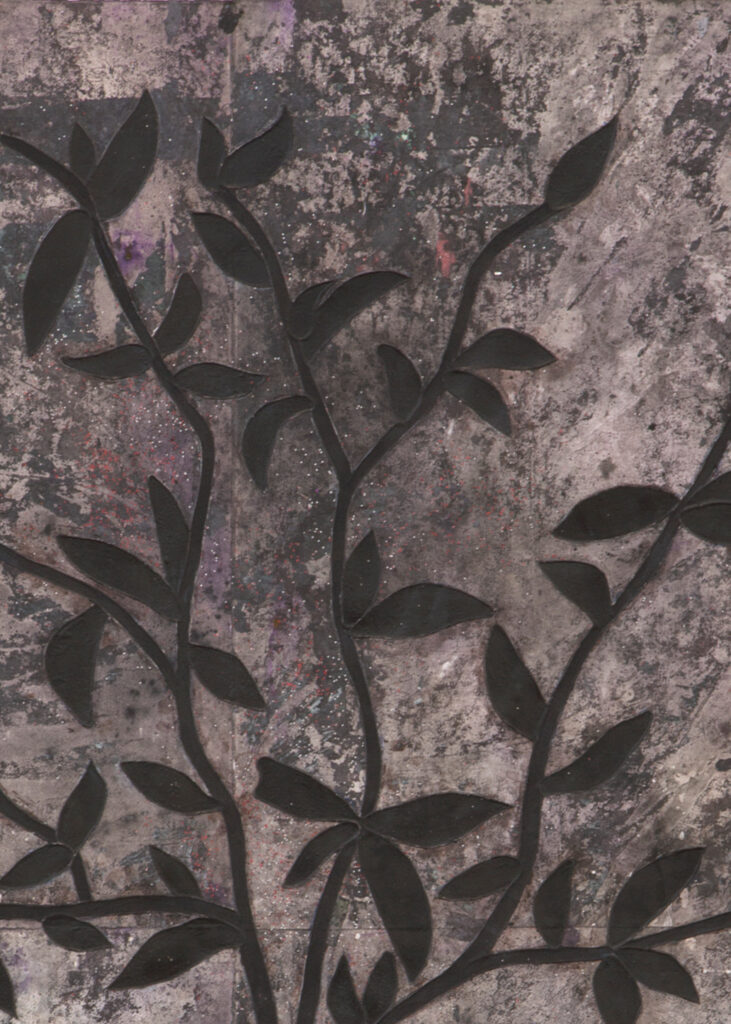
Detail of Felipe Baeza, "Ahuehuete", 2018. The Lumpkin-Boccuzzi Family Collection. © Felipe Baeza. Courtesy Maureen Paley, London; kurimanzutto, Mexico City/New York.
This shift in understanding of terrain suggests that displacement happens externally and takes root within the body. Land has entered the figure. The figure is part of the land. The emergence of the ahuehuete signals both growth and intrusion, making the body a site where land reorganizes form from the inside. The distinctions between body and environment collapse as the human and nonhuman elements merge. The implied roots and sky reaching branches are part of this submerged figures’ construction. Is the human form now the ahuehuete’s roots? Understanding the human form in this work is built from the intrusion of the natural into the body and ongoing negotiation between how we accept the separation of land and person. Echoes of previous forms linger, the human figure, the ahuehuete, and traces of the artist’s hands altering the material shape what can be seen without ever asserting a fixed form.[2]
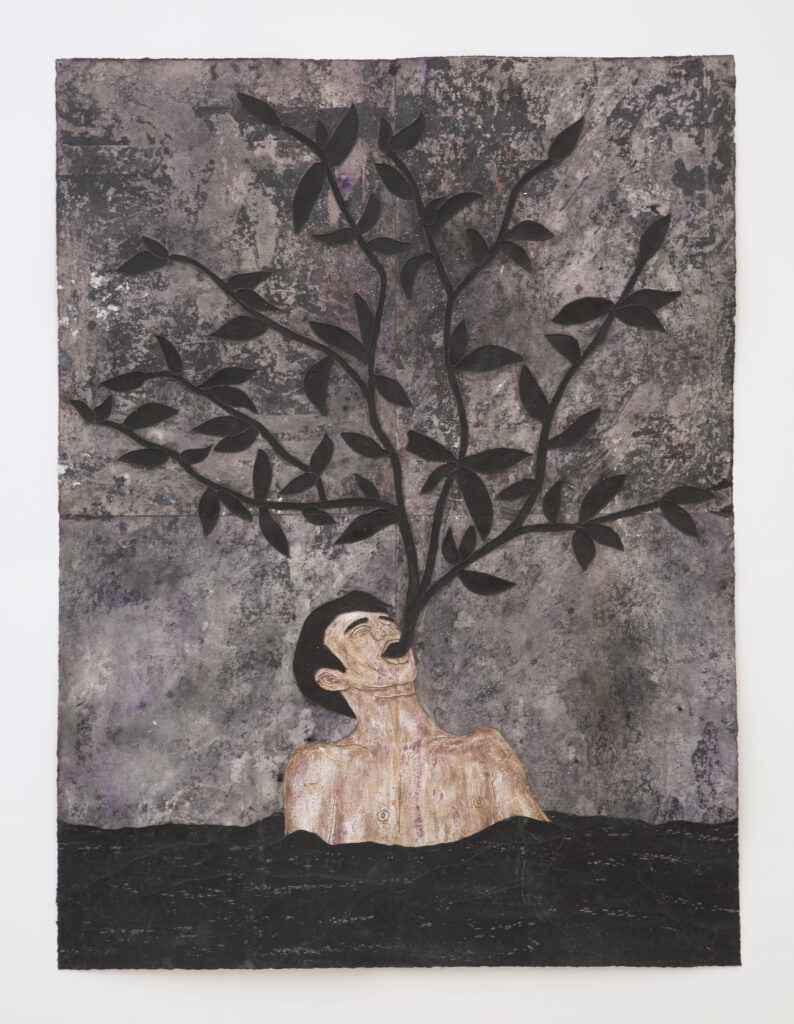
Felipe Baeza, "Ahuehuete", 2018. The Lumpkin-Boccuzzi Family Collection. © Felipe Baeza. Courtesy Maureen Paley, London; kurimanzutto, Mexico City/New York.
The refusal of neat resolve matters. What the image holds is not limited to what can be immediately seen or known.[3] The body resists categorization by incorporating fragments that makes it difficult to name or fully understand. This is done with an understanding of how legibility can function as a form of control. Being seen and recognized makes the body available to systems that can classify and regulate it. Opacity becomes strategy. The figure resists complete recognition, asserting the right to remain unseen.[4]
Ahuehuete recognizes the body as something in a constant state of negotiation with itself and its surroundings. Constructed, porous, and holding multiple histories at once. What remains withheld is the right to be unknown.
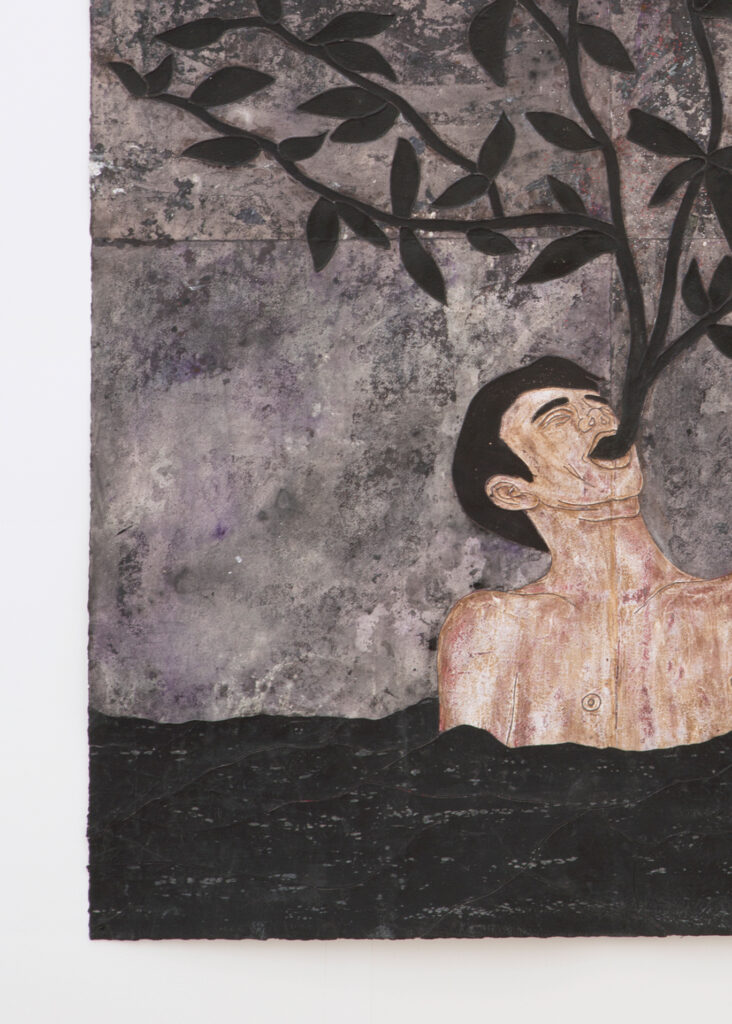
Detail of Felipe Baeza, "Ahuehuete", 2018. The Lumpkin-Boccuzzi Family Collection. © Felipe Baeza. Courtesy Maureen Paley, London; kurimanzutto, Mexico City/New York.
Endnotes:
[1] Earle, Christopher J. “The Gymnosperm Database: Home Page.” www.conifers.org, 1997, www.conifers.org/index.php.
[2] Avery F. Gordon, Ghostly Matters: Haunting and the Sociological Imagination (Minneapolis: University of Minnesota Press, 2008).
[3] Tina M. Campt, Listening to Images (Durham: Duke University Press, 2017).
[4] Eduardo Carrera R., “The Supernatural, Queer Mystical Ecologies and the Experience of Being Body in Felipe Baeza’s Artistic Practice,” U.S. Latinx Art Forum, 2025; and Tatiana Reinoza, “Felipe Baeza,” The Latinx Project, New York University, 2023.
Bio
Sarah Isela Aguilar is an educator at Wrightwood 659 and an artist from El Paso, Texas, working through drawing and text to examine perception, fragmentation, and the instability of belonging.