Object Chat: Resonances of the Subaltern
“If we literally try to hear something that is not necessarily visualized in the image, then listening to images becomes a way of enacting the broader experience of how images register. How do we get access to those deeper resonances?” – Tina Campt
In the photo series Justice for Nurjahan, Shahidul Alam strings together a visual narrative that registers starkly. The series begins at the end of Nurjahan Begum’s life in terror, leaving us wondering at what is left in the wake of her absence. Employing compositional techniques that mirror the arrangement of a storyboard, the series lays bare the nonlinearity and scaffolded, frictional impact caused by misogyny, silencing, and vigilantism within the enmeshed life and death story of Nurjahan Begum.
On January 9, 1993, Nurjahan, a twenty-two-year-old woman from a struggling household in Bangladesh, stood trial by a shalish*, and was found guilty of fornication due to her remarriage— a reversal of a previous fatwa* that had permitted her new relationship. She was humiliated, assailed with 101 pebbles and denigrated. On January 10, 1993, Nurjahan was found dead from poisoning at her parents’ home. The local newspaper reported it as an isolated suicide, but evolving interpretations of this act signals it as a siren of self-determination.
Postcolonial scholar Gayatri Spivak’s essay “Can the Subaltern Speak?” focuses on the agency for the poor and most marginalized groups in our society. How is the voice used when it is not heard? How do we access the deeper resonances and registers of the voice/less? Spivak follows this line of questioning by suggesting that the subaltern* “speak through death” and that this act springs from “a social motivation produced by the weight and length of unmitigated oppression.” The events leading to Nurjahan’s suicide establish a timeline that is mortifying and unsurprising. Though the true motivations for ending her life are unknown, when equality of life is denied, violence is produced in extremes. During times of great political urgency, people make sacrifices to be seen, heard, and noticed —producing political acts that horrify and haunt.
Justice for Nurjahan is haunted with sacrifice that troubles presumed sanctities of life. The contrasting emotions that trail from image to image makes its viewing more cinematic than documentarian, more soliloquy than elegy. This inclination is heightened through the choice to void the series of color and to piece the images side by side –each image melts, hardens, and melts again into the next. There is a tether between the first and last images, Wife of the Accused and Walking to Nurjahan’s Grave, the only two photos of a feminine figure in the entire series. Both faces are shielded from our view — one is draped with a sheer veil, and the other overlooks the clearing where Nurjahan was laid to rest, with her back towards us. A sense of caretaking is strong in the representation of these two figures, challenging the spectacle of melancholy.
In Justice for Nurjahan, Shahidul Alam evinces his commitment to intensity, reflexivity, and criticality through capturing raw and striking moments directly at the scene. We are implicated and have no means of escape, only to witness.
Isra Rene, Wrightwood 659 Educator
*shalish: a village council of local leaders who pass judgment on civil and criminal disputes
*fatwa: a legal ruling on Islamic law
*subaltern: a term used to describe a social group erased, ignored, or excluded from mainstream narratives by entities of power and domination, often applied to colonized peoples who navigate life on the margins of society, sometimes by virtue of an identity category like ‘indigenous’ or ‘female.’
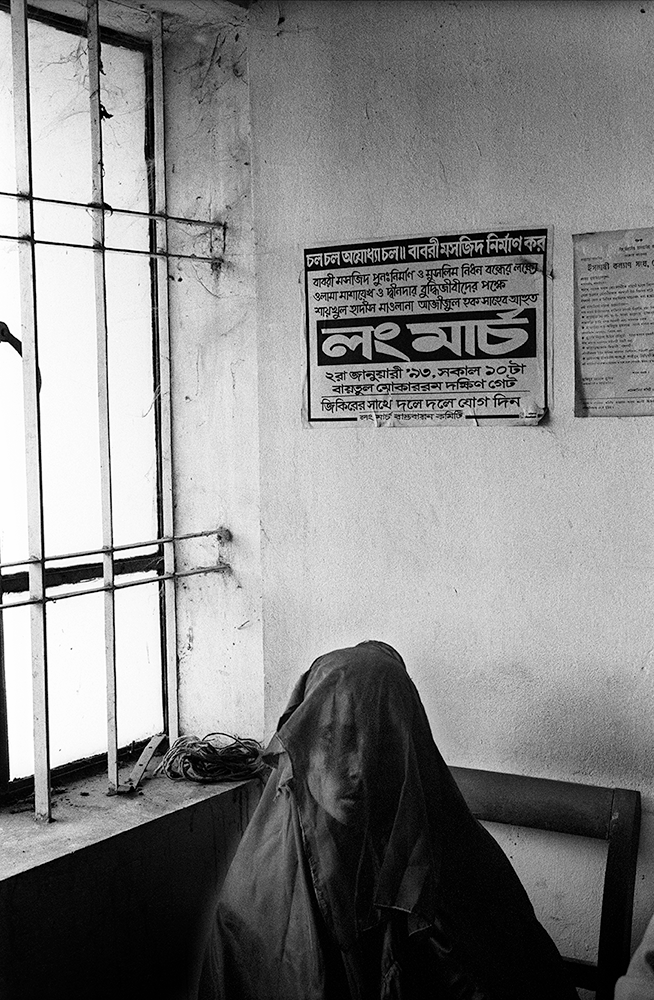
"Wife of the Accused," 1993, by Shahidul Alam. Courtesy of the artist
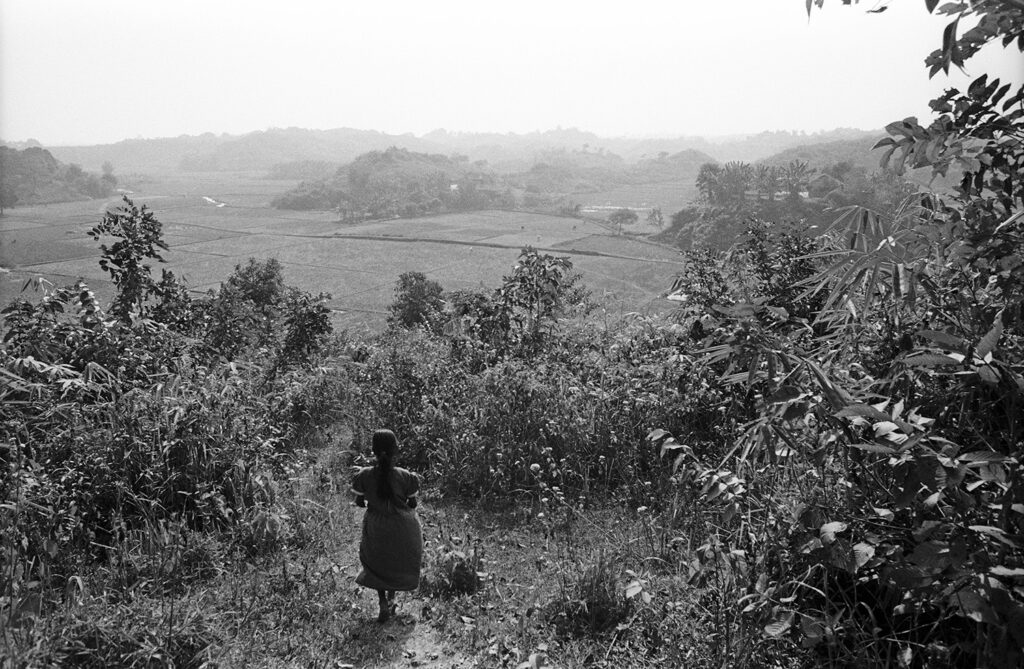
"Walking to Nurjahan's Grave," 1993, by Shahidul Alam. Courtesy of the artist