Michiko Itatani and Scientific Discovery
In his 1941 story “The Library of Babel,” Argentinian writer Jorge Luis Borges describes a universe comprised of a practically infinite library, containing written volumes of every possible combination of letters in a twenty-two-character language. The mathematical idea of infinity powers Borges’ fantastical world and prompts philosophical musings: would there be an order to such a library? What madness and discoveries might be made by sifting through all the books—equally likely to be nonsense, a gospel, or dictionary?
The concept of infinity also animates Michiko Itatani’s library paintings, in more ways than one. Formally, many of the paintings share identical or barely differentiated compositions. Others seem to show the same space from different angles, or include the same components shuffled and turned inside out. The libraries are populated with varying permutations of scientific devices, mostly globes, but also tools, symbols, and vehicles developed during the last 35,000 years of human existence. Like Borges’ infinite books, the devices appear to reference scientific advancements real and imagined. Globes take the form of way-finding instruments and fantastic worlds of lilac purple and acid yellow with swirling atmospheres. These objects are artifacts of the human desire for knowledge about our world, in real life and in fiction.
Although the artist much prefers to leave her work open-ended, many of her objects do seem to reference specific watershed moments in the history of both Eastern and Western astronomical and astrological investigation. For example, “Collection Sol III” from Celestial Maze 22-B-1 contains objects that reference the history of astronomical navigation and timekeeping. In the painting’s bottom left-hand corner, Itatani places a device visually similar to 18th century timekeepers, especially those invented by Englishman John Harrison in the mid-1720s, which provided a previously impossible accuracy, and allowed ships at sea to accurately calculate longitude. On the right side of the painting, Itatani includes a grand orrery, a hybrid device including a clock, a model of planets and moons used to calculate relative locations, and images of zodiac signs or other stellar positions and longitudes.
The center of the painting is occupied by a large astrological or astronomical chart with vague markings. The black background and white markings of the chart evoke rubbings of the Shuzou planisphere, a stone engraving originally made in 1190 in China to represent the visible sky in Southern China, from which rubbings were made between the 15th and 19th centuries. The chart also adopts the general form of natal charts used in astrology to depict the position of stars and planets in the sky at the time and place of birth, used to predict information about the life of an individual.
Other paintings include more references to historical devices. “Cosmic Wanderlust” from Cosmic theatre 10-B-3 (CWC-3) includes a silver globe constructed of concentric rings attached to smaller spheres—perhaps referencing an armillary sphere, a device used in ancient Greek times, and notably in the 17th and 18th centuries, to represent astronomical geometries, including the horizon, meridian, and Equator, as well as stars and constellations. In the painting, these devices mingle with space-age vehicles from the Space Race to modern day, including Sputnik I, Explorer I, Luna 16, and the James Webb Space Telescope.
Itatani’s devices illustrate the ubiquity across space and time of the desire to study the stars. While they extend our senses into the unknown, they also serve as emissaries from our small world to the larger cosmos, physical and spiritual representations of humanity at large. The anthropomorphic quality of Itatani’s objects expresses her “infinite hope” that the curious ambition of the human mind to project itself beyond its reach be preserved even in the most dire circumstances—including the COVID-19 pandemic, during which many of the paintings in Michiko Itatani: Celestial Stage were made. Itatani, though she prefers to leave her paintings open to interpretation, is clear on this point: we are created through our desire to know the world, and this faculty is too precious to lose.
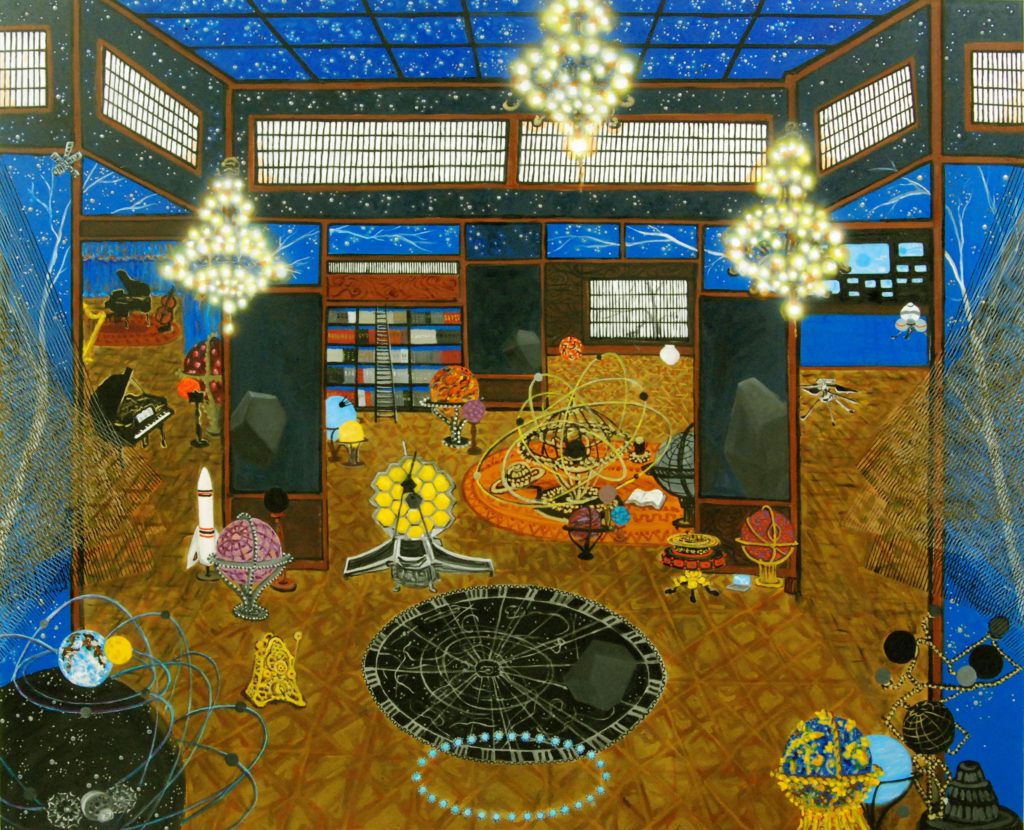
“Collection Sol III” painting from Celestial Maze 22-B-1, Michiko Itatani, 2022, 78” x96,” oil on canvas, courtesy of Michiko Itatani
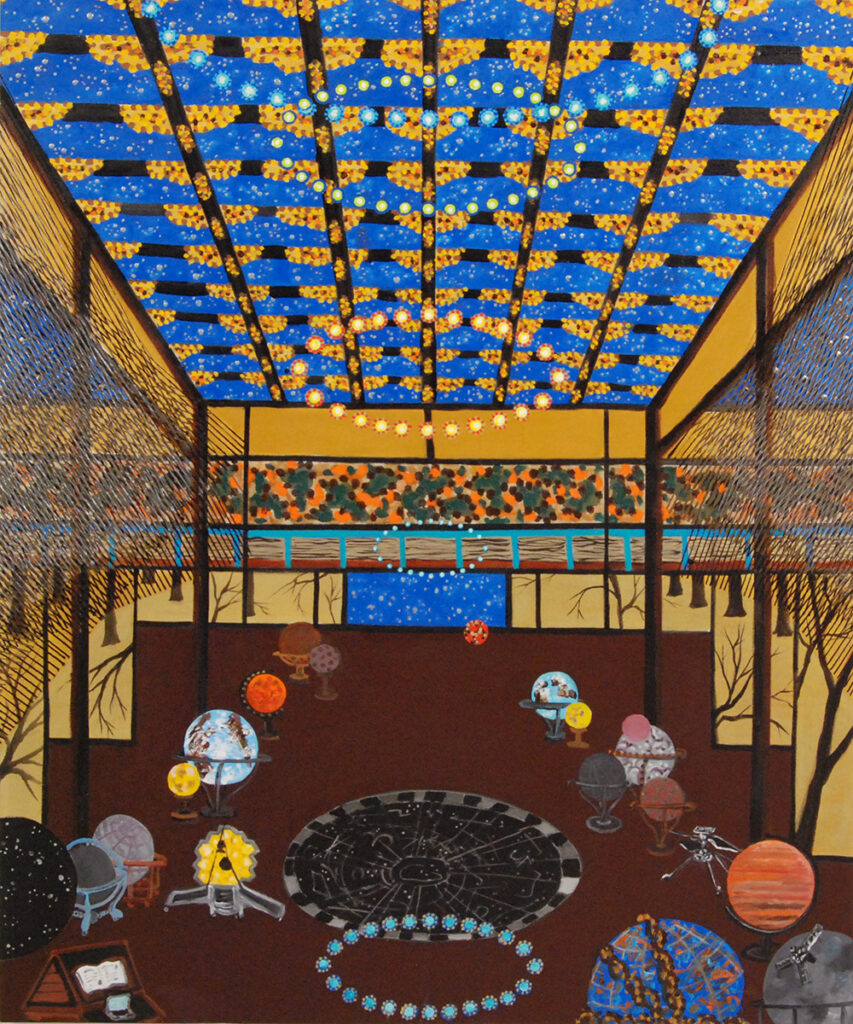
“Cosmic Wanderlust” painting from CTRL-HOME/Echo 12-B-4 (CRH-13), Michiko Itatani, 2012, 105” x 84”, oil on canvas, courtesy of Michiko Itatani