Educator Insight: Vinh on Martin Wong's "Footprints Poems + Leaves"
In 1968, Wong published Footprints Poems + Leaves, a poetry book and his first endeavor into writing. Each page, intermittently dated through July 1966 to April 1968, is filled with inked scrawl. The words sit heavy atop each other where stanzas bleed down through the sliced strokes of a K or an R. The horizontal roofs of T’s, F’s, and E’s slant at tottering angles atop their singular vertical supports. Some pages are written in thin, blocky script and others in bold, gestural lines. The poetic subjects range from urban streets with drug users and sex workers to foghorns in a lonely harbor.[1] Through it all is an instinctual balance mirrored in the art of Chinese calligraphy, and potentially, a discipline akin to the rules of hanzi stroke order and shape: top to bottom, left to right, horizontal before vertical.
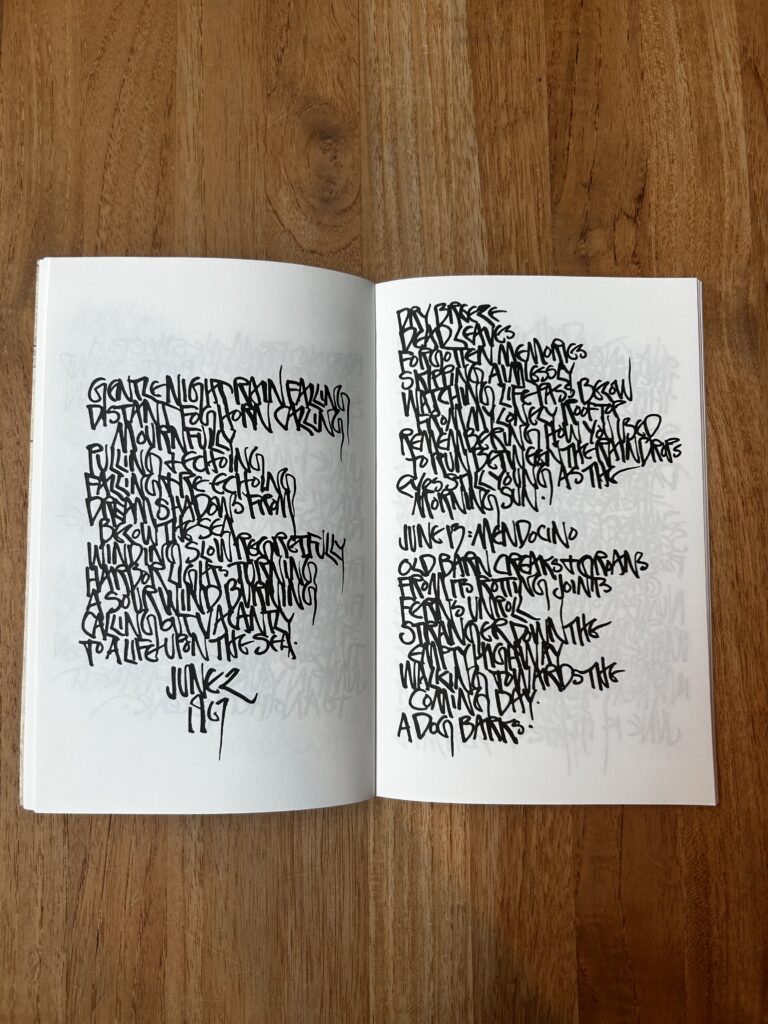
Photo of Martin Wong, "Footprints Poems and Leaves", Printed Book, Second Edition 2024, Originally Published 1968.
While often ambivalent to his Chinese identity, Martin Wong’s proximity to Chinese art and other Chinese identities allowed him to continually return to Chinese literary motifs. Wong never learned Cantonese or Mandarin, held a self-proclaimed outsider view of San Francisco’s Chinatown, and was not an active participant in the Asian American Movement of the 1960s-70s.[2] His Nuyorican friend, Chris “Daze” Ellis, was perplexed by Wong’s struggle with the Chinese language, which held a self-conscious grip over Wong, who avoided situations where this could become apparent.[3] Though Wong’s work is considered Western calligraphy because it is written in English, the visual cues of Chinese calligraphy reveal a side of affection for his mother tongue.
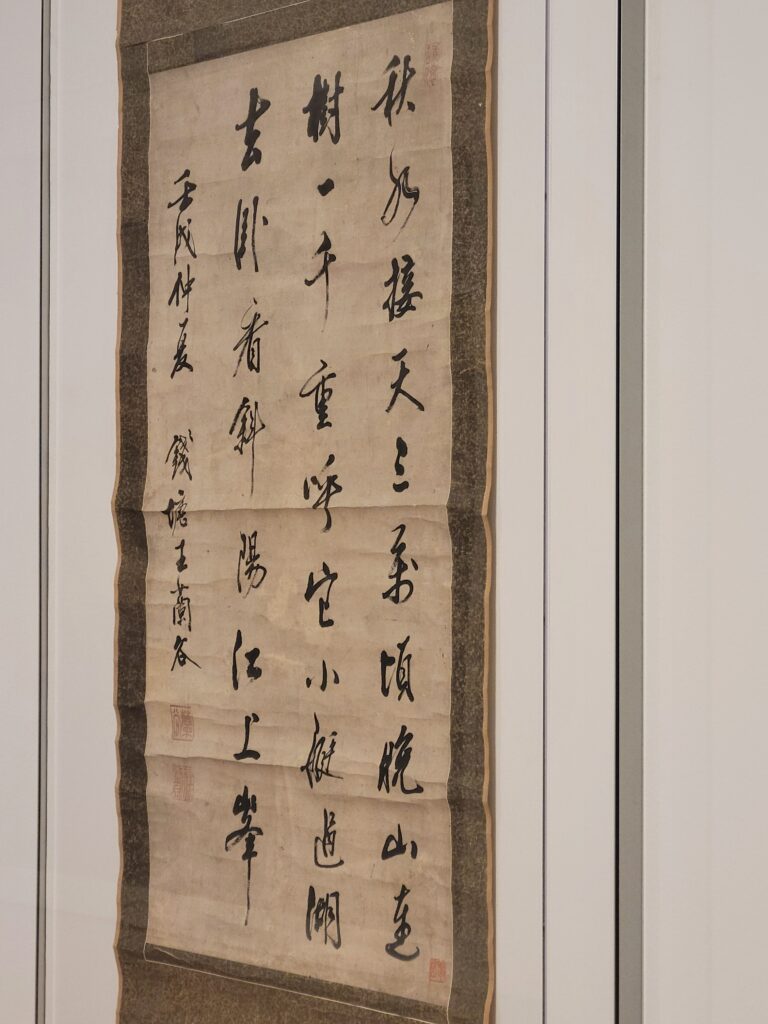
Detail of Wang Langu, "Poem by Tang Yin (1470-1524)" 1802, in "Martin Wong: Chinatown USA", at Wrightwood 659, 2026.
Like classical Chinese literature, Wong’s writing is sourced from the landscapes he lived in—the wooded coastline of his college town; the streets of New York—and the people he met along the way. Classical Chinese literature is heavy in its imagery of wistful emotions and harmony in nature. Diverting into his own style, Footprints Poems + Leaves reflects on these quick seasons of life passing by in an urban context.
While writing Footprints Poems + Leaves, Wong produced Sewer Goddess: A Martin Wong Fairytale, 1967, a 7 foot long scroll. Compared to the relative readability of Wong’s poetry book, Sewer Goddess can be described as paragraphs of briars. The story follows a young boy sucked into a city sewer, who meets a young goddess that teaches him “the rhythms of love”. When he returns to the surface, pulling her along, he discovers she was just a tangle of trash and that he drowned in the sewer long ago.[4]
Wong manipulated the genre of Chinese literature to accommodate his resistance to and reliance on identity. He could not read Chinese characters but saw his reflection in them. In this way, Wong’s calligraphy is not exclusively Western. It is the same as he was—playing with the boundaries of strict interpretation.
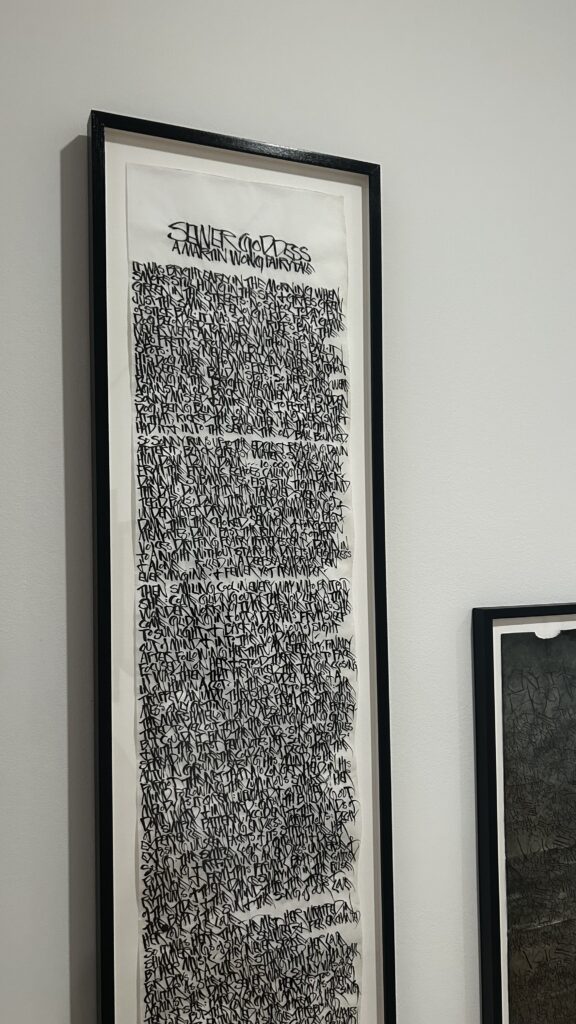
Detail of Martin Wong, "Sewer Goddess: Partin Wong Fairytale", 1967, ink on paper scroll. Courtesy of The Martin Wong Foundation (P.P.O.W Gallery).
Endnotes:
[1] Martin Wong, Footprints Poems + Leaves, 1968. Ink on paper. 8.5 x 5.5 inches.
[2] Tang, Rui. “The Dynamic: Martin Wong and The Asian American Community.” Essay. In My Trip to America by Martin Wong, 103–12. San Francisco, California: California College of the Arts, 2015.
[3] Li, Vivian. “Reading Martin Wong.” Essay. In Martin Wong: Chinatown USA, 112–20. George R. Miller & Co. with Halsted A&A Foundation, 2026.
[4] Martin Wong, Sewer Goddess: A Martin Wong Fairytale, 1967. Ink on paper scroll. 85.5 x 16 inches.
Bio
Vinh Wong is an educator at Wrightwood 659 and Managing Editor and writer at the pub. They hold a BA in Creative Writing with Honors from University of Washington Seattle.