Educator Insight: Taylor on Carlos Martiel's " Lazos de Sangre"
In Lazos de Sangre, Carlos Martiel offers his blood to the water and its ancestral inhabitants so as to simultaneously activate legacies of struggle and spirituality toward contending with a contemporary landscape of perpetual exploitation.
There is a level of depersonalization that makes it difficult to locate the work in time or space. Martiel wears nondescript black clothing, his hair is cut low, and we see only his side profile at brief points throughout the video. He could be any Black man along any coast. Cuba, in 1886, was among the last territories to see the abolition of slavery in the western hemisphere.[1] Martiel, an Afro-Cuban, descendant of the enslaved, inherits a kind of dispossession that leads him to the water in search of his “blood ties.” He speaks not of land ownership, but of its reverence. His kneeling at the tide is a renunciation of nationalism, and his arms stretch out in a way that suggests submission only to nature. As Glissant writes in Poetics of Relation, “We know ourselves as part and as crowd, in an unknown that does not terrify.”[2] Martiel reminds us of an ontological point of origin of the African diaspora that is neither in the west nor in Africa, but in between, in the water.
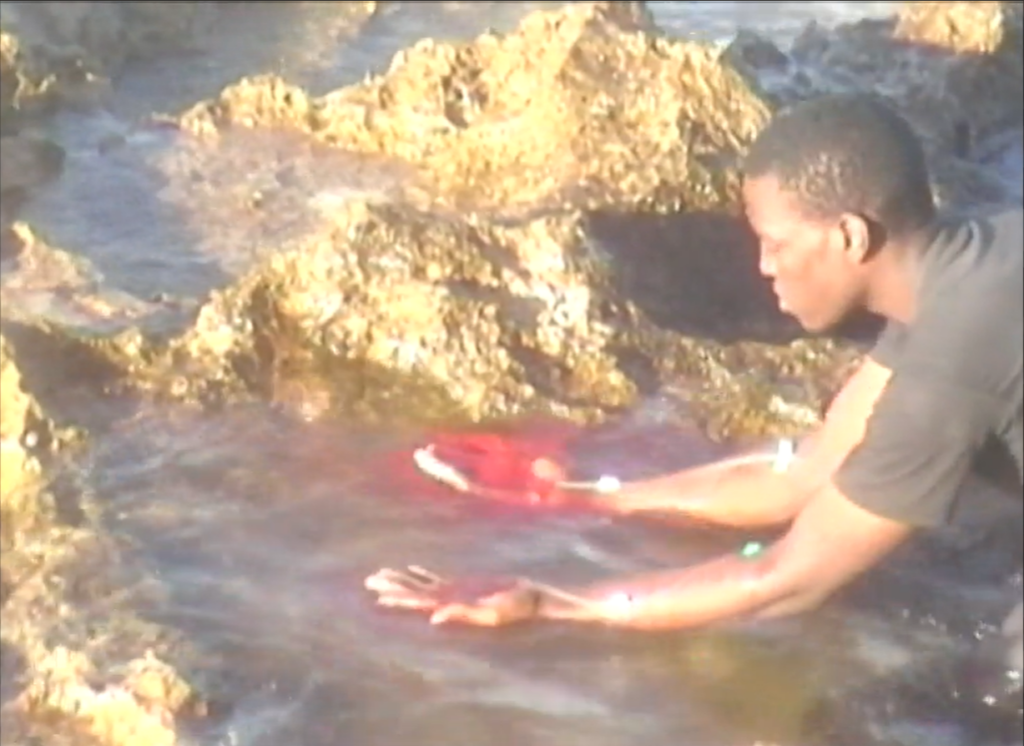
Carlos Martiel, "Lazos de Sangre", 2012, Digital Video, Courtesy of Leslie-Lohman Museum of Art.
Martiel’s blood flows freely from catheters placed in his arms, such that the audience has no way to quantify the amount that is being lost. Blood becomes a metaphor for the innumerable lives lost to the slave trade. He eventually exits the frame, leaving only a pool of red. The audience watches as waves crash into the tide, and the water runs clear. The gradual dispersion of blood into the larger body of water speaks to the omnipresence of antiblackness despite the extent to which its manifestations have been concealed or reconfigured over time. Black pain becomes part and parcel of the broader picture of social life.[3] His blood can never be removed from the water—it joins that of countless others sacrificed in the name of capital, all rendered invisible. The closing frames leave us with no information apart from the landscape; this gesture offers an opportunity not only to appreciate the vast power of the ocean, to contemplate the loss and suffering it has seen, but also to imagine what it would look like to begin again.
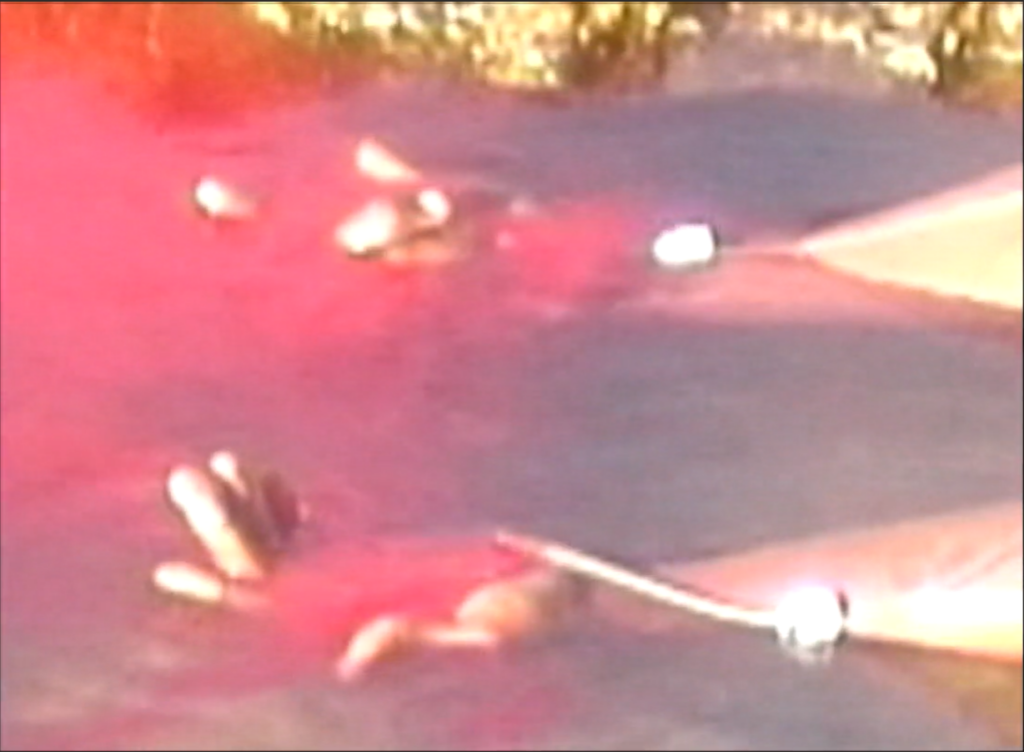
Carlos Martiel, "Lazos de Sangre", 2012, Digital Video, Courtesy of Leslie-Lohman Museum of Art.
Here, at the shore, Martiel sheds his blood, but he does so on his own terms, that it might be understood as part of a bigger story. Vaguely evocative of Afro-Caribbean religions like Santería or Vodou, perhaps his blood is a sign of life or a signal of devotion to ocean-dwelling Orishas or ancestor spirits.[4] In any case, he asserts his right to exist, with full autonomy, on and beyond the island of Cuba. Allowing his body to serve as a link to the landscape and its history, his pain is transformed for the sake of universal reckoning as we continue to navigate the afterlives of slavery.
Endnotes:
- “Afro-Cubans in Cuba,” Minority Rights Group, accessed March 26, 2026. https://minorityrights.org/communities/afro-cubans/
- Édouard Glissant, Poetics of Relation (The University of Michigan Press, 1997), 9.
- Frank B. Wilderson III., Afropessimism (New York: Liveright Publishing Corporation, 2020), 216.
- Robert Farris Thompson, Flash of the Spirit: African and Afro-American Art and Philosophy (Vintage Books, Random House, Inc., 1983), 75.
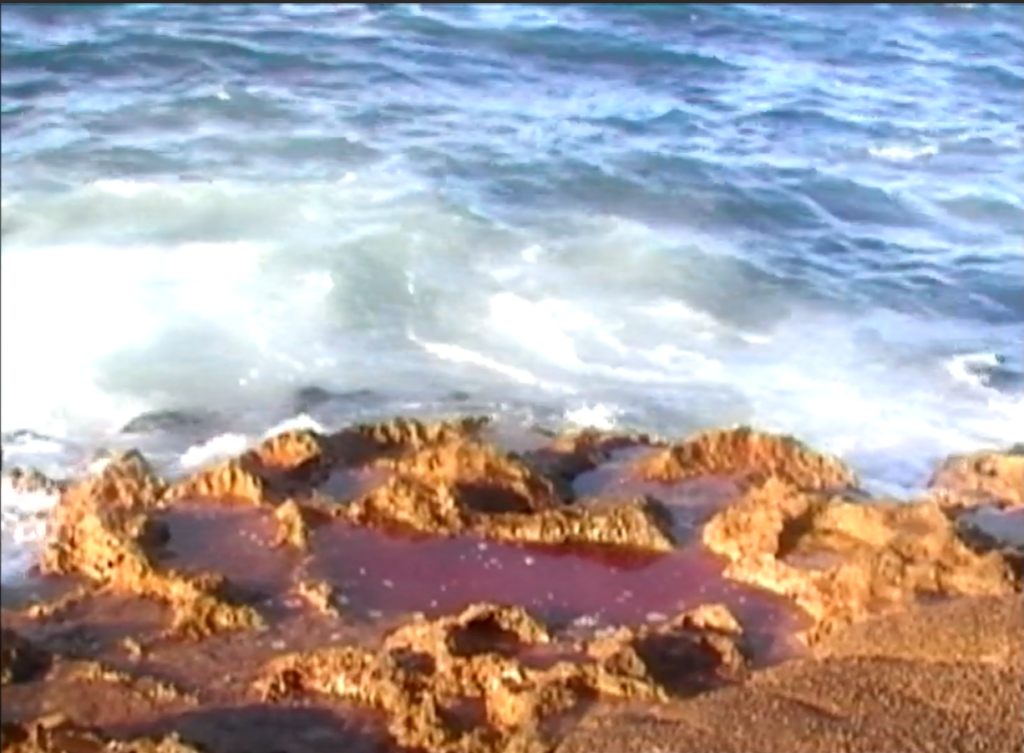
Carlos Martiel, "Lazos de Sangre", 2012, Digital Video, Courtesy of Leslie-Lohman Museum of Art.
Taylor is an educator at Wrightwood 659 and a research-based artist working out of East Garfield Park. She is a graduate of The School of the Art Institute of Chicago where she studied painting and art history.