Educator Insight: Nijae on Scott Burton and Theatrics
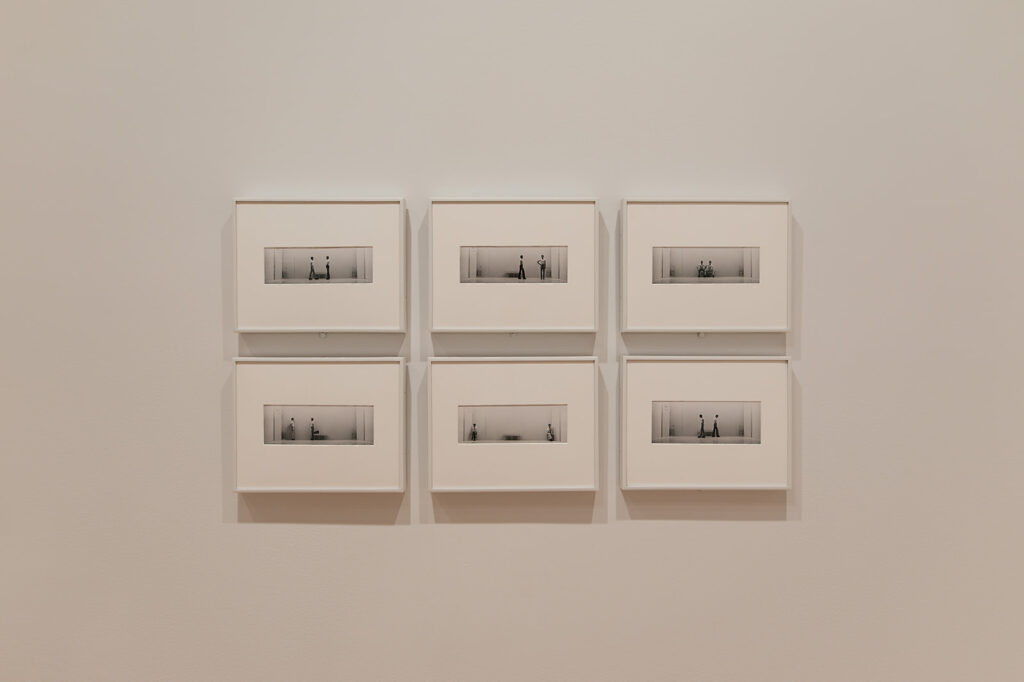
Is it possible to place two bodies on a stage and illustrate the dynamics of their relationship to one another without uttering a single word? Is there a narrative that can be conveyed through body language and configuration alone? This is what Burton was exploring in his performance piece Pair Behavior Tableaux, which premiered at the Guggenheim Museum in 1976.
Greatly influenced by NYC cruising culture in the 1970s, Burton was deeply invested in documenting and choreographing the vocabulary of non-verbal communication, especially the ways that it functioned in public space. These observations culminated in a series of performances.
In Pair Behavior Tableaux, the performance consisted of two men, dressed in white t-shirts, trousers, and platform shoes. On stage with them were two chairs and a bench. During the performance, the regular seats of the Guggenheim theater were left empty. Instead, audiences were seated in a few rows of uncomfortable chairs, lined up 50 feet from the stage at the very back of the theater.
Seated so far from the stage, the audience was unable to make out the expressions and distinct facial features of the performers. It was this distance that allowed the viewer to remove themselves from any immediate empathy with the men on stage, leaving room for subtle gestures and movements to be abstracted into a grammar of body language.
For the next hour, the two men assumed positions choreographed to illustrate various relationship dynamics in tableau’s separated by blackouts. Their movements were achingly slow and deliberate. A left hand rested lightly across the chest. A head tilted downward. Bodies turned inward. A shoulder turned away. All in silence.
It is through this unhurried pace, distance, and quiet that Burton was able to reveal the often invisible theater of everyday living, decoding the gestures of bodies in space and in community— bodies seeking, accepting, and betraying connection without saying a single word. As a gay man in 1970s NYC, it makes sense that this was a language Burton would be fluent in.
But this performance was not meant to simply illustrate a coded language among gay men. It was ultimately an exploration of awareness —one that rippled out to those seated fifty feet away. Amidst the silence, the audience was compelled to notice their own posture and presence. Suddenly conscious of the placement of their hands, or the closeness of the stranger sitting next to them. In this way, the piece transformed spectatorship itself into a participatory act.
This awareness—of the body, of space, of others—would come to define Burton’s practice. From the stage to the street, from the gallery to the park bench, he traced the subtle exchanges that structure human life. His work reminds us that every shared, public space carries its own quiet choreography.
Notes:
1. Burton, Scott. Interview by Mimi Poser. “Round and About the Guggenheim”.
“Guggenheim Museum, 9 Apr. 2015, https://www.guggenheim.org/audio/track/pair-behavior-tableaux-1975-1976-1976.
2. Simmons, Steve. “Scott Burton.” Artforum, vol. 14, no. 9, May 1976, https://
www.artforum.com/events/scott-burton-6-232007/.
3. Burton, Scott. Pair Behavior Tableaux, 1976 (Two Short Clips). Vimeo, uploaded by
David Getsy “vimeo”, 2023, https://vimeo.com/791239911.
Installation view of "Scott Burton: Shape Shift", at Wrightwood 659, 2025. Photo courtesy of Daniel Eggert (@DesigningDan).