Educator Insight: Nijae on HyperObjects

What is a Hyperobject?
Coined by Timothy Morton in 2013 with his book Hyperobjects: Philosophy and Ecology after the End of the World, a hyperobject is an “thing” so vast, so intricately entangled time, space, and awareness, that it escapes any attempt at total/complete comprehension.
A hyperobject is something so big and entangled that, at any one time, we can only understand a fraction of a corner of it. And even that corner is malleable and ever-shifting. Global warming, nuclear waste, the internet— these are hyperobjects. They exist in the spaces between what we can see and what we can only theorize. Because of this, They defy traditional ideas of what a “thing” is, stretching beyond our ability to grasp them as a whole.
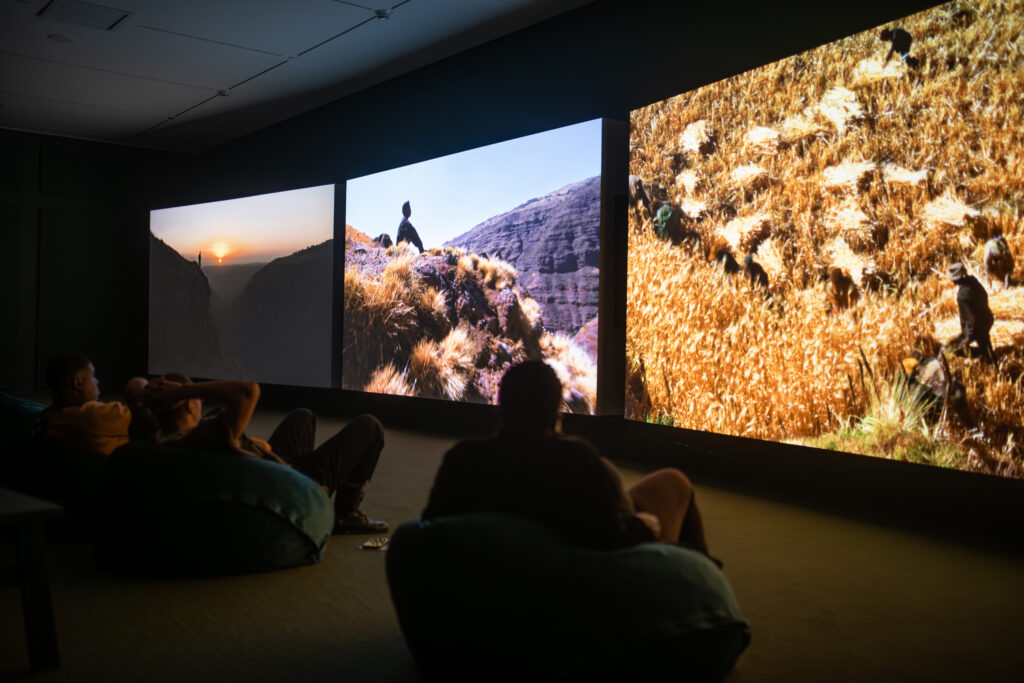
Installation view of John Akomfrah: Four Nocturnes at Wrightwood 659, 2024, © John Akomfrah; courtesy of Smoking Dogs Films and Lisson Gallery. Photo: Daniel Eggert (@DesigningDan).
Four Nocturnes Focus
In Four Nocturnes, John Akomfrah is focused on global warming as a hyperobject. He zooms in on its effects on the West African landscape and wildlife—more specifically, the declining elephant population. But even in zooming in on one specific geographical location and one species, the incomprehensibility that defines a hyperobject remains apparent
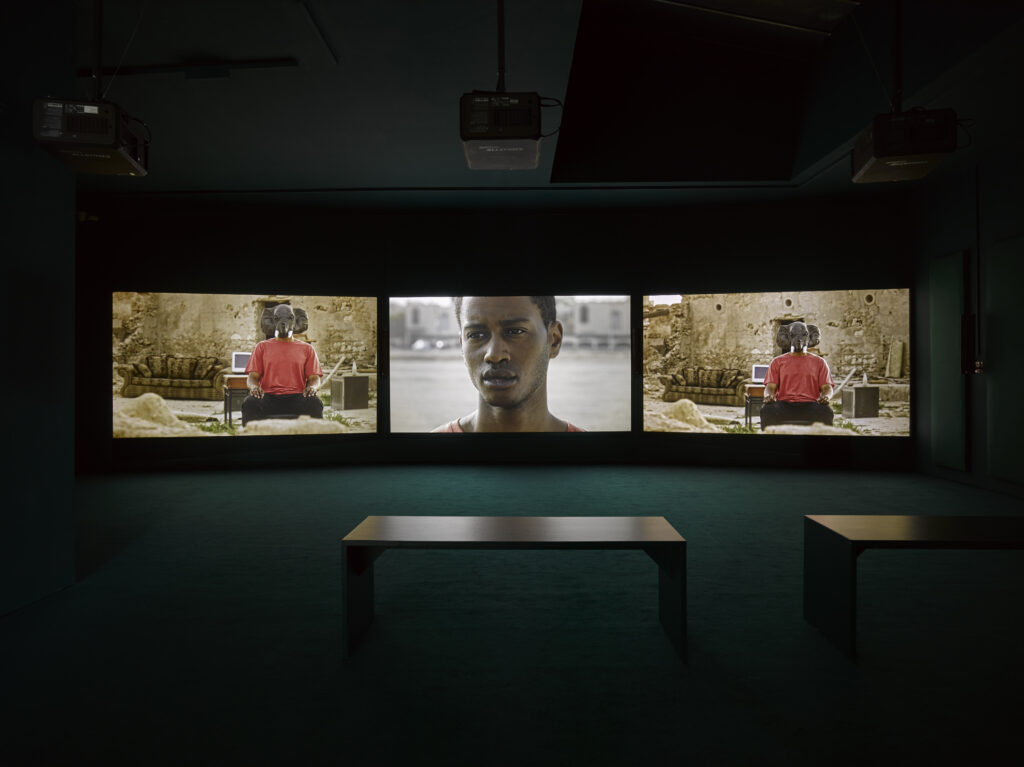
John Akomfrah; "Four Nocturnes," 2019, three channel HD colour video installation, 7.1 sound 50 minutes, installed in "The Unintended Beauty of Disaster," Lisson Gallery, London, 2021.
Elephants Cause & Effect
In investigating the declining elephant population, there is no single cause or effect. No single entry point. There’s poaching and the ivory trade, there’s droughts and the desertification of the landscape, there’s the still present ghosts of colonialism and economic exploitation. All interwoven. Revealing a complex web of challenges.
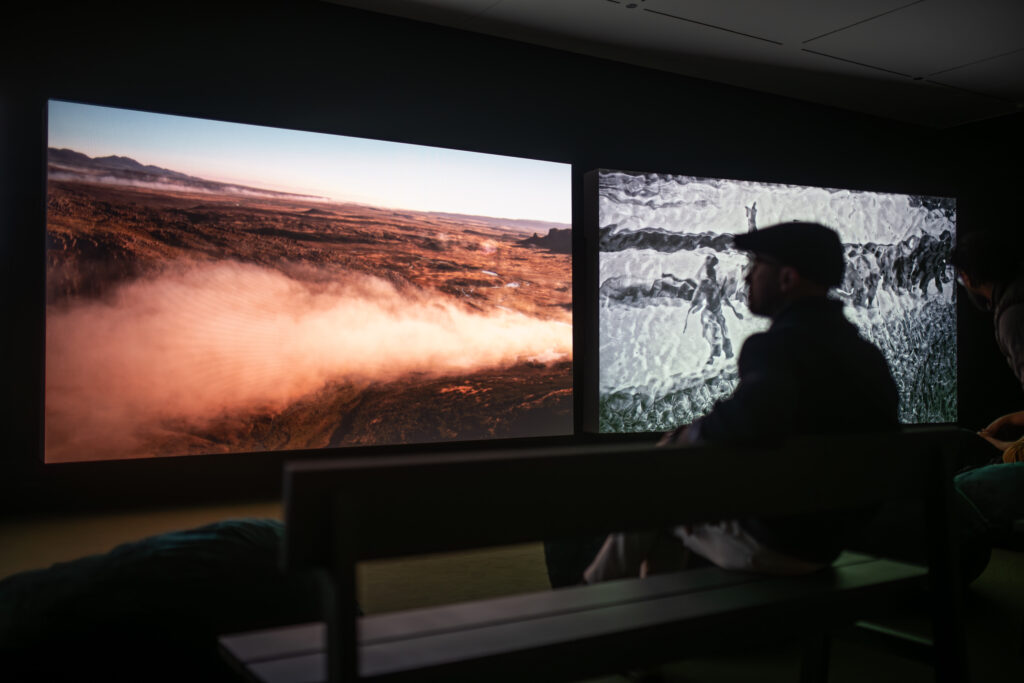
Installation view of John Akomfrah: Four Nocturnes at Wrightwood 659, 2024, © John Akomfrah; courtesy of Smoking Dogs Films and Lisson Gallery. Photo: Daniel Eggert (@DesigningDan).
How Does Four Nocturnes Illustrate this Connection?
The experience of viewing Akomfrah’s Four Nocturnes acknowledges this impossible comprehension. His immersive three channel installation can at times be disorienting in it’s non-linearity. It’s influx of images and sounds. Sometimes quiet. Sometimes cacophonous. At times both beautiful and grotesque. And never fully understood.
Four Nocturnes’s layered, fragmented approach parallels the infinitely layered impacts of global warming, which also manifests across multiple “channels” (ecological, political, social, and personal). This approach mirrors the way hyperobjects feel both simultaneously close yet incomprehensibly vast.
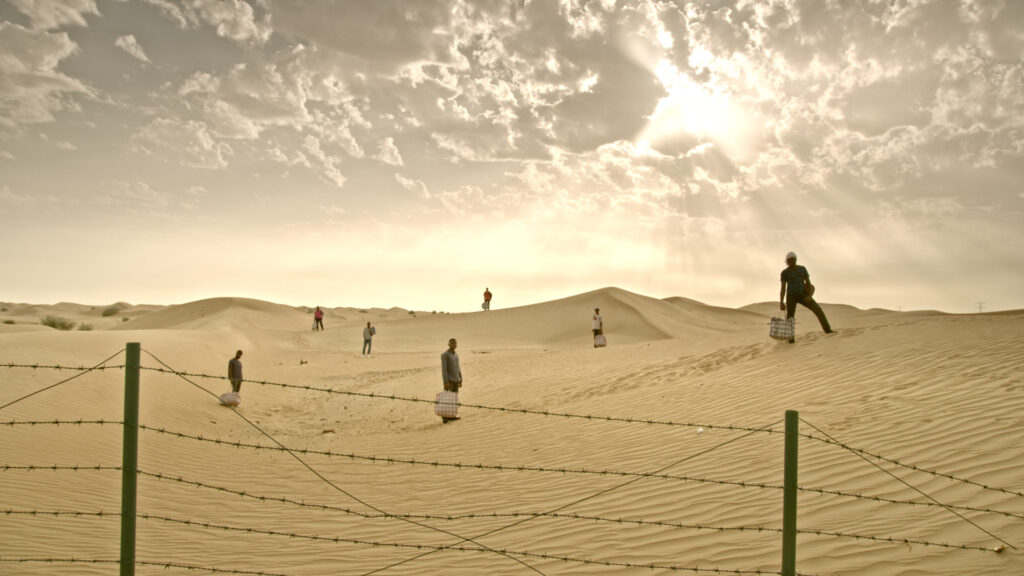
John Akomfrah; "Four Nocturnes," 2019, three channel HD colour video installation, 7.1 sound, 50 minutes.
Quote from Akomfrah
“Four Nocturnes” offers up no answers. Instead, it challenges us to stop looking away. To face this reality and all it’s complexities. This, Akomfrah feels, is his responsibility as an artist. He states, “Once you become aware of the implications of climate change for future generations, it is almost as if you have to respond. But I’m not a scientist or a campaigner; I’m an artist. I’m interested in the philosophy of climate change rather than the hard science.”
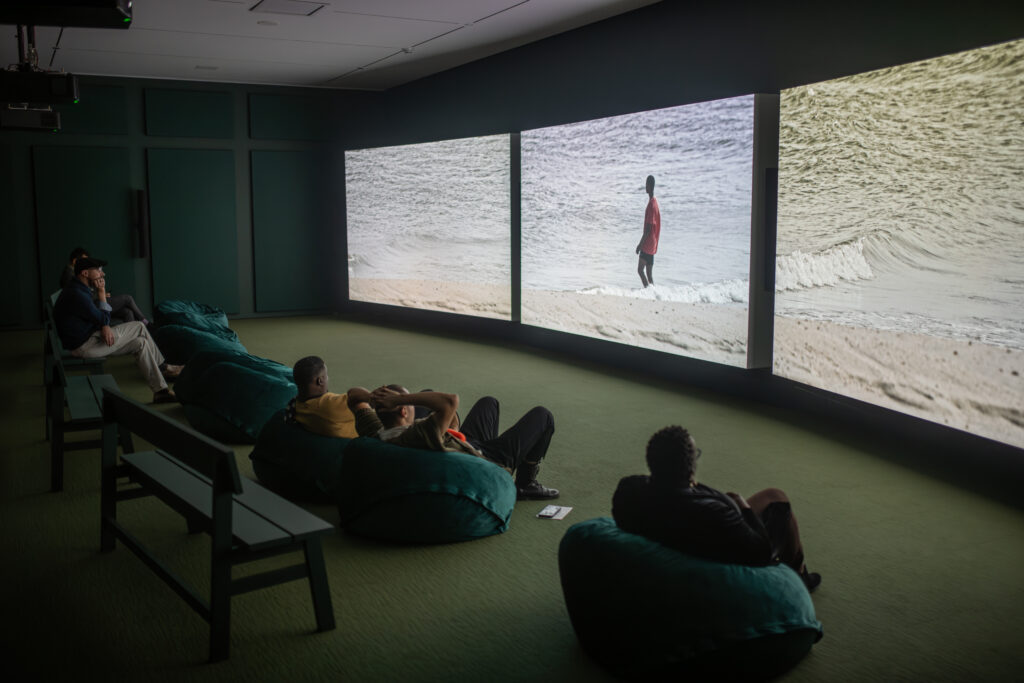
Installation view of John Akomfrah: Four Nocturnes at Wrightwood 659, 2024, © John Akomfrah; courtesy of Smoking Dogs Films and Lisson Gallery. Photo: Daniel Eggert (@DesigningDan).
Question and Conclusion
What might it mean to acknowledge the incomprehensibility of climate change and still face it, without expecting to fully grasp it? What can we learn from the way artists respond to that vastness to help shape our own collective & individual response?
Bibliography
Morton, Timothy, Hyperobjects: Philosophy and Ecology after the End of the World, Minneapolis: University of Minnesota Press, 2013.
Sean O’Hagan, “John Akomfrah’s Purple: An Artistic Meditation on Climate Change,”The Guardian, October 1, 2017, https://www.theguardian.com/artanddesign/2017/oct/01/john-akomfrah-purple-climate-change.