Educator Insight: Ben on Colectivo Ayllu
How is history remembered? As a group of migrants, people of color, and queer and sexual-gender dissidents from ex-Spanish colonies, Colectivo Ayllu takes political and artistic action against the dominating voices of white supremacy, heteronormativity, and European colonial ideologies in history. Their 2020 lithograph titled No nos culpen por lo que pasó [Don’t blame us do what happened] overwrites a 1594 print by Theodor de Bry depicting Balboa and the Spaniard’s massacre of the Cueva people, specifically the two-spirited individuals who held celebrated roles in Cueva society. According to anthropologist Michael Horswell, the existence of the two-spirited Cueva “introduced a crisis into the Spanish patriarchal paradigm.”[1] In response, the Spanish violently imposed their colonial hierarchies. Theodor de Bry recorded the events in a strict composition. Theodor de Bry depicts a hierarchy of Balboa and the Spaniards above the Cueva people, who are placed on the same level as the dogs who violently attack them. Colectivo Ayllu’s lithograph disrupts this colonial gaze. They directly call out the colonizer’s subjective, moralizing justifications for violence, quoting “they were all sodomites and they committed that abominable sin.” The dogs are highlighted orange illuminating their unnatural use as tools of violence. This colonial violence against the Cueva, anthropologist Michael Horswell describes, had the purpose to “destroy part of the people’s memory and understanding of the cosmos.”[2] Colectivo Ayllu identifies this erasure and enforced replacement of indigenous understanding of gender and sexuality as “a colonial project”, not limited to just a singular historical moment, but rather a continuous expansion into all aspects of the present.
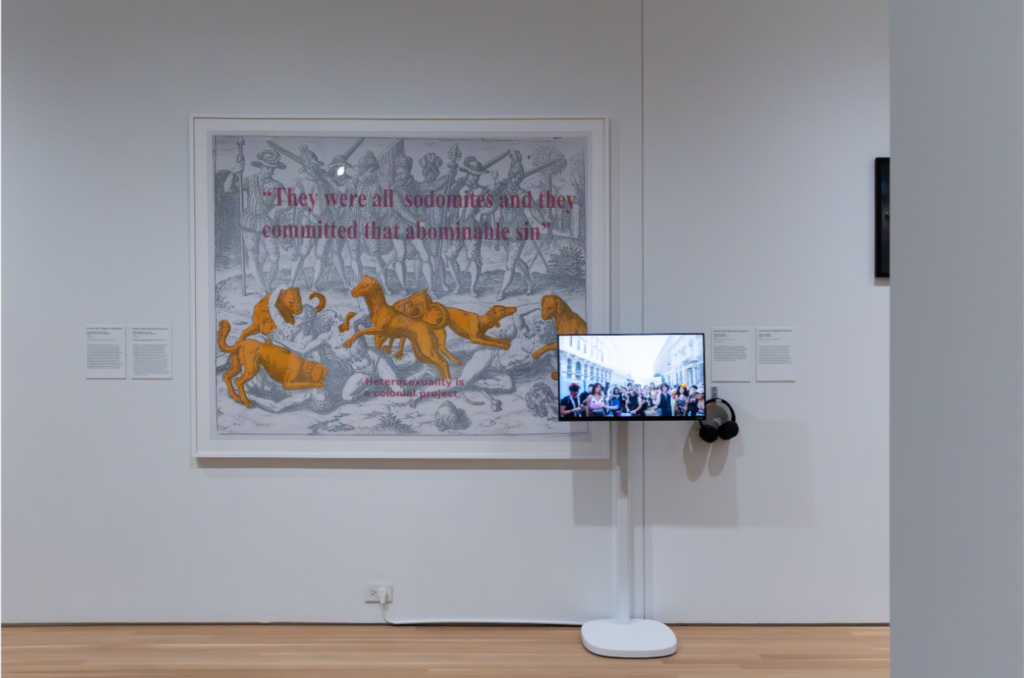
Installation view of "Dispossessions in the Americas: The Extraction of Bodies, Land, and Heritage from La Conquista to the Present", at Wrightwood 659, 2026. Photo by Shanti Knight.
Accompanying the lithograph is the video Beautiful Creatures created during LGBT pride month in Madrid. While Theodor de Bry’s composition sought “order”, Colectivo Ayllu’s video is directed by dis-order, manifesting in the form of protest. Scenes of the march through Madrid are recorded from the perspective of the crowd, actively weaving through people and posters projecting their messages of resistance across the colonizing Spanish state. Colectivo Ayllu documents the group of migrant, queer, trans, and anti-racist activists’ varying opinions and multitude of lived histories that exist against the colonial project’s singular conception of being. The march is not just an act of protest, but an act of celebration. A celebration of all that the colonial project attempts to make forgotten and claim has never been. They celebrate with make-up and clothing, with trans-affirming care, with indigenous spirituality, with dances like voguing and perreo. Like the title suggests they celebrate beauty beyond hierarchies. The most powerful act of protest against the amnestic colonial project might just be the celebration of memory. “We remember that we’re alive because of our ancestors. We resist with pleasure, we resist with our colonial wound still open.”

Video still of Colectivo Ayllu and Mirgantes Transgresorxs, "Beautiful Creatures", 2019, digital video. Courtesy of Colectivo Ayllu.
Endnotes:
[1] Horswell, Michael J. Decolonizing the sodomite: Queer tropes of sexuality in colonial Andean culture. (Austin: University of Texas Press, 2021), 4.
[2] Ibid.
Bio
Ben Planer is an educator at Wrightwood 659 and an art historian and casual collector of art.