Chryssa’s Use of Timing and Frequency
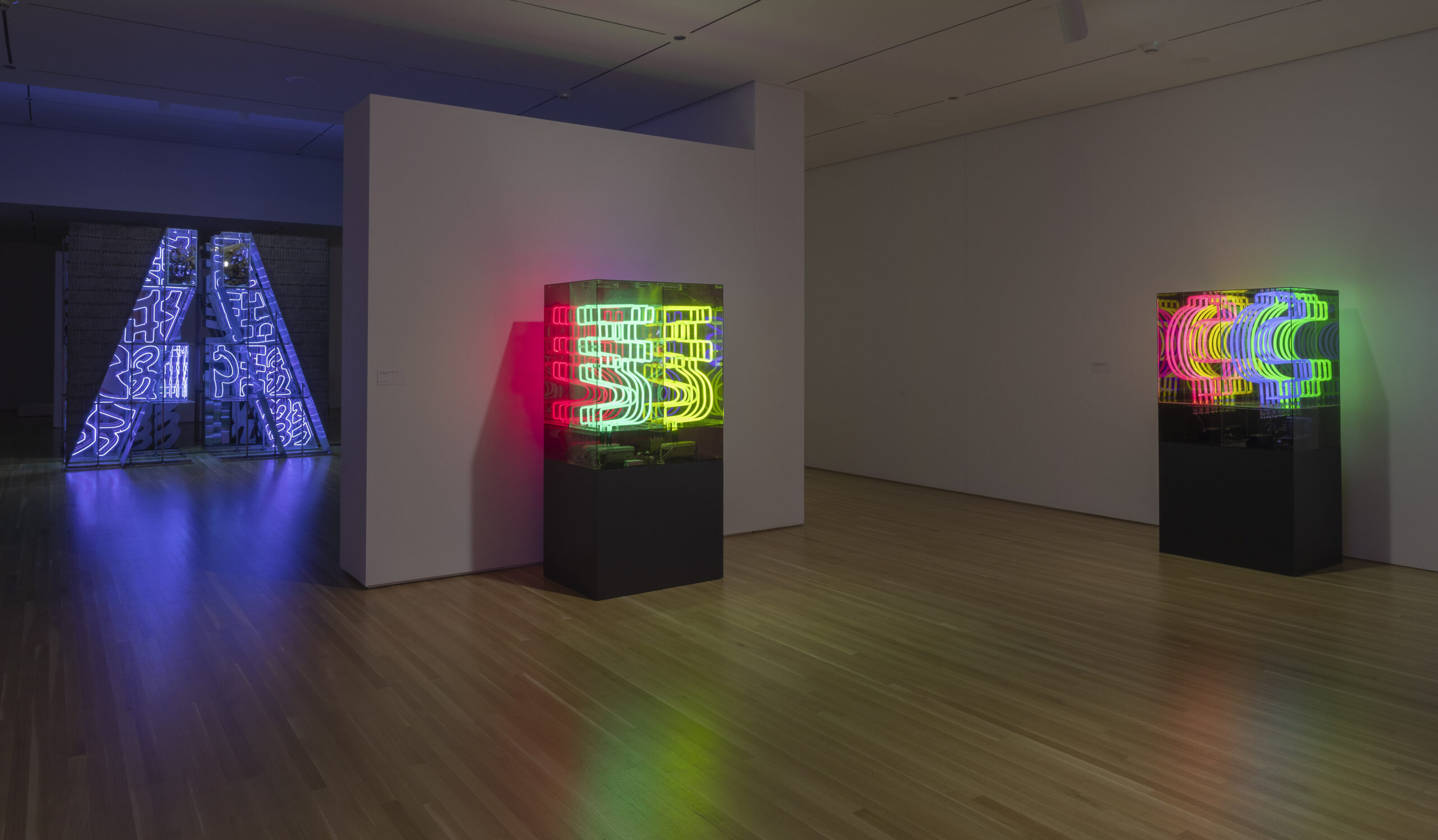
Installation view of Chryssa & New York at Wrightwood 659, 2024, © 2024 Alphawood Exhibitions LLC, Chicago. Courtesy: Alphawood Exhibitions LLC, Chicago. Photo: Michael Tropea.
By Anna Eisenman
I am an Educator at Wrightwood 659 and a digital artist. My practice explores how the technologies of our time create inner belief systems which reckon with grander technological forces outside ourselves. I focus on how art can be a space for both relaying the experience of living amongst technology, while also examining freedoms to change a technologically advanced society. In this talk, I will approach three of Chryssa’s studies for The Gates to Times Square through the perspective of the technological advancements at the time of their making and how her perspective of the post-war United States, specifically her time in New York City, is imbued within these sculptures. Through these works of art, we can discern the discontents and potential freedoms Chryssa saw in the post-war American landscape.
These three sculptures, The Gates of Times Square, completed in 1965, Study for the Gates, completed in 1966, and Cents Sign Traveling from Broadway to Africa via Guadeloupe, completed in 1968, are part of Chryssa’s larger series of studies that revolve around her monumental magnum opus, The Gates to Times Square. Each piece consists of neon letterforms on the cusp of legibility, which flicker on and off and whose glow reflects against their dark plexiglass encasement. At the bottom of the sculpture, we can see the mechanical inner-workings of the machines that power the neon elements; timers, wires, and electrical components. If we stand before Chryssa’s work in silence, we can hear a syncopated symphony of humming, buzzing, and clicks. The intensity of these sculptures, which feel like modules of contained energy, escapes from beyond their rectangular bounds and into the entirety of the space that surrounds them. Direct and prolonged communion with the works can be overwhelming; the flickering light burning after images of Chryssa’s cryptic letters into the eye, and the mechanical orchestra of whirring and ticking seeping its way into your thoughts. Through this sensory experience, Chryssa creates a mediated imitation of her experience of Times Square and New York City, a sensorium of language, lights, and sounds which Chryssa was attuned to and inspired by.
In 1950s and 60s America, there was a rapid growth of individual consumerism bolstered by the technological advancements produced by the American Military Industrial Complex during World War II. When the war ended, the titans of industry which were producing vast quantities of munitions, pivoted to household consumer products. A crucial player in America’s industrial boom was plastic. Plastic derived products such as Teflon that were previously used for containing volatile gasses for atomic bombs were now used to coat pots and pans. Another, plexiglass, once used on military aircraft, was now being experimented with by artists in their studios. With this boom of industry came increased employment and an overall increase in GDP. There was an overall feeling of shaky abundance in the air.
Chryssa first arrived in the US during this industrial renaissance in 1952 and later settled in New York in 1956. Prior to this time, she had only ever known Europe, especially her birthplace,Greece, and France, where she briefly studied. These countries were nearlydestroyed by World War II and Nazi Occupation. Left to rebuild in economic and political distress, the artistic communities of Europe were disrupted as well. Chryssa left behind the rubble of post-war Europe, with its bombed-out buildings, mass casualties and a culture forced to rebuild itself from Fascist dregs. She arrived in New York City to find the United States rising from the boon of post-war fallout into a shiny facade of industrial and consumer wealth. Upon arriving, Chryssa is utterly awe-struck by Times Square, with its plethora of flashing lights and collage of multiple languages in signs and advertisements. As Chryssa said, “the whole of Times Square was to me a place that I could easily gather [the whole] of America.”
This whole of America which Chryssa saw within Times Square was vulgar and blunt, yet also imbued with a kind of “Homeric wisdom” and poetic potential. The gaudy, brightly lit advertisements which animated the streets of Times Square was where Chryssa looked for inspiration and materials for her work. She would scavenge through so-called sign graveyards and collect the discarded metal channel letters which she would then manipulate, fragmenting their function as communication and creating abstracted forms which straddle the line of decipherability.
By comparing the abstracted forms we see in Study for the Gates, and The Gates to Times Square with the somewhat legible cent-sign form we see in Cents Sign Traveling from Broadway to Africa via Guadeloupe, this series of work can be viewed through the lens of currency and commodity, creating an awareness of the certain time and place in which the letter fragments are drawn from. Chryssa’s use of the smoky-gray plexiglass walls, a novel plastic primarily used in the fabrication of consumer products, was cutting edge in its time and was intended to mimic the nocturnal experience of Times Square; neon lights flashing underneath the smoggy night sky of Manhattan. While neon signs were popular and plentiful at the time, they had never before utilized as an artistic medium and were tightly controlled by union laws regulating who could and could not be trained to create them. Chryssa was among the first to work alongside neon fabricators to create her sculptures, and became a pioneer combining the commercial and artistic arenas.
By exposing the mechanical “guts” of the piece, the technology which makes the sculptures “work” Chryssa draws the viewer’s attention to the work’s technological reality. This integrates the technology into an aesthetic experience. She assigns poetic meaning to these mechanics by fusing the industrial and the artistic. Revealing the mechanism that allows the sign to function is an artistic choice, contrary to the giant commercial neon signs on the street, in which wires and mechanics are often disguised from pedestrians. By exposing the technology within the sculpture, the mechanics becomes recontextualized out of the world of the commercial and into an aesthetic realm, thus creating new meaning within the mechanisms’ utility.
Chryssa felt that the element of time, which the exposed mechanical equipment illustrates, was one of her primary sculptural interests. She says the internal timer represents, “freedom and possibilities”, while also supplying her with, “precision and control”. The timer which enables the flow of electricity to the neon tubes gives Chryssa opportunities to wield the artist’s hand in the movement of light. Chryssa can control, through moments of darkness and illumination, the way the viewer accesses and perceives the sculpture. For example, how long one stands in front of it, as with Studies for the Gates #2 where the neon is extinguished for 57 seconds and then on for only 3. However, Chryssa felt that there was no “on” or “off” for her sculptures, rather she says, “The dark interval is never long enough for me. I do not expect or want anybody to wait for the moment when the sculpture lights up. […] I look THROUGH [them] all the time. The sequence repeats itself ad infinitum”.
In this quote, Chryssa brings up a contradiction between the human understanding of time and the mechanical expression of time. The mechanical understands time through distinct intervals, 12 seconds on, 40 seconds off, automatic and unfeeling. Whereas we can experience the timer on a continuum. Repeating itself to infinity, the timing sequence can continue seemingly forever. When the gallery is closed and everyone has left, the sculptures can plausibly illuminate and return darkness, on and off, continuously and unruptured. However, the mechanical nature of the work, made detectable to the viewer through its visible mechanisms and its sonic chorus rupture the illusion of that infinity. The exposed inner devices beckon to the sculpture’s artifice, and we are reminded that the timer can break, the plug can be unplugged, the electricity can be cut.
Chryssa was able to reckon with an experience of a mechanized and “vulgar” society through these sculptures, which draws from the experience of post-war New York City—and the United States as a whole. The streets filled with larger-than-life displays of power and wealth, neon and mechanical advertisements manufacturing a farce of magic, signs suspended in air, miraculously lit with kaleidoscopic colors, each communicating something separate, in whole creating a visual system of language that Chryssa drew from to create her own personal lexicon. The colossal flashing lights high in the sky among the skyscrapers grab the attention of pedestrians, however agnostic they actually are to their existence. The lights stay on with or without people present to see them. Perhaps Chryssa saw the grandeur and omnipresence of Times Square as similar to the ruins of the Parthenon in Greece. Once a place to worship and submit to Gods, now a ruin, a monument to past beliefs and past civilization. Perhaps in the American landscape, Chryssa saw a civilization not yet close to ruins, but imagined what those ruins would be. So can her studies be seen as ruins of American industrial society.
Chryssa’s works deploy the language of neon advertisement, but instead of lighting up and projecting something “distinct” or understandable, her works illuminate an abstract lexicon, which do not “say” anything explicit, rather, they point directly to an experience. The experience of walking along Times Square, surrounded by a bombardment of commercial activity. She mediates this experience of Times Square through her sculptures, lone neon lights encased in dark smog, endlessly repeating themselves, removed from the viewer by an artificial haze. She distills the sensory atmosphere, and through that distance from the actual place, we are able to meditate on the experience of living among a technologically intertwined modern society.
Chryssa was enticed by the monolith of the United States because it felt like a culture with no real “past”, when compared the ancient civilizations of Greece, saying, “I was drawn to America which was a country, I thought, a country of barbarians. Therefore, that self-expression was more possible to me. Of course, being Greek and going 3,000 years back in the history of art … the tradition of America was not so impressive… I needed a new space, a new communication”.
During this time, many artists were preoccupied by questions of how to assert individuality and freedom in an increasingly mechanized society. Chryssa sought the poetics to be found within the mass-produced urban landscape. Within the cold detachment of mechanized society, Chryssa collected fragments of signs, lights, sounds, and with it created work which conveys her unique experience of American post-war society, both detecting the fear of an impending mechanized subjectivity, as well as encouraging the artistic potential within the industrialized sphere.
Chryssa’s work embodies this contradiction of technological advancement provoking rumination on whether these technologies allow us more or less freedom. Perhaps through her outsider’s perspective, Chryssa is sensitive to the precarious abundance and over-ripeness of post-war America. It lends her a new space of artistic creation, and forges a space for new meaning to emerge through her manipulation of industrial materials. Working with the materials of her time, Chryssa points to the tensions between the potentials as well as setbacks of technological progression. Industry and technology can often feel so obfuscated and out of reach, hard to grasp, Chryssa’s work showcases the ability to act upon our environment, using our environment as a poetic and creative outlet. Chryssa exemplifies how an artist can capture the society they live in, in order to point beyond the current existence.
Join E-News
Please sign up to receive our weekly E-News, full of timely and insightful information about our exhibitions, artists, and programs.
Spring's Most Anticipated Exhibitions are on Sale
"Martin Wong: Chinatown USA"
"Dispossessions in the Americas"
"Statue of Athena" on long term view.