Chryssa’s Americanoom
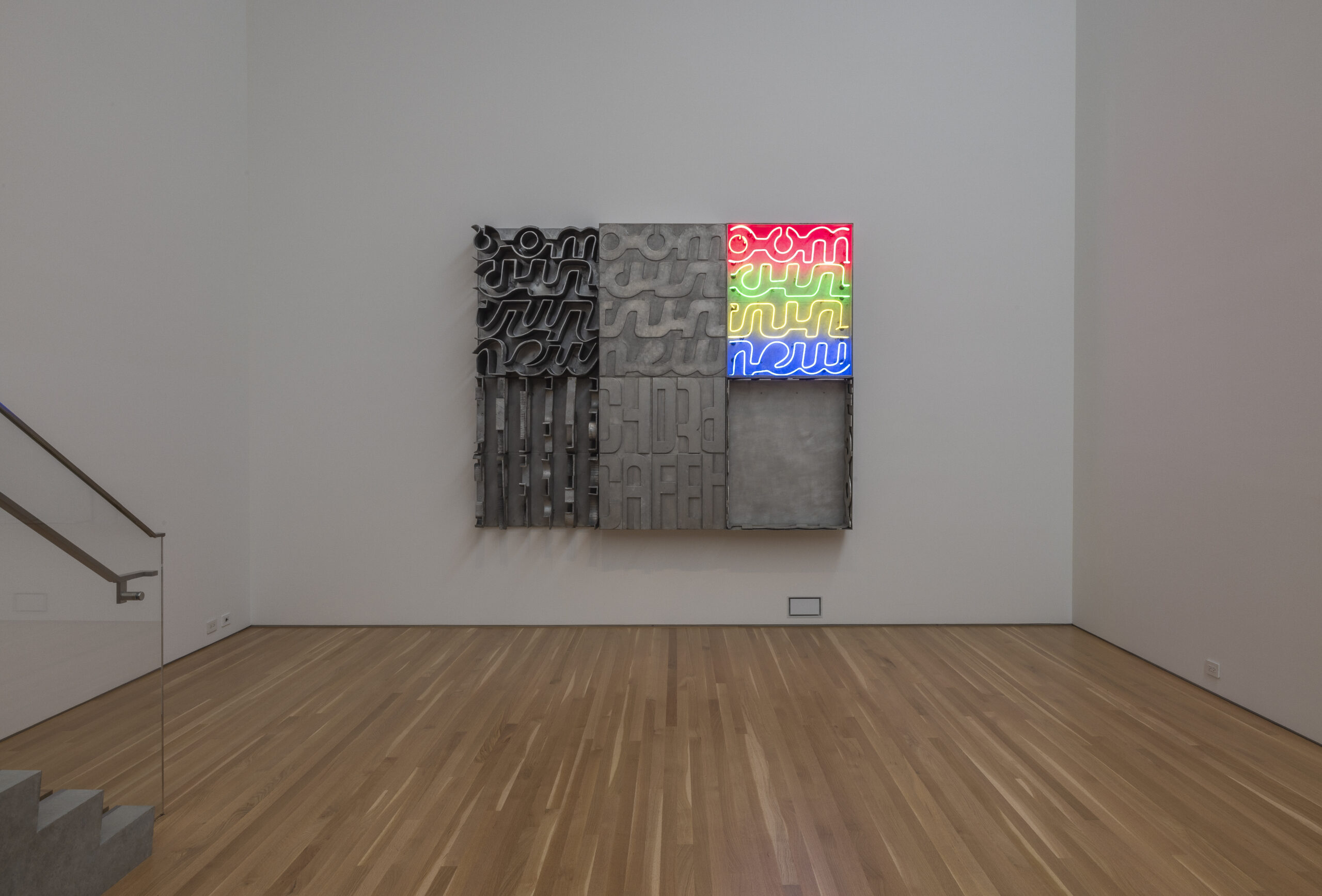
Chryssa, “Americanoom,” 1963. Aluminum, welded steel, stainless steel, and neon, 90 x 108 in. (228.6 x 274.3 cm). Collection of the Lowe Art Museum, University of Miami (Coral Gables, FL). Gift of Mr. and Mrs. Aron B. Katz, 82.0226 © The Estate of Chryssa, National Museum of Contemporary Art Athens.
Photo: At Wrightwood 659 by Michael Tropea
By Erica McKeehen, Wrightwood 659 Educator
Chryssa and New York assembles Greek-born artist Chryssa’s luminous sculptures, prints, and paintings that she made while she lived and worked in New York City in the 1950s-1970s. As a documentary image-maker, I have always been interested in visual art as an artifact that can document and express humankind’s lived realities. More, I am curious about what we can glean as common narratives about a place and time after engaging with these artifacts. Viewers can better connect to “Chryssa’s New York” via close looking at her use of fragments from the urban environment to construct her elaborate 1963 piece, Americanoom,
Born in Athens in 1933, Chryssa grew up under the Nazi occupation of Greece and was imprisoned on three separate occasions as a child during the German and Italian occupation. In later interviews, she recalls seeing how the Greek resistance fighters would write anti-fascist messages on the walls at night– early demonstrations of the power of letters and words– only to be erased later by the Axis forces each morning. In 1955, years since fleeing Greece and after studying at the California School of Fine Arts in San Francisco, Chryssa became a United States citizen and established a studio in New York— where she experienced the awe-inspiring spectacle of Times Square for the first time.
Chryssa viewed the urban landscape as a bright new world of artistic possibilities. For her, sculpture’s past was tied to the heavy origins of Western art and its foundation in ancient Greece. Upon arriving in New York, she found liberation from her idea of art’s historic past by utilizing the city’s array of industrial refuse— like neon tubing, stainless steel, lead, and metal— in novel ways. Following WWII, New York City was donned the “crossroads of the world” and was becoming an electrical environment of industry and consumption. Chryssa embraced the way pulsing, bright lights, metal signage, and language from advertising dominated the city. The perpetual flashing lights of New York City are thus expressed through Chryssa’s use of flashing, colorful neon letters in the upper right-most quadrant of Americanoom.
Fellow European émigré’ Ernst Haas’s color photographs of New York City made between 1952-1962, as Chryssa would have seen it while she lived there, present the same place and time (New York City in the 1960s) as Americanoom, and similarly are beaming with colors, textures, and lights. When Ernst Haas moved from Vienna to New York City in 1951, he left behind a war-torn continent and a career producing black-and- white images. For Haas, the new medium of color photography was the only way to capture a city pulsing with energy and humanity.
Although expressed through sculpture rather than color photography, Americanoom, like Haas’ images, utilizes colors, textures, and lights to reflect the vibrant and energetic essence of New York City in the 1960s. To construct the piece, Chryssa sourced the materials used in the piece (aluminum, welded steel, stainless steel, and neon) from the urban landscape itself and often salvaged material from local sign graveyards, interested in repurposing tools of mass communication. Her reworking of the same letters over and over within Americanoom mimics the repetitious nature of language in cities.
Ever questioning the authority of language, urban relics of advertising gave way to Chryssa further disturbing the status quo in her art. While her contemporaries— like Jasper Johns— were also starting to incorporate the alphabet into visual works, they treated letters as emblems and icons, addressing modes of perception and knowledge, Chryssa Implemented letters as aesthetic forms instead of carriers of meaning. Even though every now and then Chryssa’s playful tendencies reveal recognizable language within her work– words like “café” or “new”– our inevitable human urge to decipher and understand meaning when words are involved cannot be fully satisfied! And as much as we want to “read” her works like sentences, our inability to is a powerful metaphor for humanity’s ongoing complicated— yet fascinated— relationship with communication and language.
In closing, Ernst Haas, attempting to convey his view of post-war America through the specific lens of New York City, gravitated toward some of the same visual facets when photographing as Chryssa did when sculpting and fabricating. Both artists’ portrayals of the same place (New York City, New York, in the United States of America) during the same time (the 1960s, following WW!!) resonate with life, connection, and bustling industry. No doubt contemporary artists who depict New York City latch on to the some of the city’s same timeless formal aspects and qualities.
Join E-News
Please sign up to receive our weekly E-News, full of timely and insightful information about our exhibitions, artists, and programs.
Spring's Most Anticipated Exhibitions are on Sale
"Martin Wong: Chinatown USA"
"Dispossessions in the Americas"
"Statue of Athena" on long term view.