Chryssa from the Perspective of a Neon Artist
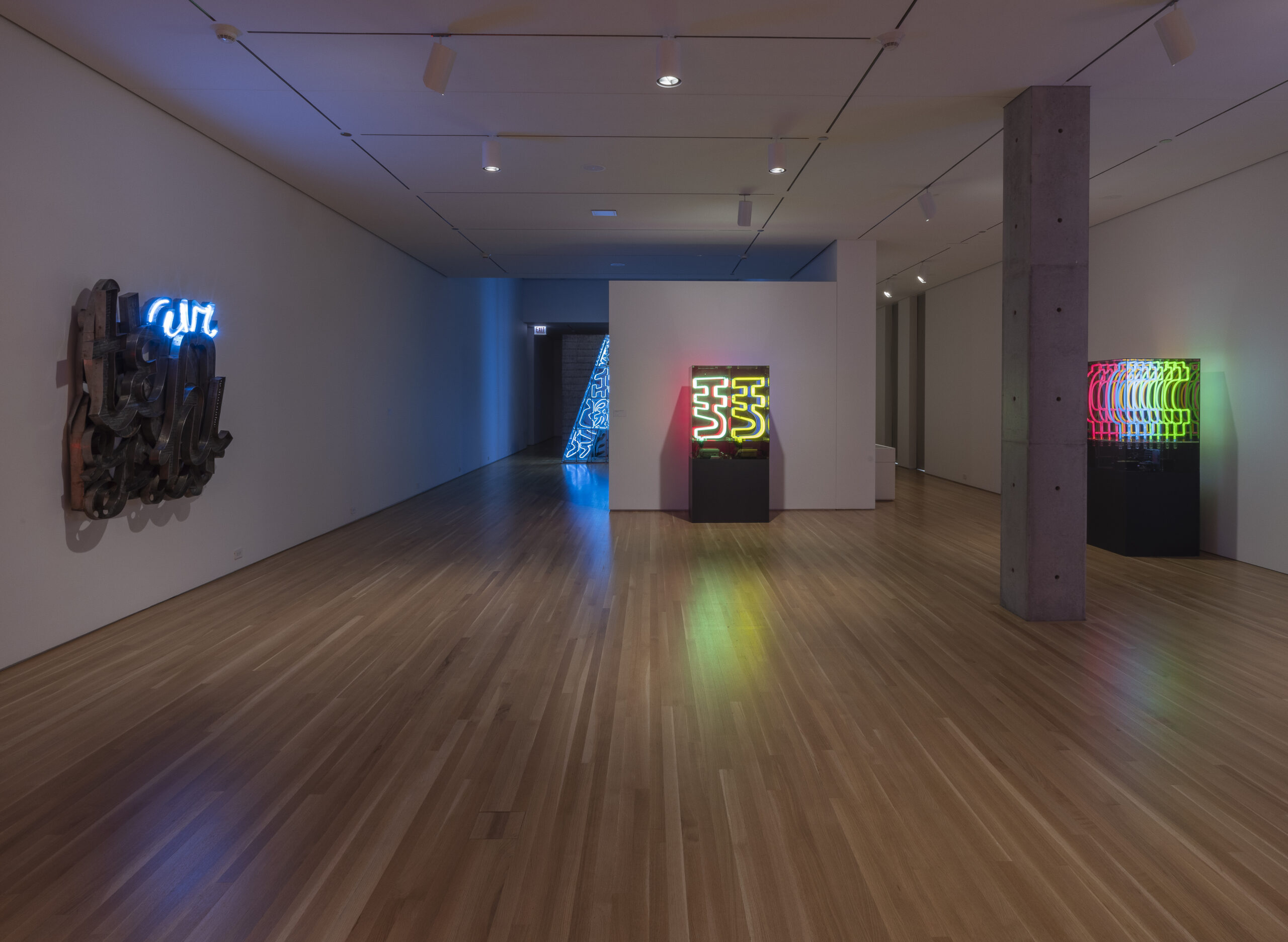
Installation view of Chryssa & New York at Wrightwood 659, 2024, © 2024 Alphawood Exhibitions LLC, Chicago. Courtesy: Alphawood Exhibitions LLC, Chicago. Photo: Michael Tropea.
By Emma Varano, Wrightwood 659 Educator
When I first found out about the exhibition, Chryssa & New York, and that it would be traveling to Chicago, I jumped at the opportunity to work as an Educator. Despite Chryssa’s insightful and ever-relevant body of work, I had never heard of her, save for an excerpt by my professor who met her once. He was working in a commercial sign shop in Chicago right out of grad school, and a woman with a large fur coat bustled in. With an elaborate air, she rushed through the studio, held her nose up, and scoffed and left soon after—my professor’s coworker turned to him, and said:
“That was Chryssa.” To which he said, “Who?”
When we think of neon signs, there is an incontestable association with its history as a way to advertise anything from produce to alcohol to the pornography theater marquees that populated the Times Square landscape on 42nd Street. This would have been its state as Chryssa first encountered it. As a Greek immigrant to the United States during the latter half of the mid twentieth century, Chryssa had a sort of grotesque fascination with American language, culture, and industry that was mirrored in the excess dynamism of Times Square. She took the thousands of images projected by the urban landscape onto its inhabitants and literally chopped them up, welded them together, and transformed them across her deliberative compositions. She used her art as a form of research and critique of the heartily commercialized art world and American consumerism in general—which we can see in Chryssa’s 1968 sculpture, Cents Sign Traveling From Broadway to Africa via Guadeloupe
The neon elements are broken into four colors, in four rows, and in four quadrants. Underneath Chryssa displayed the transformers and analog hardware that makes the piece flash on and off. The glass itself is layered,and follows the curves of the tubes! Her treatment of glass and language is itemized but seems endless, echoing the culture she was reacting to and working within. Additionally, Chryssa appreciated and elevated the wiring of neon, rather than hiding it. The transformers, the original animation programming, and the wiring and electrodes are clasped together—all illuminated by the timed glow above.
Chryssa’s consideration of form and function was unique. Other artists working with neon were not thinking as three-dimensionally as her, which points to her ardent insistence that she was a sculptor first, never accepting the sole moniker of a “neon artist”. This is why I am particularly drawn to Chryssa’s work—she considers the whole tube and treats it as something beyond a flat animation. The glass is a vehicle to the vocabulary of Chryssa’s art, rather than relying on the limiting allure of nostalgia that I see most neon art fall into. She sculpts and critiques with illuminated line. You can also observe this in Chryssa’s use of a timer in Study for the Gates #2. In this sculpture, neon has designed two periods of darkness and illumination. With the neon elements being illuminated for 3 seconds, and then off for about twenty-seven.
In numerous lectures, Chryssa describes having never been satisfied with the length of time that the sculpture remains in darkness. Because of the effect induced by the timer, we as viewers are drawn in to it like moths to flame. As we stand in front of it, waiting in anticipation for the moment of splendid light, we observe our own image reflected back at us on the plexiglass’ shiny surface, prompting us to examine ourselves as spectators. In this piece, Chryssa challenges our patience and asks us: What if the work of art doesn’t accommodate our preconceived notions of what it is or is supposed to do? Ultimately, do we seek satisfaction or do we desire to examine how and what we see? Chryssa wants us to sit in the room with her.
Contrary to the comforting belief that art is eternal and timeless, Chryssa staunchly believed in the ability of her art to both change over time and yet remain worthy of aesthetic appreciation, saying“the transformers will eventually wear out. Fortunately, there is the sun and the moon, day and night. Without electricity, my sculpture will still survive.” Chryssa knew that the technology controlling the neon would eventually become obsolete, but was adamant that her work would remain light sculptures even without the pulsating artificial illumination. To make a comparison to painting, this is like if a painter took into account the eventual deterioration of their canvas while still planning its composition. Or, the affects of ultraviolet light and aging linseed oil that would alter their original color palette over time. How does the approach to making art change when one acknowledges its material “limitations”, or, in the case of Chryssa, how can these “limitations” inspire new artistic forms?
As a neon practitioner, I find Chryssa’s Study for the Gates #14 and Study for the Gates #15, very compelling due to their rare glass tubes. The tubes are filled with the same gas combination as we see in The Gates to Times Square but instead of being pumped inside of clear glass, they are inside blacklight tubes. The neon tubes we see here were fabricated just in 2023, a full decade after Chryssa’s death, by a multi-national team of conservators, neon-benders, and other craftspeople to replicate the original tubes as closely as possible. The only reason these replicas were made was because Chryssa’s originals are too fragile to travel long distances. We can hear the hum of the piece, the shapes she originally designed, but Chryssa does not know the sculpture as we do now. Its swooping bird shapes rise and fall, echoing her established visual poetry.
Chryssa was an incredible artist, and the ways she approached glass has really important critiques to consider in today’s age. She was making work after the neon industry was already becoming defunct, and today neon has been replaced almost completely by LEDs. Now that the industry has faded into technicolor daydreams, her practice is especially important as we consider what it means to work with media that is increasingly supplanted by newer technologies, just like photography changed painting, LED changed neon, and as AI is on our current creative horizon. Chryssa imparts to us a metric that implores us to consider why, where, and how we do what we do.
Join E-News
Please sign up to receive our weekly E-News, full of timely and insightful information about our exhibitions, artists, and programs.
See Them First–Spring's Most Anticipated Exhibitions Now on Sale
"Martin Wong: Chinatown USA"
"Dispossessions in the Americas"
"Statue of Athena" on long term view.