Chryssa and the Flame of Prometheus
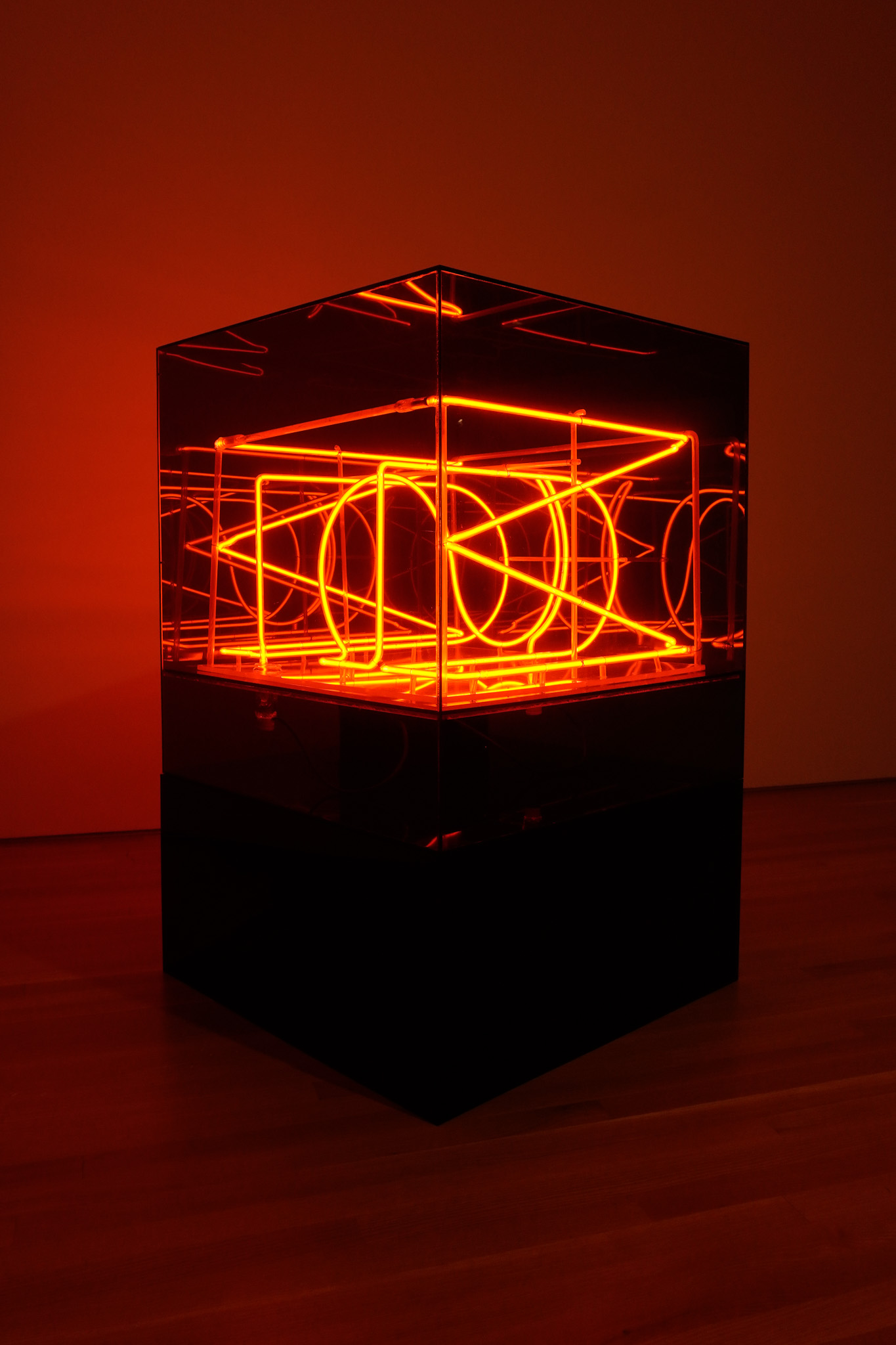
Chryssa, First Preparatory Work for a Neon Box, 1962. © Εstate of Chryssa, National Museum of Contemporary Art Athens.
By Zaid Khan, Educator at Wrightwood 659
When I first saw Chryssa’s 1962 sculpture, First Preparatory Work for a Neon Box, I was pierced by its dispassionate glare. I spent my time as an Educator thinking about this sculpture, and its cousins on Wrightwood 659’s second floor. In this text , I’m going to consider the poetics of neon and propose a theory on why they astonish us, and why they astonished Chryssa, by drawing comparison to the ancient Greek myth of Prometheus.
I wonder, what inspired Chryssa to create sculptures in fiery neon that pierces the dark? The myth of Prometheus will be helpful for us here. The king of the Greek pantheon, Zeus, forbade humanity access to the divine fire, fearing that they would grow powerful and independent of the gods’ divine mercy. The far-sighted Prometheus, friend of humanity, stole this divine flame and delivered it upon humans. This flame was no mere element, it was the fire of invention from the forge of Hephaestus, God of artisans and craftsmen.
The fire delivered by Prometheus is not just a symbol in a story; the very ember which ignited human invention to build marvelous cities and machines flickers within Chryssa’s sculptures. If you have driven along a highway towards a city and seen the skyscrapers and city lights come up over the horizon, then you have seen the flame of Prometheus burning still. And when you look at Chryssa’s electrified sculptures, you see the fire here as well. This line of thinking is the key to understanding what Chryssa loves about neon. Neon is a very human type of light, neon demonstrates human brilliance.
Besides the beautiful aesthetic of their luminous effect, Chryssa deeply admired the craftsmanship of designing and building neon forms. In an interview with Ann Geracimos titled “There’s Only So Much You Can Put on a Hot Dog,” Chryssa says, “those neon sign makers really knew what they were doing, I think. They are really very clever the way they handle light—the tinting, the shading, the contrasting colors”. She obviously admires the craftsmanship that goes into these sign works. But beyond just the craftsmanship, there is the inventive engineering of it. Craftsmanship is intelligence of the hands; engineering is intelligence of the mind. Both these elements hover inside her sculptures.
We as a species have always been dazzled by bright lights. Whether it is a crack of lighting across the sky, or the reflection of the shattered sun on the lake, or even the pulsing embers of a dead fire. All these lights can feel hypnotic. But neon feels like a different species of light altogether.
When Chryssa looked to the neon forms which enlivened and illuminated the 20th century city, she became mesmerized by its synthesis of the natural, the inventive, and ultimately ethereal qualities which she strove to capture and convey in her art. In the aforementioned interview with Geracimos, Chryssa says, “I’m interested in light and air and space” and then later “The neon is glass. It is extremely fragile to work with. And the color it makes are beautiful. They are almost unreal. I take the neon and bend it. I put it behind glass, like glass within glass […]Glass is made of sand, light, air, the natural properties. Glass within glass, like a mirror within a mirror, the ultimate eye.”
To Chryssa, her neon sculptures represent the natural world altered through the craftmanship and ingenuity of humanity. Fragile, ethereal, intricate, refined. These are all words of a Hephaestion pursuit. In her neon sculptures, Chryssa continuously pushed her materials to their limits to create delicate yet far-reaching forms.
Though the final form of her neon sculptures emits an other-worldly beauty, they all get their start in natural elements, such as the sand that melts to form glass, or the chemical gases which radiates colored light upon interaction with electric currents. Across human history, the scientifically-minded among us have transformed mundane materials into transformative inventions. Chryssa continues these mutations and manipulations in her own practice akin to artistic alchemy.
Chryssa compares her methods to that of a scientist, saying “art is science. I feel like Jules Verne, exploring the world of nature very scientifically”, as well as, “signs have tremendous energy and depth. I want to get inside them, to study them from all angles, to turn them inside out”. She achieves just this in First Preparatory Work for a Neon Box.
When I look at this sculpture, I see a flame unspooled into thread and then pulled taut into shapes like cat’s cradle or a five-finger star. It reminds me of Prometheus, and the internal flame which ignites curiosity and propels human ingenuity. In her own words, Chryssa describes her fascination, near obsession, with studying and understanding the magnetism which emanates from signs and symbols. Through her neon sculptures, she at last captures and recreates this phenomenon, imbuing them with the essential human fervor for crafting new worlds.
Join E-News
Please sign up to receive our weekly E-News, full of timely and insightful information about our exhibitions, artists, and programs.
Spring's Most Anticipated Exhibitions are on Sale
"Martin Wong: Chinatown USA"
"Dispossessions in the Americas"
"Statue of Athena" on long term view.