Educator Insight: Liv on Frau Diamanda's "Transversiva Post Andina Revolucionaria, El Regreso"
Frau Diamanda, “audiovisual transvestite artist, drag performer, independent curator, DJ and occasional actress who defines herself as a “cultural infector’,” dresses to kill in her performance piece Transversiva Post Andina Revolucionaria, El Regreso (Transversal Post-Andean Revolutionary, The Return).[1] Photographs of El Regresso subvert the assumption that war and revolution are tied to militant masculinity and submissive femininity. By reenacting scenes of war and focusing on female revolutionary powers in Peru, Frau Dimanda invites us to imagine a more radical present and future, where femininity, transvestism, and gender transgression help us encounter alternate herstories centering non-dominant narratives of strength and resistance.[2]
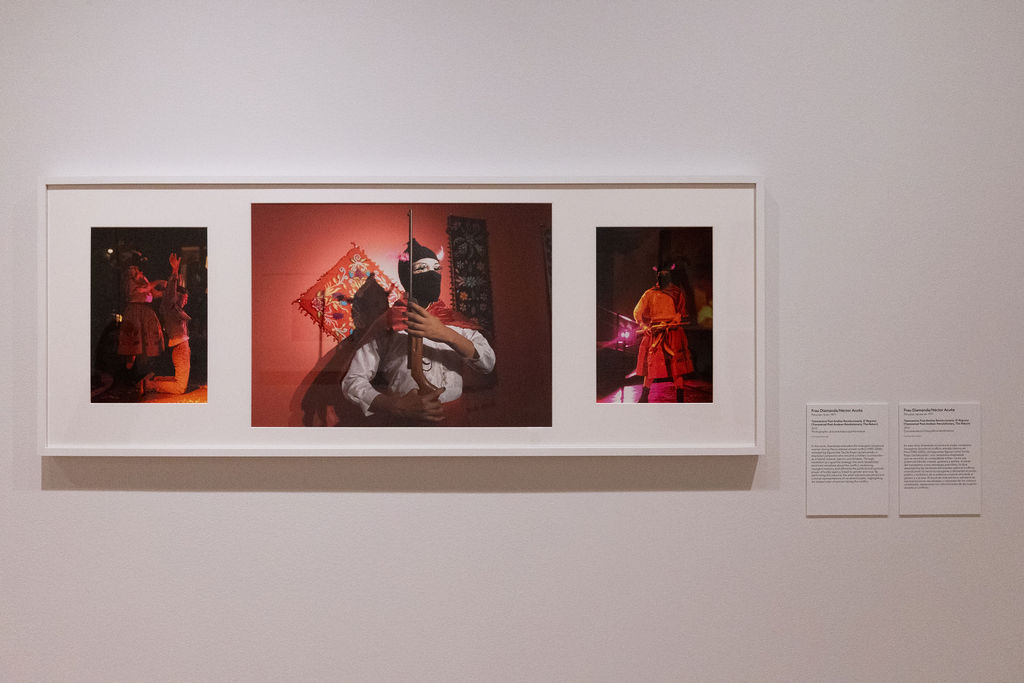
Installation view of "Dispossessions in the Americas: The Extraction of Bodies, Land, and Heritage from La Conquista to the Present", at Wrightwood 659, 2026. Photo by Shanti Knight.
Throughout the 1980s and into the early 2000s Peru experienced an internal armed conflict between the nation-state and left-wing revolutionary parties.[3] El Regreso utilizes dress, video projection, music, weaponry, and the body as a mode of remembering this violent moment in the Peruvian Andes. However, instead of recreating warfare for the sake of celebrating a patriarchal or patriotic history, the performance emphasizes feminine, classed, and culturally specific imagery to connect displaced Andean women and gender deviants across space and time. Frau’s clothing resembles that of Andean cultures: a red lliclla draped around her shoulders and a chumpi, woven belt, tied across her waist.[4] She also wears a pollera, layered skirt, which has origins in the early colonization of Peru and can be found in a variety of Latin American cultures.[5] These culturally specific items are paired with a black mask that covers the entire head, leaving just the eyes visible. Two hot pink feathers adorn the mask next to each eye, and long silver lashes peek out to meet the audience.
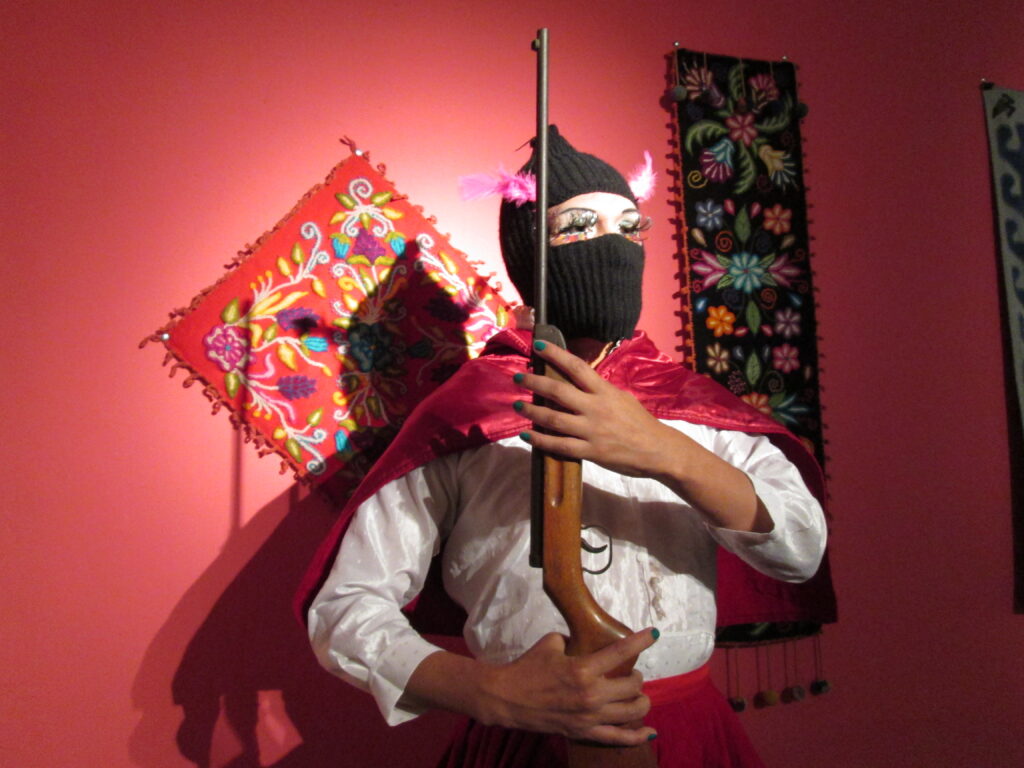
Frau Diamanda, "Transversiva Post Andina Revolucionaria, El Regreso", 2012, photographic documentation/performance. Courtesy of the artist.
What the photographs do not capture is the speed projected images flash onto the artist, the lively songs playing over the performance, and the artist’s interaction with her audience. Archival images appear on the wall behind Frau Diamanda as she does push-ups and stalks the crowd with her gun.[6] Projected letters spell out words from the Quechua language, “warmi” and “mamaku”–approximately meaning woman and maternal/matriarchal figure.[7] [8] Her references to indigeneity extend from language to clothing to the electronic music playing, which utilized Andean wind instruments and the Spanish language in a Euro-dance mix. [9] [10]
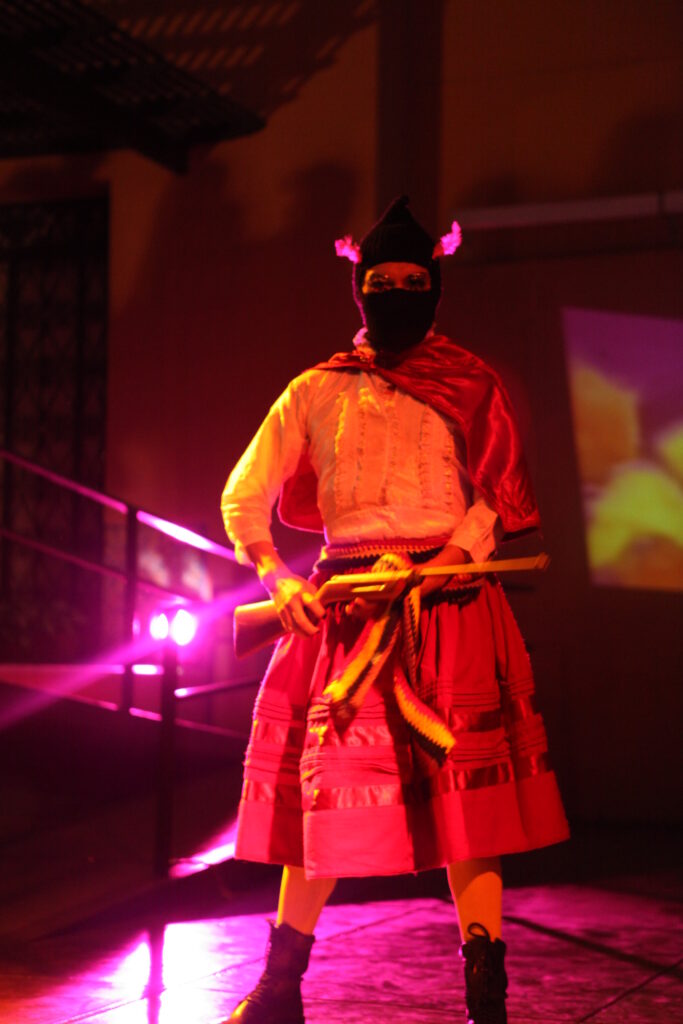
Frau Diamanda, "Transversiva Post Andina Revolucionaria, El Regreso", 2012, photographic documentation/performance. Courtesy of the artist.
The final action of El Regresso involves Frau Diamanda blindfolding a guest performer, binding his wrists and ankles together. Frau frames women as in command, trained to overpower men, and disrupts the notion women in unstable historical moments are essentialized victims, relying on men for survival. Assumed power dynamics are inverted, and femininity, often rendered peripheral to combat, becomes the enactor of restorative violence. By tying up the male performer Frau Diamanda loosens the restrictions placed on women’s history. A hybrid representation of cultures and eras results from the multimedia, multilingual, and multidimensional performance piece, as Frau embodies the feminine, transvestite, indigenous, guerrilla warrior.
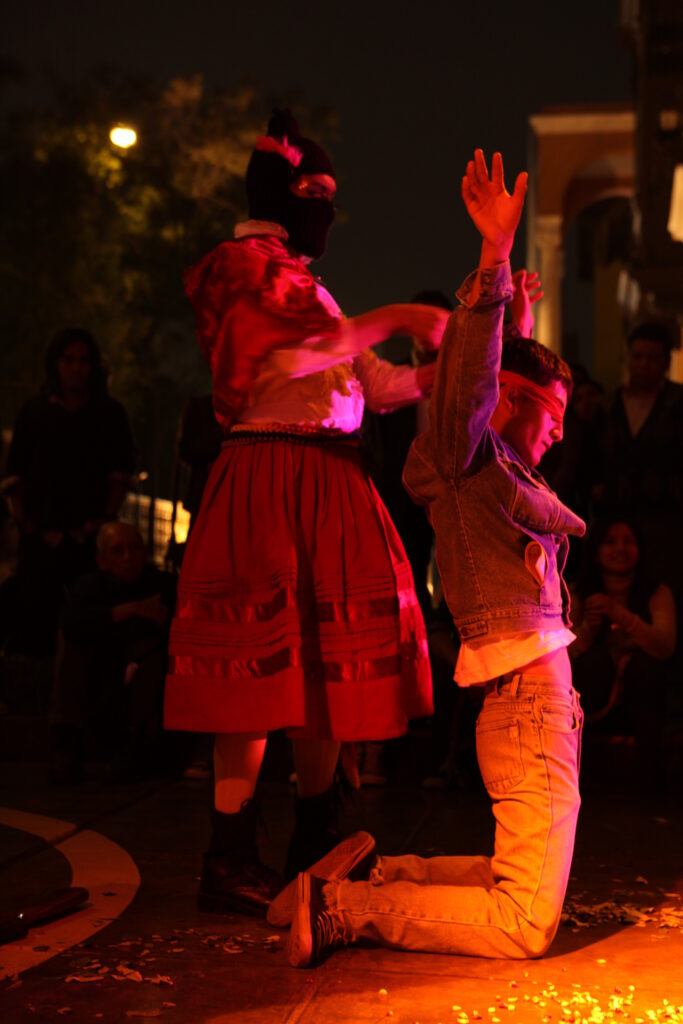
Frau Diamanda, "Transversiva Post Andina Revolucionaria, El Regreso", 2012, photographic documentation/performance. Courtesy of the artist.
Endnotes:
[1] “I Declare Myself a Transvestite on Four Stages Multimedia Performance by Frau Diamanda.” Museo Nacional Centro de Arte Reina Sofía, https://www.museoreinasofia.es/en/activity/multimedia-performance-frau-diamanda.
[2] “Herstories” emphasize women’s perspectives, voices, and contributions to history, often from a feminist lens; the term is used to reckon with our societies overemphasis on male-centered and patriarchal retellings of the past that continue to shape our present. “Herstory.” Merriam-Webster, https://www.merriam-webster.com/dictionary/herstory.
[3] Boutron, Camille. “Women at War, War on Women: Reconciliation and Patriarchy in Peru.” In Female Combatants in Conflict and Peace, edited by Seema Shekhawat, 149-166, Palgrave Macmillan, London, 2015.
[4] Beaule, Christine. “Indigenous clothing changes in the Andean highlands under Spanish colonialism.” estudios atacameños 59 (2018): 7-26.
[5] Ibid.
[6] “TRANSVERSIVA EL REGRESO 2012.” Recording of multimedia performance by Frau Diamanda. Posted June 3, 2013, by Hector acuña. Youtube. 16 min., 42 sec., https://www.youtube.com/watch?v=_DDdMDdu7V4.
[7] “Warmi.” Wiktionary, https://en.wiktionary.org/wiki/warmi#Quechua.
[8] “Mamakuna.” Wiktionary, https://en.wiktionary.org/wiki/mamakuna#Quechua.
[9] The songs that play are by a 1990s Italian-techno group, “Atahualpa,” named after an Incan emperor, generally considered the last “true” Incan ruler before his execution by Spanish colonizers. “Atahualpa.” Discogs, https://www.discogs.com/artist/28122-Atahualpa.
[10] “TRANSVERSIVA EL REGRESO 2012.” https://www.youtube.com/watch?v=_DDdMDdu7V4.
BIO
Liv Majetich is an educator at Wrightwood 659 and a graduate student in the Loyola Chicago Gender Studies program; he is primarily interested in connecting trans* and feminist theory to art history and art activism.