Educator Insight: Magdalena on Ana Mendieta's "Burial Pyramid"
Ana Mendieta’s practice as a land artist, collapsing the boundary between the female body and earth, provides context as to how Burial Pyramid is both an anti-colonial and feminist work of art. Born in Cuba and exiled to the United States as a child during the Revolution,[1] Mendieta frequently addresses histories of displacement, colonization, and gendered violence in her “earth body” works.[2] Burial Pyramid, a prime example of the “earth body” relationship, illustrates the earth as a no longer passive setting, but an active force that suppresses the female body. As Mendieta breaks free from the land, we see a reclamation of her own agency.
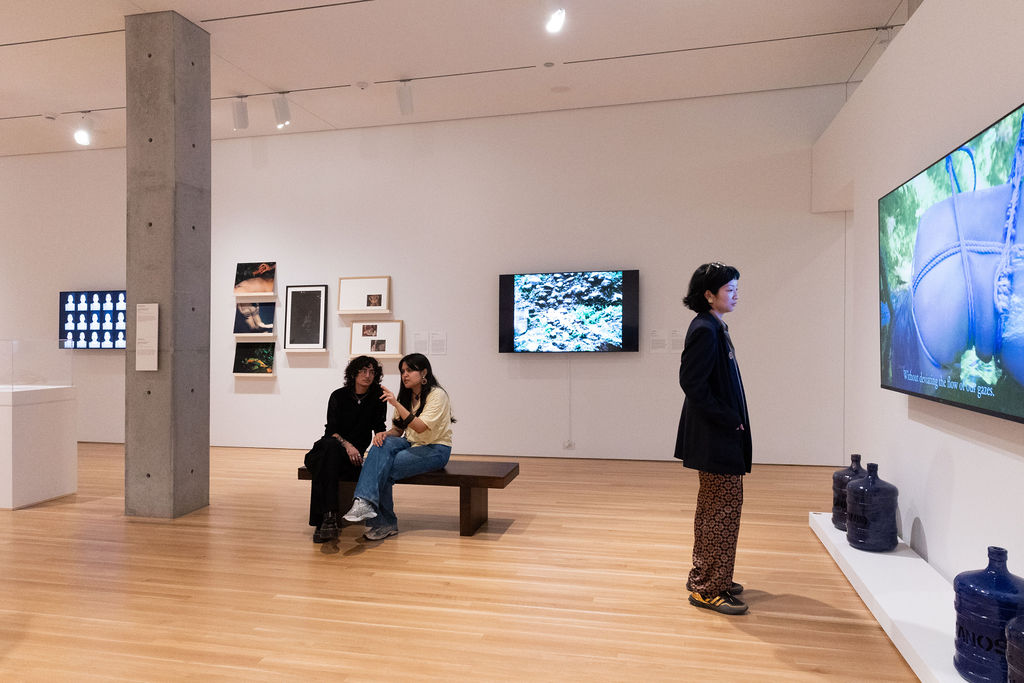
Installation view of "Dispossessions in the Americas: The Extraction of Bodies, Land, and Heritage from La Conquista to the Present", at Wrightwood 659, 2026. Photo by Shanti Knight.
At first glance, Mendieta’s Burial Pyramid seems to be documentation of a stagnant pile of rocks and debris at an ancient burial site in Oaxaca, Mexico. One might mistakenly assume this is a still image, but slowly, small rocks begin to wobble and fall to the ground, uncovering the female form. Mendieta is buried underneath the earth. As she breathes, her chest starts to heave, pushing the heavy boulders off her body. Mendieta’s limbs and hips start to shake, her entire body uncovered. As Mendieta frees herself from the weight of the rocks, viewers can see her nude body in direct contact with the dirt, emphasizing an intimate connection to earth as a living, maternal force rather than a passive surface. Initially appearing as a landscape, Burial Pyramid transforms into a visceral scene of pain and power.
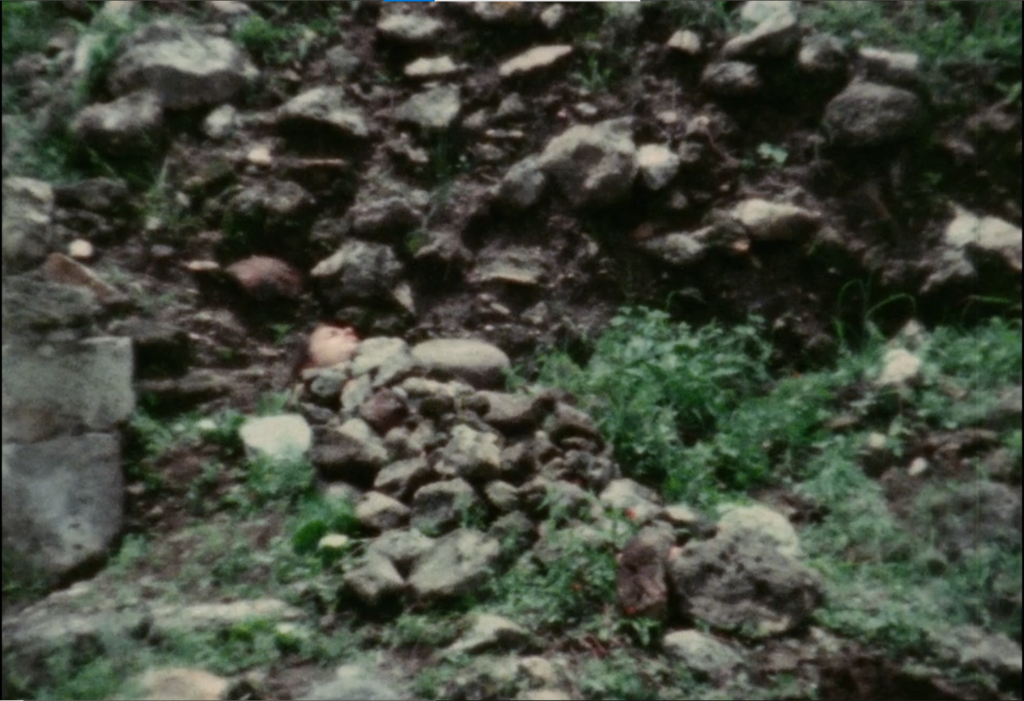
Video still, Ana Mendieta, "Burial Pyramid", 1974, video, Super 8 color, silent; 35-mm color slide. Courtesy of Museo Nacional Centro de Arte Reina Sofia.
Burial Pyramid mixes present day issues of gender, violence, and colonial history with Mendieta’s understanding of pre-Columbian religious and cultural burial practices. Mendieta draws upon the practice of spiritual burials: temples in pre-Columbian Cuba used to honor the dead by burying bodies under pyramids of rocks.[3] However, her re-staging of this ritual is not reverential. Instead, the rocks appear oppressive, their weight causing Mendieta’s body to be nearly immobile and restricting the artist’s breathing. The land now becomes implicated in a form of colonial gendered violence, Mendieta’s naked body constrained and suffocated by the earth. Mendieta suggests land that holds ancestral memory also bears the history of colonialism, where Indigenous and racialized women’s bodies have historically been controlled, buried, and silenced.[4]
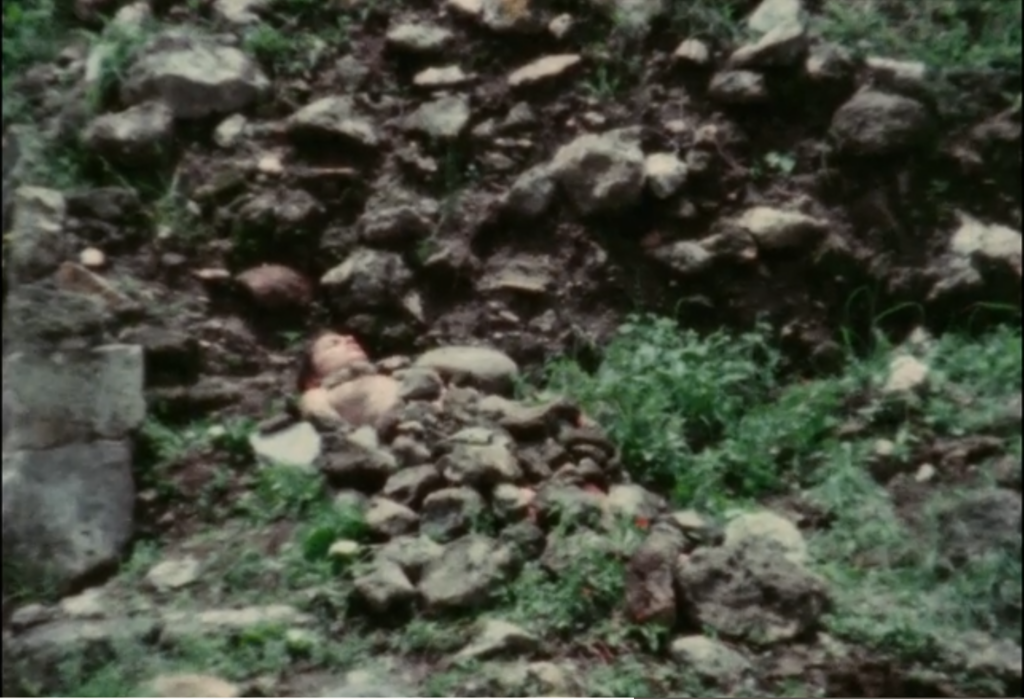
Video still, Ana Mendieta, "Burial Pyramid", 1974, video, Super 8 color, silent; 35-mm color slide. Courtesy of Museo Nacional Centro de Arte Reina Sofia.
The land becomes a metaphor. Rather than becoming a passive victim, Mendieta breaks free of the weight of the land, taking control of the narrative and shining light on the history of colonial abuse. Furthermore, Mendieta’s implication of the viewer in this scene of violence requires us to question our own passive acceptance of these colonial histories.
Endnotes:
- Abumrad, J. (Host). (2023, October 6). Ana Mendieta: Silueta de sangre (Season 1, Episode 1) [Audio podcast episode]. In Death of an Artist. Pushkin Industries.
- Roulet, L., & Iles, C. (2004). Ana Mendieta: earth body: sculpture and performance, 1972-1985.
- Welsh, R. (2016). Classification and Analysis of Ancient Maya Burials and Burial Customs, (Doctoral dissertation, University College London, pages 55-57). UCL Discovery. https://discovery.ucl.ac.uk/id/eprint/1546147/
- Hyacinthe, G. (2019). Radical Virtuosity: Ana Mendieta and the Black Atlantic. MIT Press. https://www.artforum.com/features/bodily-rites-the-films-of-ana-mendieta-226183/
Bio
Magdalena Saliba is an educator at Wrightwood 659, as well as a practicing artist and student in the School of the Art Institute’s MA of Art Education program.
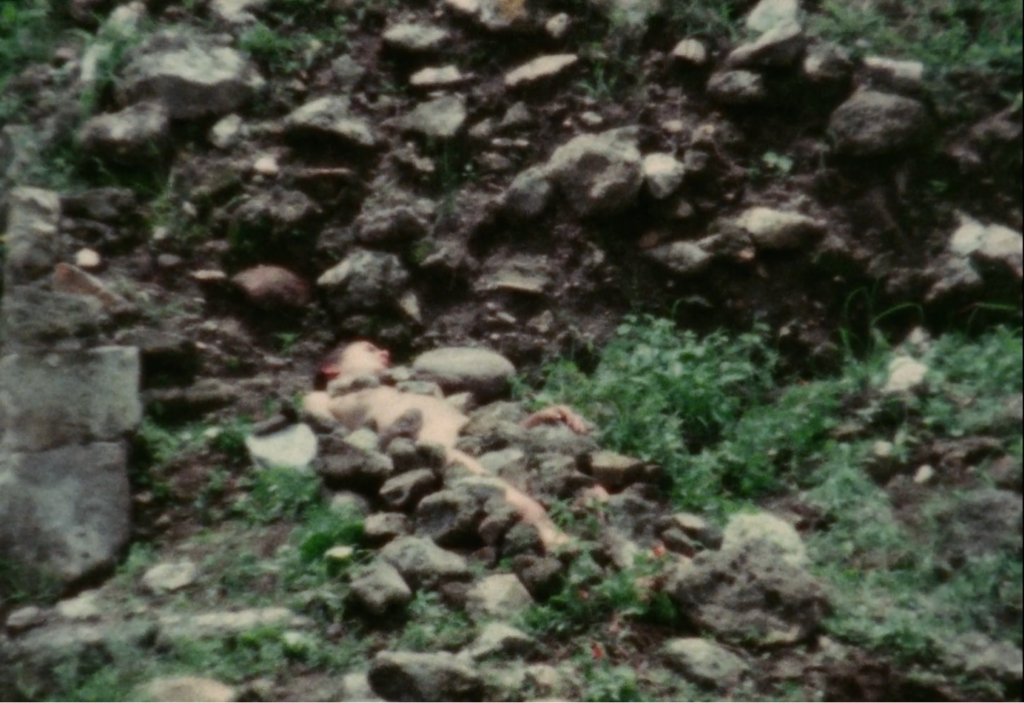
Video still, Ana Mendieta, "Burial Pyramid", 1974, video, Super 8 color, silent; 35-mm color slide. Courtesy of Museo Nacional Centro de Arte Reina Sofia.