Educator Insight: Luke on Martin Wong's "Clones of Bruce Lee"
Martin Wong’s 1992 painting Clones of Bruce Lee signals a shifting narrative about Asian Americans during the late 20th century through the blending of Chinese iconography and American pop-culture.
Clones of Bruce Lee centers four Bruce Lee’s posed in front of a jewel-toned blue Chinatown, although it is not the first painting Wong made in his likeness. In his 1982 ASL “fingerspelling” painting, Wong references Lee, spelling out the title of the work The Clones of Bruce Lee. Later, his 1992 painting titled Incident at Waverly Lane depicts Bruce Lee as crime fighting “Kato” from the 1966 TV-series The Green Hornet. Lee is a muse for these works and is a potential portrayal of how Wong saw a shift in the representation of Chinese Americans.
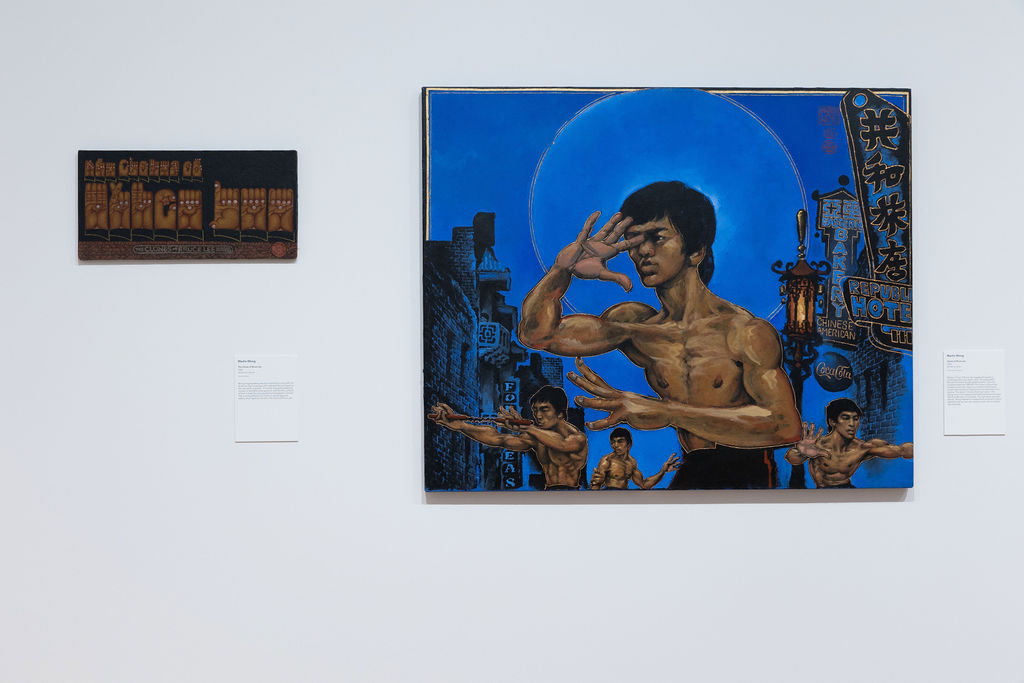
Installation view of "Martin Wong: Chinatown USA", at Wrightwood 659, 2026. Photo by Shanti Knight.
The start of Chinese American immigration to the United States can be traced back to the California goldmines in the mid 19th century, with a decades-long hiatus due to the Chinese Exclusion Act of 1882 and its repeal in 1943; although anti-Chinese sentiments or “Yellow Peril” lingered decades past its annulment.[1] Bruce Lee’s launch to stardom in the 1970s countered the previous narrative of how Chinese Americans were viewed in the arts as foreign or other and broke stereotypes around Asian men by conveying strength and popularizing Chinese martial arts in Western culture. While living in the Lower East Side, Wong noticed Lee’s cultural impact on the Puerto Rican kids who were obsessed with him.[2] Lee’s presence in cinema challenged a Western notion of villainous Chinese archetypes, from the prevalent “Fu Manchu” caricature in the early 20th century, to one that embodied heroism.[3]
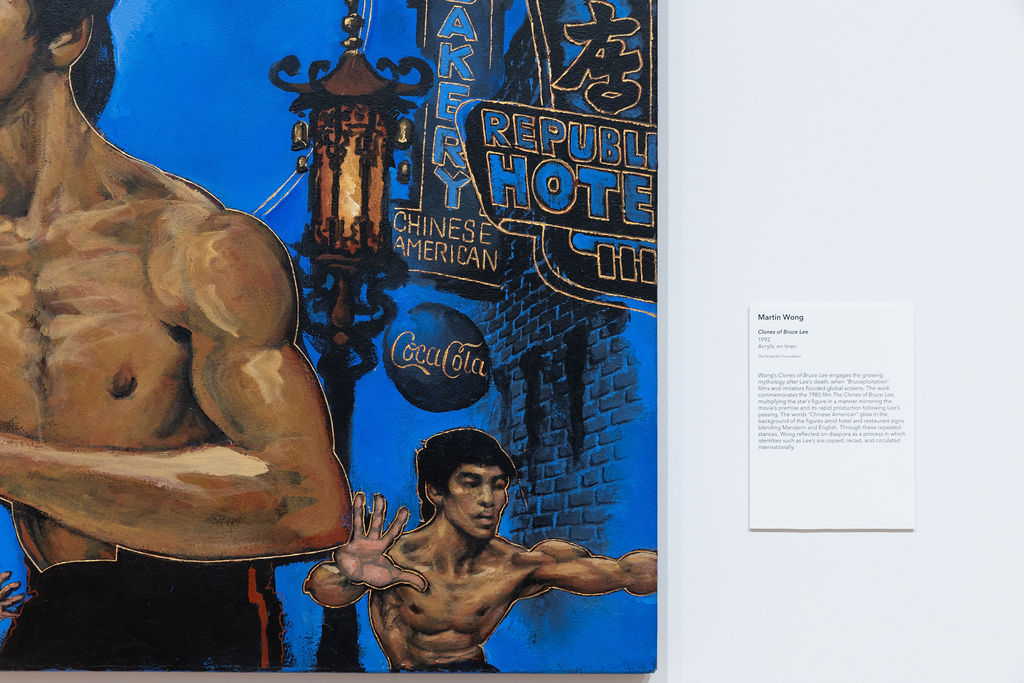
Detail, Martin Wong, "Clones of Bruce Lee", 1992, Acrylic on Linen. Photo by Shanti Knight.
Clones of Bruce Lee reads as an homage to Lee, through dynamic stances and a central Bi behind Lee’s head. The traditional Chinese Bi is a circular piece of jade with a hole in the center that represents heaven or sky. Wong’s placement of a Bi in the piece is reminiscent of how Renaissance painters used golden halos behind the heads of figures to signify divinity or to denote figures of worship. Wong is celebrating Lee by painting him as “holy” in status. This is further reinforced by Wong’s subsequent sculpture Bruce Lee Shrine made a year later in 1993. The sculpture incorporates pictures and trinkets of Lee arranged to mirror a traditional ancestral shrine or household altar for religious worship. Wong’s fascination with Lee may stem from Lee’s Hong Kong American identity but also for his image as a pop cultural icon. Clones of Bruce Lee converses with the history of the Chinese diaspora in America and memorializes a shift in how Asians were represented in American pop-culture.
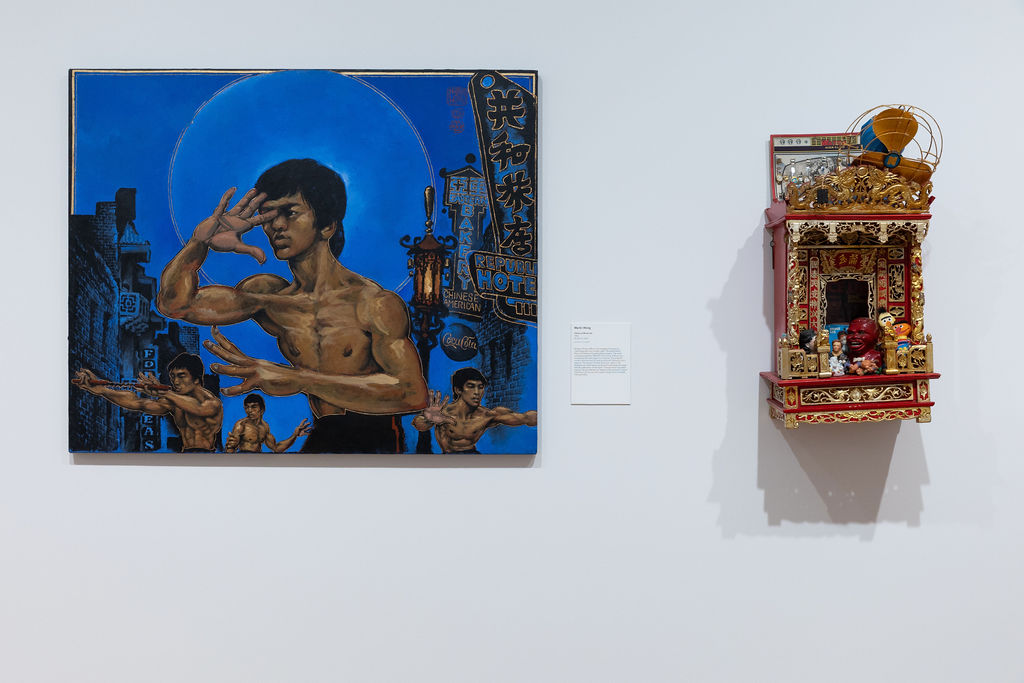
Installation view of "Martin Wong: Chinatown USA", at Wrightwood 659, 2026. Photo by Shanti Knight.
Endnotes:
- “Chinese Immigration and the Chinese Exclusion Acts.” U.S. Department of State. https://history.state.gov/milestones/1866-1898/chinese-immigration.
- Martin Wong, interview for PPOW exhibition, 1993
- Chan, Jachinson. Chinese American Masculinities: From Fu Manchu to Bruce Lee. Routledge, 2020.
Bio
Luke Xuan Dalton is an educator at Wrightwood 659 and a multimedia artist with a focus on painting and drawing. He earned his BFA at the School of the Art Institute of Chicago.