Educator Insight: Patrick on Martin Wong and "Peking on Acid"
Peking On Acid: Through the Glittered Gates of the Forbidden City
The Angels of Light never shied away from fully embracing glamour, glitter, and camp. Active throughout the 1970s in the San Francisco Bay Area, the Angels were a theater troupe that focused on communal living, creating repurposed “genderfuck” fashion, and celebrating free love.[1] Martin Wong joined the Angels and became instrumental in shaping their signature style by creating dazzling, maximalist attire and transcendent stage design and props, while incorporating his Chinese heritage and San Francisco’s vibrant Chinatown into his art.
One of the Angels’ most revered–and controversial performances was Peking On Acid. Part of an entire day of programming showcasing the Angels’ community work that focused on free performance, Peking on Acid was a “multipart extravaganza featuring a panoply of ethereal deities drawn from a syncretic mix of Asian cultures.”[2][3] The performance, which incorporated Asian folklore and the influence of San Francisco’s Chinatown on the Bay Area counterculture, solidified Wong’s stamp on the Angels’ signature oeuvre.
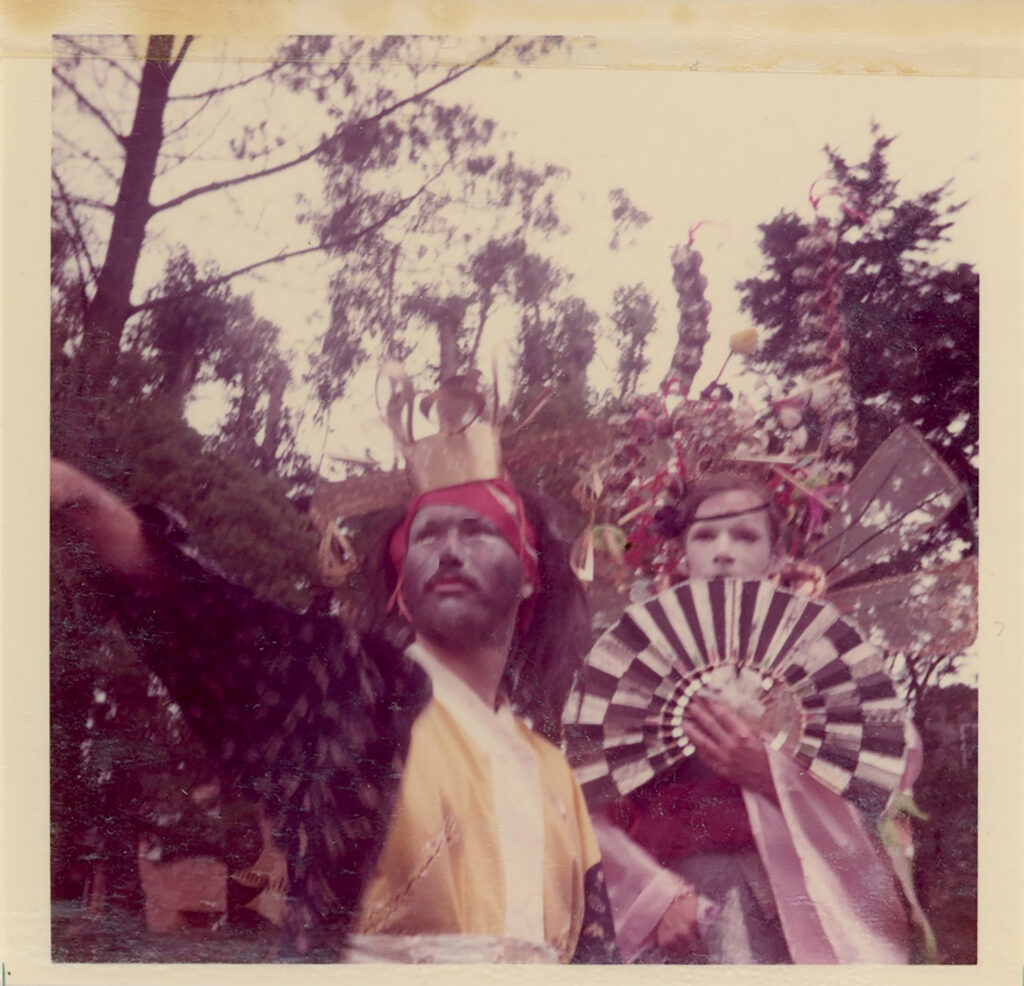
Documentation of the Angels of Light Free Theater, c. 1972, photograph, Courtesy of the Martin Wong Foundation and P·P·O·W, New York.
Recovered video footage from Peking On Acid showcases the sheer brilliance of Wong’s bold and assertive artistic style and impact on the sets, costumes and make-up. By juxtaposing traditional Chinese patterns against vibrant lamé, sequin, and rhinestone studded fabrics, Wong outfitted the performers in a way that “took Chinese Opera on an acid-drenched journey through the gender bending theater of communal fantasy.”[4]
Wong created an Asian fantasy world that was inhabited by dragonflies, frogs, Pixiu (or Pi Yao), “skulls, bunnies, and duckies,” using secondhand fabrics, paper, cardboard, trinkets, feathers, and figurines to construct them.[5] Each character in the production was clothed in billowing and blousy jumpsuits comprised of bright, saturated colors and prints. Wong outfitted a towering kabuki courtesan in silver lamé, fixing a foot-tall, bejeweled metal fascinator to their head, and he dressed actors in shredded sequined green fabric, papier-mâché headpieces, and secondhand swimming fins to represent frogs in the court’s pond. His immense set designs created a literal and figurative euphoric backdrop for the “kabuki show”, integrating Chinese imagery and iconography into the production.[6]
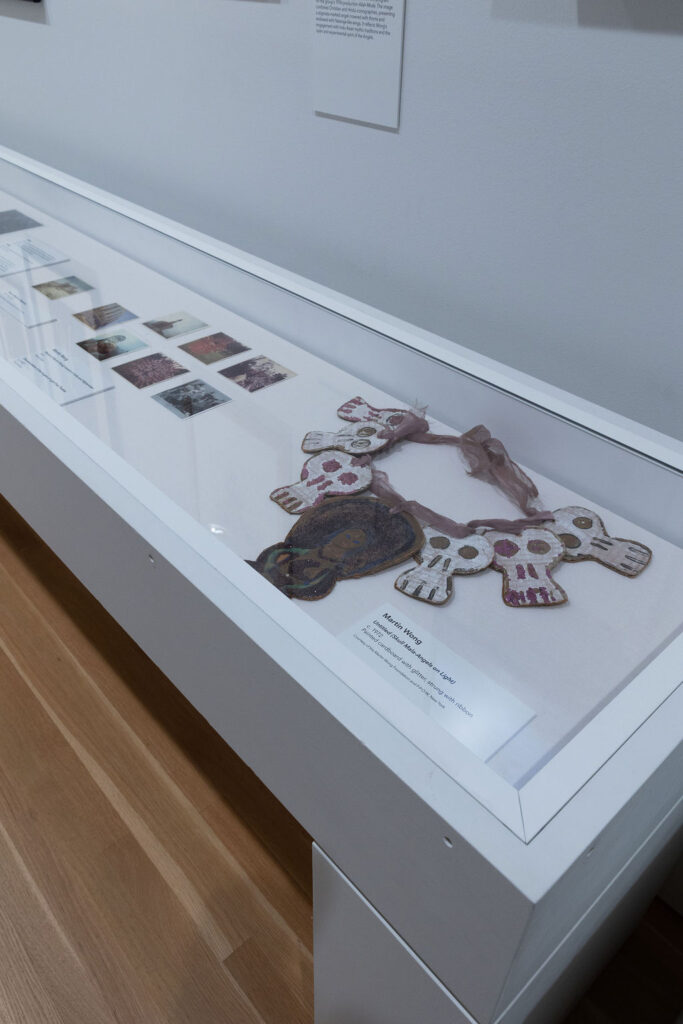
Installation view of "Dispossessions in the Americas: The Extraction of Bodies, Land, and Heritage from La Conquista to the Present", at Wrightwood 659, 2026. Photo by Shanti Knight.
While Peking On Acid created a safe space for the Bay Area queer community to engage and celebrate gender fluidity and expression, some critics viewed the performance as “anti-Asian, raising questions about [Wong’s] own relation to the productions’ orientalizing.”[7] Despite its polarizing reception, Peking On Acid remains a vital representation of Wong’s incorporation of his Chinese heritage and Chinatown into his work, an approach that Wong would continue to implement into his works throughout his career.
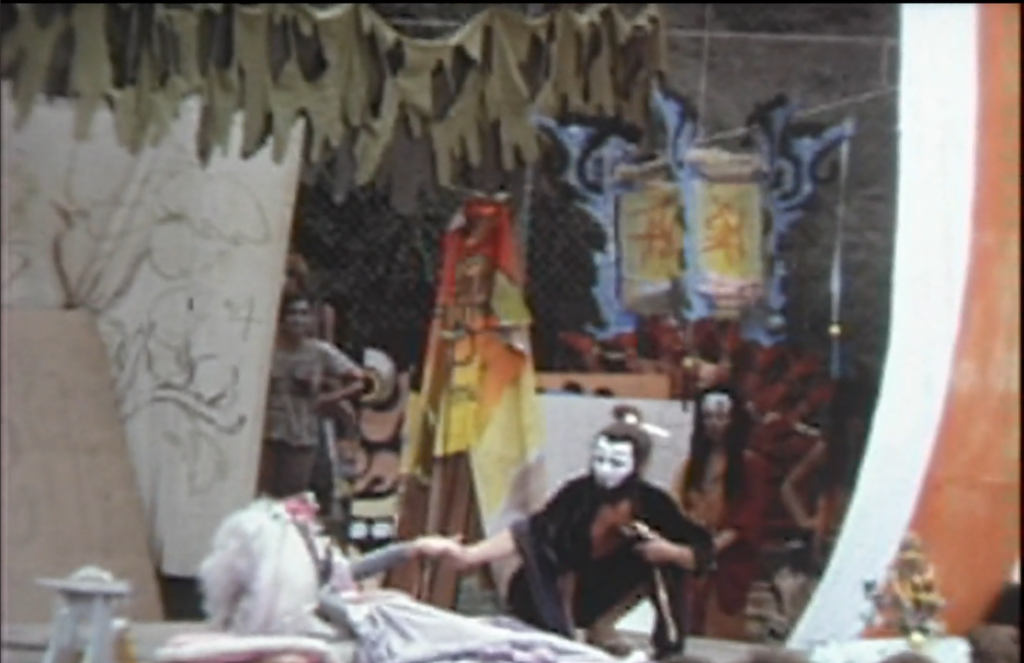
Video Still, Angels of Light Free Theatre in “Peking on Acid” at the Kaliflower Inter-Communal Free Carnival A film by James (JET) Tressler (aka Jilala Jet von Jalopy).
Endnotes:
- Bryan-Wilson, Julia. Fray: Art + Textile Politics. The University of Chicago Press, 2017, pg. 45.
- Ibid, 48.
- Kwon, Marci. Martin Wong: Malicious Mischief. Edited by Krist Gruijthuijsen, and Agustín Pérez Rubio, Köln: Verlag der Buchhandlung Walther und Franz König. 2022, pg. 55.
- Inter-Communal Free Carnival. The Digger Archives, https://www.diggers.org/ic_free_carnival_1972.htm/.
- Lake, Bambi, and Alvin Orloff. The Unsinkable Bambi Lake: A Fairy Tale Containing the Dish on Cockettes, Punks, and Angels. Manic D Press, 1996, pg. 55.
- Ibid.
- Bryan-Wilson, Julia. Fray: Art + Textile Politics. The University of Chicago Press, 2017, pg. 57.
Bio:
Patrick Leombrone (he/him) is an educator at Wrightwood 659 and a recent graduate of Harvard University, receiving his master’s degree in museum studies. In addition to working as an Educator at Wrightwood 659, he also serves as a Faculty Assistant at Harvard DCE for multiple courses in the Museum Studies Department.