Educator Insight: Eden on Scott Burton's Public Art
Scott Burton began his artistic career as a writer, earning a bachelor’s degree from Columbia University and later a master’s from New York University. Trained as both an art critic and performer, Burton had a deep affinity for storytelling, public engagement, and socially engaged art. Burton wanted to not only create aesthetic forms but also to be able to design forms that engaged active participation. His public installation work served as an intermediate force between public usage and artistic activation. While Burton focused on creating forms with utilization in mind, his works were never stripped of their aesthetic value; Rather Burton emphasized how aesthetic form and public function can co-exist and amplify each other. As Burton phrases “Public art is not sculpture. In it one is dealing with a total situation-a situation with a shared psychology, where there’s a whole set of needs”.(1) Burton understood that to create a body of work that existed within the public had to have forms that were both integrated and stimulating.
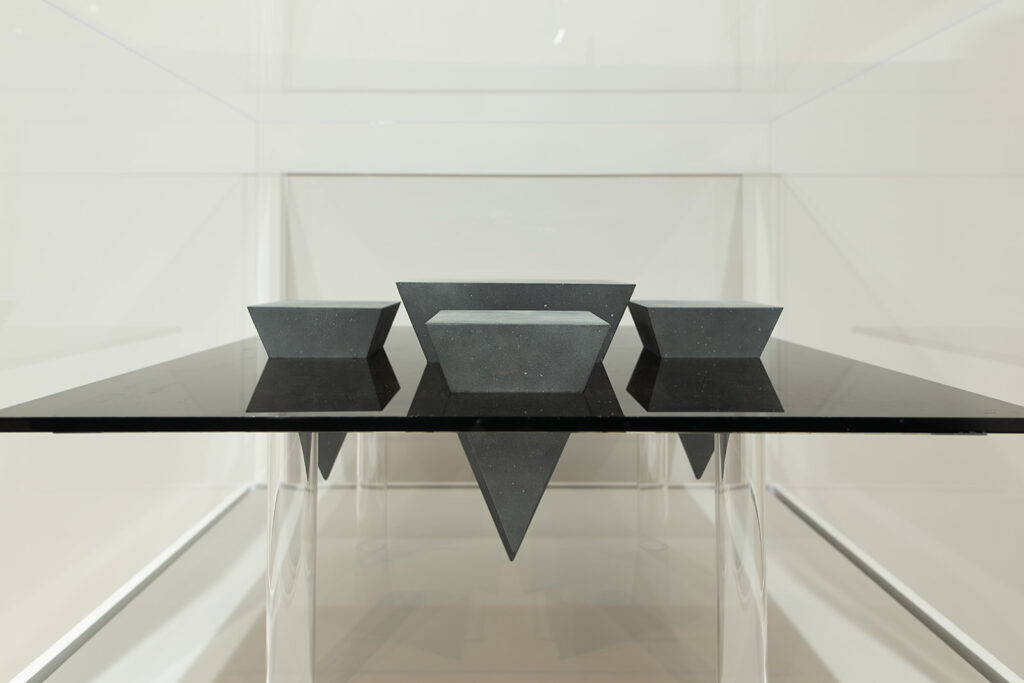
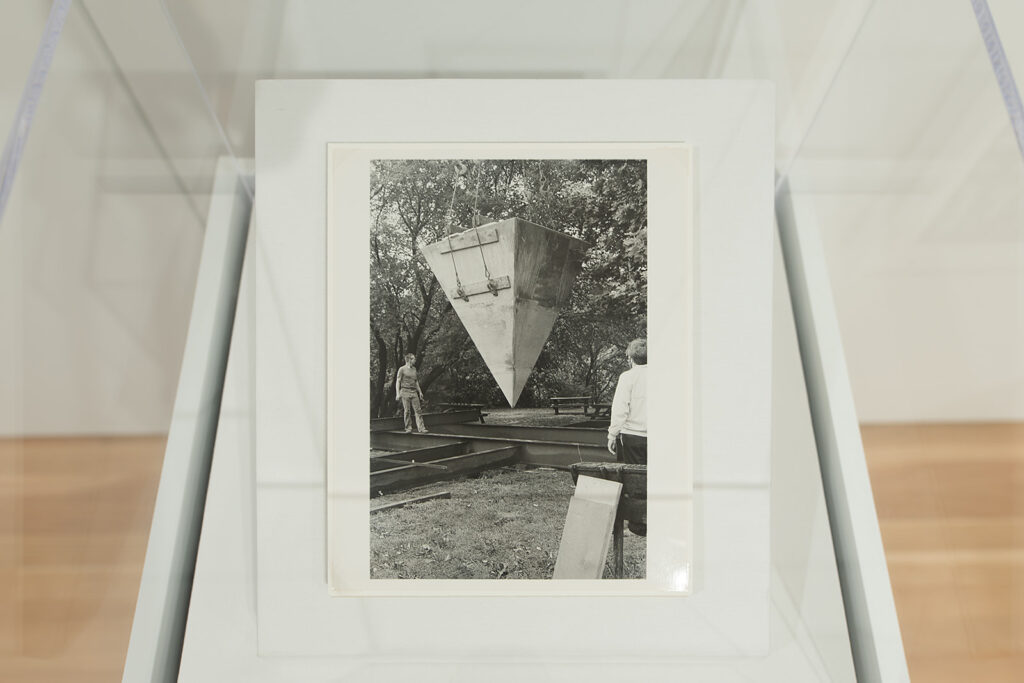
Described as “furniture-sculptures” Burton’s public installations existed in between art and utility. We can see the beginnings of the shift in Burton’s thinking about function with his earlier public art; such as Bronze Chair (1972), which was cast from a chair left by the previous tenants of Burton’s apartment. Burton placed the chair in an alleyway, and through its materiality it was rendered unusable, transforming it into a static form that focused on aesthetic presence. Later pieces of Burton’s work then developed as his positionality within the art world shifted into architecture and furniture design. Works such as Picnic Table and Benches (1983) embody the evolution in thought and execution, focusing on communal interactions. The forms are utilitarian within their final manifestation as a space of rest, but are imaginative and counter intuitive; the forms that compose the installation are large inverted pyramids partially submerged into the ground. They function as a series of small benches around a square top table, a functional form that remains visually engaging enough to encourage usage. As Burton states “My principle was to use the elements of the surrounding environment rather than to introduce new ones. My attempt was to blur boundaries, especially with the use of plantings and boulders, so that one is not quite sure where my contribution begins or ends”.(2) Burton challenges the traditional frame of public installation, as his pieces then become a continual conversation with the public, an everlasting performance and activation.
Ultimately Burton’s public art illustrates that true publicly engaged work does not stem solely from form or aesthetic functions, but rather the intertwinement and balance of both concepts. No form in Burton’s public art is entirely dependent on upholding function without a visual language. Therefore the aesthetic form in a manner becomes an inherent part of functionality, encouraging public participation and enjoyment.
Notes:
- Scott Burton, “Essay by Scott Burton” in Design Quarterly, no. 122, 1983, pp. 10.
- Scott Burton, quoted in P. Fuller: Five Artists at NOAA, Seattle 1985, p.25.
Eden Rodriguez is an educator at Wrightwood 659 and a Chicago artist whose work spans performance and writing.
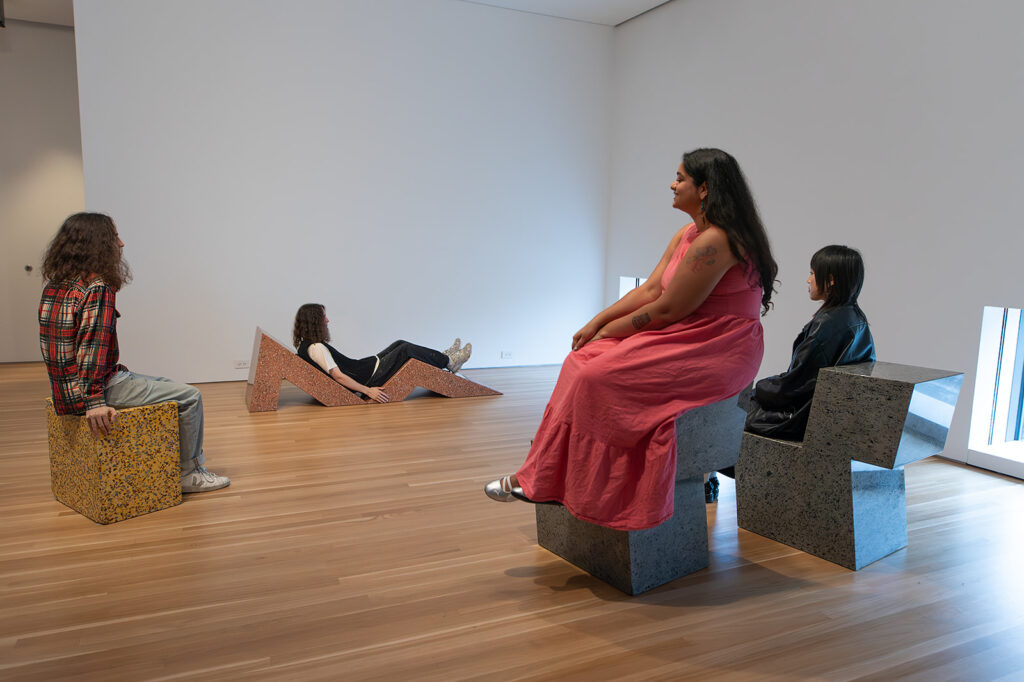
Installation view of "Scott Burton: Shape Shift", at Wrightwood 659, 2025. Photo courtesy of Daniel Eggert (@DesigningDan). Models (left to right): Jake Planer, Ben Planer, Sarika Tatineni, Haemin Kim