Educator Insight: Natalie on Scott Burton's "Indiviual Behavior Tableaux"
Scott Burton used performance and sculpture to explore the complexity of queer behavior in an unaccepting public, paying particular attention to cruising—a sphere of nuanced behaviors involving the scanning for and communication of clandestine sexual desire in public, semipublic, and designated zones.(1)
Individual Behavior Tableaux, a work completed by Burton and performed by Kent Hines in 1980 at the University of California, Berkeley, translates the dynamics of cruising into the visual language of a historic art form. He’s referencing the tableau vivant, a popular Victorian-era form of entertainment that recreated paintings and statues as static live scenes featuring costumed actors standing motionless in sets. By reengaging this medium, Burton situates contemporary queer expression within the visual and performative traditions of Western art history, which often denied or excluded queer existence.
Burton’s lived experience as a queer man underpins his practice. He stated that, in creating the piece, “I try to get the poses that I see in the bars, in baths and on the street corners that I frequent. I mean, my own personal experience has to come [into it].”(2) Still, his interest in the politics of visibility and art historical reference keeps the performance of Individual Behavior Tableaux highly restrained.
Drawing from the frozen actors of traditional tableaux vivants, his choreography is exceedingly sparse. But set against a plain white backdrop, the figure cut by Hines is striking: young, muscled, and naked except for a pair of tall leather platform boots. Hines moves painfully slow, in continuous but restrained motions: an arm raises, a leg bends, a head tilts. Throughout the performance, Hines’ expression remains neutral, refusing any context or emotion to the captive audience.
Understanding the influence of cruising on Burton’s artwork transforms these glacial movements into legible queer signals. Early in the performance, for example, Hines lingers with an arm above his head, hand to the wall behind him. He’s turned to the side, but his head is tilted towards the viewer, and his back leg is bent and raised, as if resting against the wall behind him. It’s the casual leaning pose taken up by many waiting to meet others—one that is passable to heteronormative conventions of behavior in public spaces, but also a subtle indication of queer desire to those familiar with cruising.
Staged around a plain geometric sculpture resembling a chaise lounge, the performance also implies social (and sexual) interaction. The wooden sculpture is composed of two main elements: a large rectangular base, upon which the performer occasionally sits, and a gradually sloping triangular back. Paring down the object to the chaise’s most essential forms removes any time or place specificity from the furniture and allows the setting of the performance to be determined by the viewer. Its placement facing the audience draws audience members in as active participants in the social setting of their choosing, in dialogue with Hines.
The grounds for engagement with the performance also complicate visibility. Viewers of the original performance were situated about eighty feet from away from Hines(3)—a distance which completely obscures the identity of the performer. At such a distance, audience members would also have to strain to view the work, forcing heightened attention on the referenced behaviors that typically go unseen in public spaces. And, with an audience size limited to only twenty people, the atmosphere is also intensely intimate, amplifying the performance’s meditation on distance, surveillance, and the politics of looking.
Burton’s masterful experimentation with form and choreography empowers a sharp negotiation between heteronormativity and queer visibility. This kind of careful attention to behavior, social expectations, and relationships is just as relevant today as it was forty years ago when Burton created the work. Burton’s transformation of a historic form of representation into a stage for queer self-definition illuminates the enduring tension between recognition and concealment that continues to shape queer life.
Notes:
- Getsy, David. 2022. Queer Behavior : Scott Burton and Performance Art. Chicago: University of Chicago Press, 27.
- Getsy, Queer behavior, 32.
- Auping, Michael. 1980. Individual Behavior Tableaux. Berkeley: Berkeley Art Museum.
Natalie is an Educator at Wrightwood 659 and a Chicago-based artist and art critic. Her work has been published in Hyperallergic, White hot Magazine, Artsy, Newcity, and the Chicago Reader
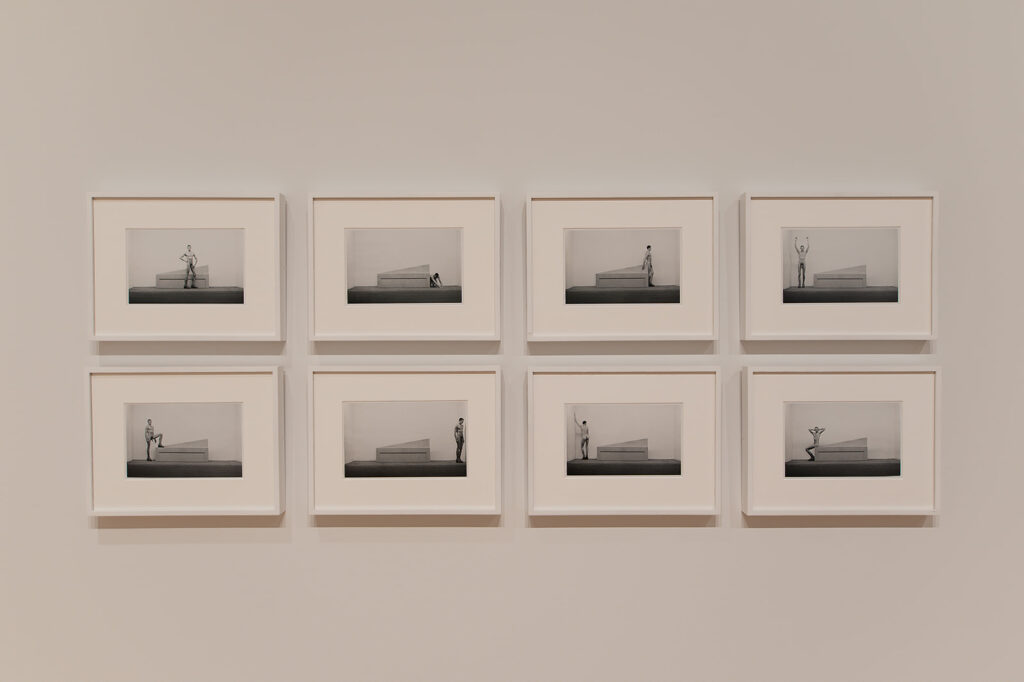
Installation view of "Scott Burton: Shape Shift", at Wrightwood 659, 2025. Photo courtesy of Daniel Eggert (@DesigningDan).
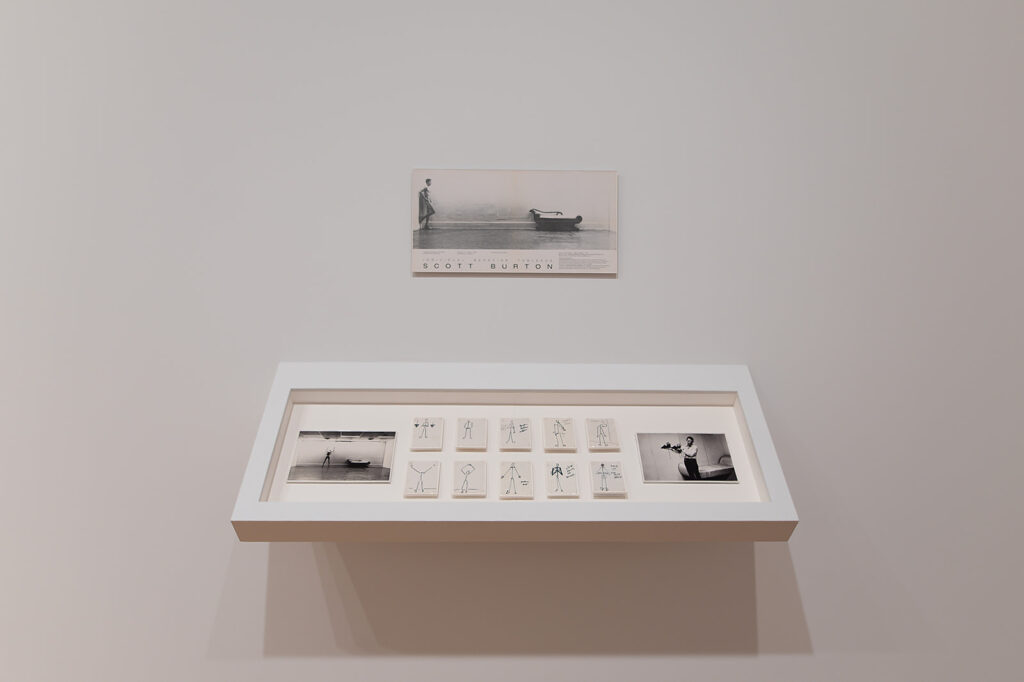
Installation view of "Scott Burton: Shape Shift", at Wrightwood 659, 2025. Photo courtesy of Daniel Eggert (@DesigningDan).
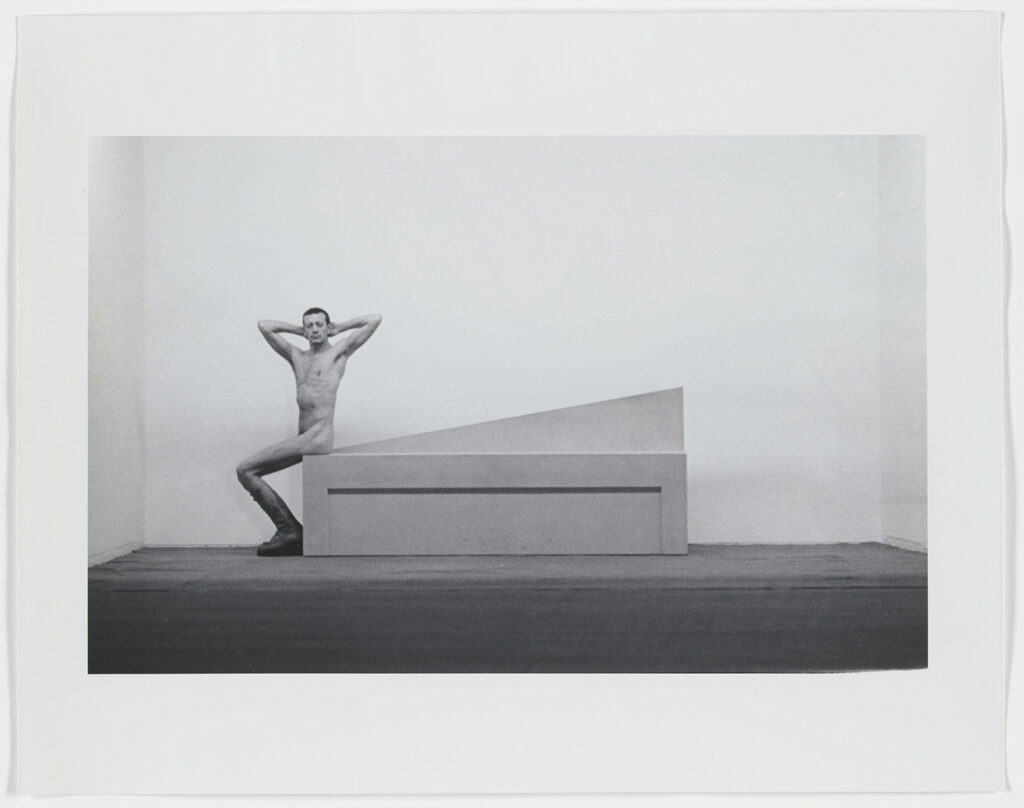
View of "Individual Behavior Tableaux," as performed by Kent Hines, 1980. Gelatin silver print. 7 15/16 × 10" (20.2 × 25.4 cm). Scott Burton Papers, II.22. The Museum of Modern Art Archives, New York.