Chryssa’s Projection Series
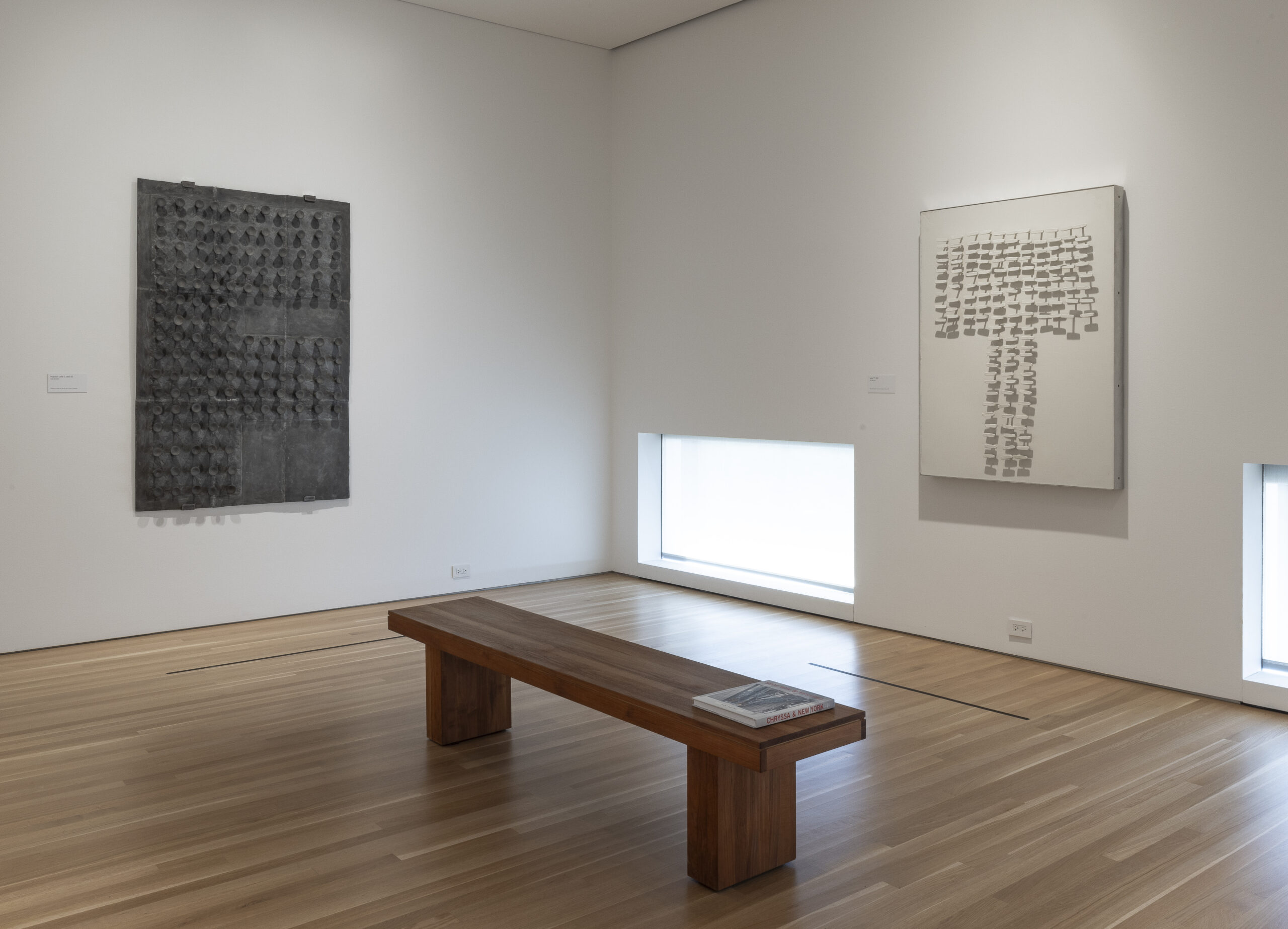
Installation view of Chryssa & New York at Wrightwood 659, 2024, © 2024 Alphawood Exhibitions LLC, Chicago. Courtesy: Alphawood Exhibitions LLC, Chicago. Photo: Michael Tropea.
By Emily Bylsma
Chryssa’s Cycladic Book series serendipitously began with a studio accident—plaster poured into a cardboard box—shortly after Chryssa moved to the United States from Greece. These minimalistic sculptures invite the viewer to notice how slight angles and lines create a sense of depth. As her time in the US goes on, Chryssa begins to expand upon the ideas she initially explored in those books, increasing depth and perspective while integrating more structured ideas surrounding light and time.
Chryssa described her books and projections as utilizing “static light.” To Chryssa, static light wasn’t necessarily a style or technique but a material she wanted to include in her art. The term static light refers to natural sunlight and the way that it can manipulate the appearance of one of her works. “Static” might seem a strange way to describe, natural light, considering light is entirely dynamic and constantly moving; Chryssa clarified what she meant by this term during a 1968 lecture at NYU, stating, “The form is static, not moving, and is not activated by the use of artificial light but by natural night alone.”
This concept becomes most clear when compared to her subsequent idea of “dynamic light.” Chryssa describes her neon works as including dynamic light in the sense that she takes control and manipulates the light itself. In contrast, the static light she describes is a light she cannot change; instead, she allows the light to change her artwork.
Window shades neighboring the projection works were kept open to allow visitors to experience Chryssa’s works as she intended; activated by natural light. Shadows are the main visual phenomena created by static light in the projections, and so much can be said about how shadows play a different role in each piece. In examining the piece, Letter “T”, one can see the smaller cast aluminum “T” shapes producing consistent shadows on both the work and onto the separate white wall behind it. Chryssa allows the shadows to expand the piece beyond its physical limitations. These works are constantly changing. Every day, these sculptural paintings change completely depending on the natural light they receive. Chryssa was aware of how fluctuations in light augmented her projections; she was known to choreograph the shadows of these sculptures by brandishing a flashlight around the jutting forms to impress visiting collectors. In addition, they change as one simply moves around it. When looking at the pieces from different angles, a viewer might notice how the shadows look different depending on their position in relation to the piece. From a viewer’s perspective, the art they experience in their moment is not the same art someone else will experience the next day, which adds an ephemeral element to Chryssa’s work. Chryssa titles this ephemeral creation “formless form.” While seemingly an oxymoron, Chryssa means to emphasize the fact that these shadowy shapes seen on the wall are not of her own creation, but instead a form that can appear and disappear from one moment to the next.
I want to now return to something I mentioned earlier: Chryssa’s concept of “dynamic light.” Oftentimes, when visitors walk from her projection series and newspaper series works down to her neon works, they mention how drastic the change in her work appears to be. Despite the clear visual change that most definitely occurs between her projections and her neon pieces, I think they are much more similar than they may appear at first look.
Chryssa allows natural light to manipulate and continuously change the projected forms she creates, but when she works with neon, Chryssa has almost complete control over the form of light in each piece. The movement of natural light over these surfaces makes evident aspects of time, which we notice as the sun moves across the sky. This differs from Chryssa’s neon works, where she moderates the frequency and pacing of electric light with mechanical timers. From the shape of the neon sculptures to the color tone of each tube, Chryssa dictates how each viewer sees light in that moment. Consider, for example, Cycladic Movement, a wall-based sculpture with neon elements emitting light onto neighboring letterforms—animating the white layer below in shadows cast by static and electric light.
However, her neon works can still be observed in the way in which the projection works are observed. By moving around her neon pieces and examining them from different angles, a viewer is able to see other pieces entirely, as the various colors of lights separate and subsequently blend together. Whether Chryssa deems a piece “static” or “dynamic,” in each one, Chryssa creates an experience that invites the viewer to actively engage with the work. In this sense, all of Chryssa’s sculptures extend beyond themselves, creating those constantly changing “formless forms” discussed earlier.
On or off, Chryssa saw her works as complete sculptures, emphasizing the importance of darkness as a contrast to the light. In her 1968 lecture at New York University, Chryssa proclaimed, “I feel strongly about media and most of all about the independence of my light sculptures from their technology.” She continues, “Without electricity, my sculptures will survive.” In this sense, Chryssa’s work was designed to endure the test of time, and she saw them, in many ways, as immortal—akin to ancient fabrications of gods. Just as long as the sun continues to rise and set, Chryssa’s work can be experienced anew each day.
Join E-News
Please sign up to receive our weekly E-News, full of timely and insightful information about our exhibitions, artists, and programs.
See Them First–Spring's Most Anticipated Exhibitions Now on Sale
"Martin Wong: Chinatown USA"
"Dispossessions in the Americas"
"Statue of Athena" on long term view.