Chryssa’s Cycladic Books
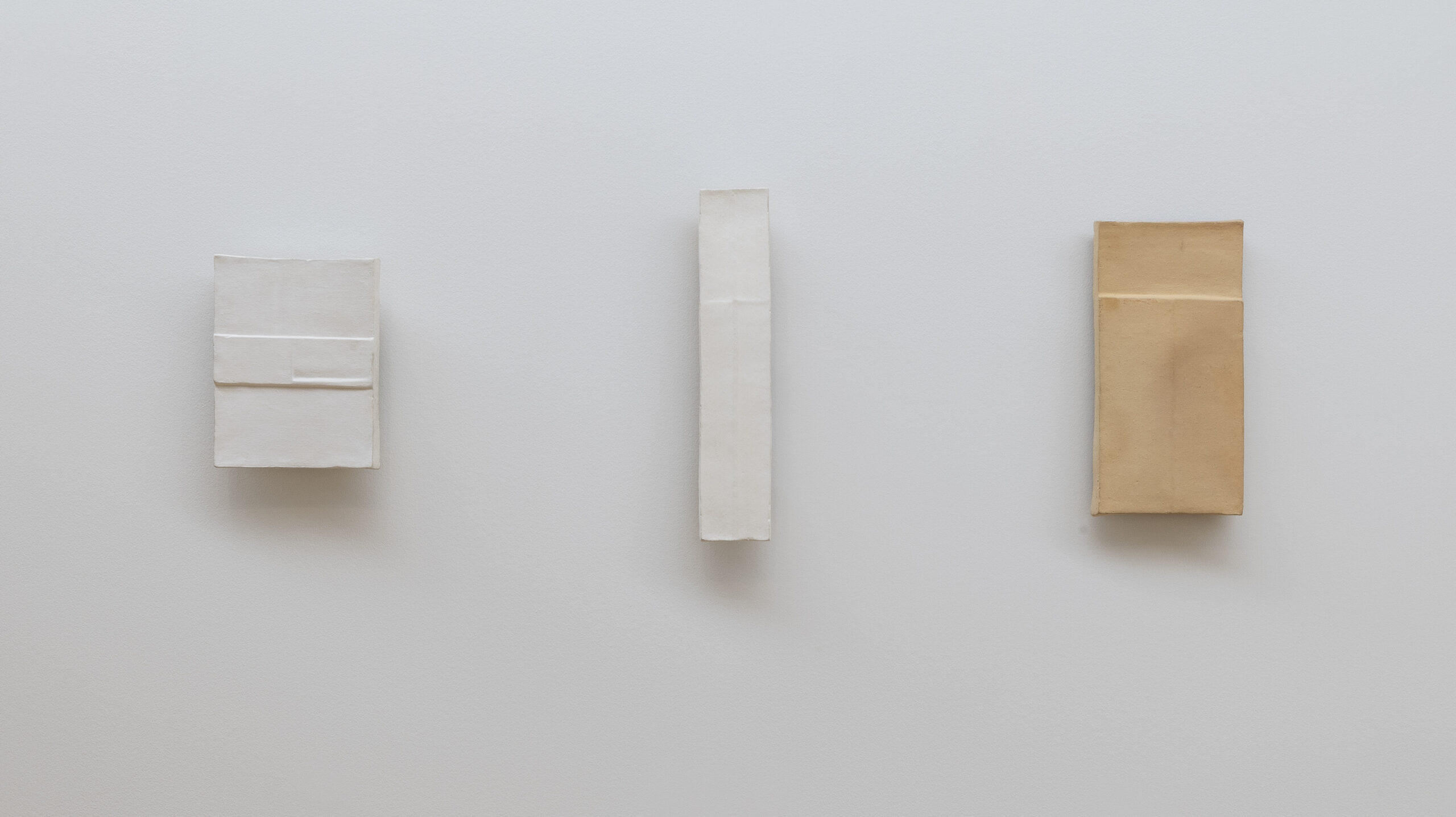
Installation view of Chryssa & New York at Wrightwood 659, 2024, © 2024 Alphawood Exhibitions LLC, Chicago. Courtesy: Alphawood Exhibitions LLC, Chicago. Photo: Michael Tropea
By Nijea Draine, Wrightwood 659 Educator
Chryssa’s series of plaster Cycladic Books represent the earliest works featured in Chryssa & New York, dating back to the 1950s. This decade marked a significant period for Chryssa. It was the decade she left Greece—a country still reeling from the devastation of World War II—and eventually settled in the United States.
Chryssa’s first endeavor into her Cycladic Book series came about entirely by accident. One morning, after having left some wet plaster in a grocery carton overnight, a curious Chryssa opened the container to find that it had dried and taken on the form of the carton’s negative space. To her, the smooth geometric planes formed by the plaster felt reminiscent of the ancient Cycladic statues she had seen while in Greece, which themselves were unearthed on the Greek Cyclades islands.
These Cycladic statues date back as far as 3000 BC, and are the best-preserved remnants of the unique culture that flourished on the islands from around 5300 to 2000 BCE. Images of these ancient figurines show bare marble faces, square shoulders, and cleanly folded arms. The faces of these statues are the most striking. No eyes, lips, or ears. Just a clean oval with a triangular protruding nose that casts a distinct shadow. The minimalism of these facial features evokes a sense of eerie, ethereal absence—only heightened by the distance of all that time in between now and then.
We can imagine Chryssa standing in some makeshift studio, holding up her own discovery. Noticing and tracing the grooves that the cardboard indented into the plaster, the textures, the width and depth, maybe watching the way the shadows form and bend in the sunlight, and seeing the old ghosts of the home she so resolutely left behind.
It’s intriguing (though not surprising) that Chryssa’s artistic journey begins with the Cycladic Book series, directly connecting herself to a lineage of ancient Greek artistry. It’s intriguing because it was this very expanse of Grecian history that Chryssa sought to escape in her migration to the United States. Chryssa expressly desired a lack of historical precedent, a place not tightly bound within the timeline of thousands of years of legacy, creation, and ruin. She believed the United States to be exactly this kind of place. A blank slate upon which to build her own imaginings.
In a 1962 interview with a reporter, Chryssa cheekily said, “How can you work next to the Parthenon?”
Whatever her expectations in moving to the US, these Cycladic Books serve as evidence of the impossibility of severing oneself from the imprints of the past, the ghosts of antiquity. Even in the plaster. Even in the cardboard. Even in the morning. There sits the ancient—at least from Chryssa’s point of view.
Many of us might walk past Chryssa’s Cycladic Books without giving them much attention, failing to notice the differences between each book. We might overlook the varying grooves and textures left by the cardboard casing or how the seemingly uniform white plaster takes on different shades depending on the angle of the light. Others might notice all these things and still wonder— Why? Why pay attention to these books?
The issue isn’t always what we see but how we see it. While, for some, it might be difficult to discern a single story from the blank faces of these books, Chryssa intuited an entire history. All through the lens of time.
In a 1967 interview Chryssa states“it is the element of time that plays, I think, a great role in my work… of course time cannot be illustrated, but I’m still involved with it.”
With her Cycladic Book series, Chryssa plays with time in two distinct ways: First, she explores the passage of time recorded through natural light, which she categorizes as “static light.” Chryssa relied on sunlight to transform her sculptures throughout the day, shaping them anew as the sun shifts and its shadows move. Second, she examines time through the broader lens of history, reaching back to antiquity and drawing connections between her plaster, terracotta, and marble books and the ancient Cycladic figurines of Greece. She uses time to project a historical narrative, blurring the line between the present and the distant past. In doing so, she transforms an accident into an echo: plaster left in cardboard overnight becomes an artifact of millennia ago.
Both the passage of time as demonstrated through static light and the recollection of a distant history make these Cycladic Books a distinctly “Chryssa” endeavor. These books demonstrate the beginnings of an artist’s process of seeing. Chryssa had a unique ability to look at what is in order to remember what was.
The minimalism and deceptive simplicity of these Cycladic Books may seem to be in stark contrast to Chryssa’s later works—especially her more dynamic, industrial sculptures made with neon, lead, and steel. But I would argue that Chyrssa’s unique inclination to look at the mundane and/or modern and see a “[the] memory of antiquity” is a common thread throughout her work.
Chryssa observed the world as an archaeologist, seeing even the most contemporary and industrial technologies of her time as the relics of some future-past.
When describing how she felt first seeing the illuminated neon signs of New York’s Times Square, Chryssa states “Believe me when I say that there is wisdom, indeed, in the flashing lights in Times Square… A foreigner can observe this, describe this. Americans feel it . . . Times Square I knew had this great wisdom—it was Homeric.”
Chryssa compares the chaos, bustle, and bright lights of Times Square to the epic poems of Homer. Yet again, projecting a distant past onto an unlikely present, just as she did with the plaster. Maybe this way of seeing—of looking backwards while staring forward—came from an understanding she couldn’t shake: after having grown up in Greece while under Nazi occupation. Chryssa knew first-hand how quickly and unceremoniously nations can fall.
How might this intimate understanding of impermanence have affected Chryssa’s point of view? When Chryssa migrated to America, she was fleeing the past which permeated all of contemporary life. She was attracted to the United States because she thought that—in comparison to Greece—it was a young barbarian nation with no history. She thought, here, she could freely practice her art unburdened by the shadow of the Parthenon, and the devastation of war and conflict.
In this belief, she was wrong. She thought we had no history, but really, it was that we had no memory or little desire to look back. Always pressing forward. It is the rapid pace at which America moves and consumes that makes it so easy to forget and move on. Still, Chryssa couldn’t help but keep remembering. It was in the plaster. It was in the neon. It was in the noise. The echo of history. The ache of impermanence.
Maybe she saw everything as an artifact. Maybe she knew that everything would, eventually, become an artifact. Absolutely. Inevitably. And maybe she was right. Because it wouldn’t be long before those flashing neon and metal beacons of Times Square that so inspired her, would be discarded and forgotten, replaced with plastic. And, then, Chryssa would become the archeologist digging through signage graveyards, repurposing abandoned metal scraps to create her sculptures. And those sculptures would be praised and hung in galleries and purchased and, then, forgotten. For a very long time, forgotten. Until… Until… many, many years later… She is, suddenly, rediscovered. And her work is hung on walls, once again. The walls of Wrightwood 659, perhaps.
It’s interesting to note that both the earliest and latest work of Chryssa’s featured in this exhibition are displayed on Wrightwood 659’s fourth floor. The plaster and terracotta Cycladic Books she made in the 1950s are displayed alongside the marble books she returned to over 40 years later in the late 1990s. The switch to marble may seem like an obvious choice, a direct link to her Greek heritage and the long tradition of marble being used as a medium in classical sculpture. But I also wonder if it had something to do with the Chryssa’s awareness of the impermanence of her own art legacy. By this point, she would’ve experienced the rise and fall of the art world’s intense but fleeting attention. Maybe she thought the marble would outlive their forgetfulness.
Maybe. Only time will tell.
But, now, we are getting ahead of ourselves. We must see as Chryssa sees. Looking forward into the past. Pretend you are peering through a window of time— It is 70 years ago. Right now. And it is nighttime in a makeshift studio. And the plaster is still wet but drying in the cardboard. A happy accident. But Chryssa hasn’t discovered it yet. No. Chryssa is still asleep.
Join E-News
Please sign up to receive our weekly E-News, full of timely and insightful information about our exhibitions, artists, and programs.
See Them First–Spring's Most Anticipated Exhibitions Now on Sale
"Martin Wong: Chinatown USA"
"Dispossessions in the Americas"
"Statue of Athena" on long term view.