Lior Zalmanson
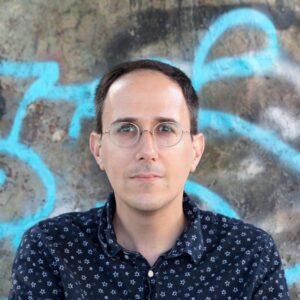
Israeli, born 1983
Lior Zalmanson (he/him/his) is a writer, artist, and curator who uses film, theater, and digital technologies to explore digital culture, online behavior, and the information society. His works often involve hacking or reverse-engineering technologies that supposedly make the web more accessible and personalized. In 2011, he founded Print Screen Festival, Israel’s digital arts festival. His projects have been showcased at venues including the Tribeca Film Festival and The Jewish Museum in New York, NY. He is currently an Assistant Professor at Tel Aviv University, Israel.
See more of Zalmanson’s work at his website: liorzalmanson.art.
The subjects of my works are not usually humans, or still life, but rather algorithms, these pieces of codes that are part of our apps, and our tools in the digital world… And I’m trying to play with them, find their blind spots, find the weaknesses, find the ways in which they break down, and find even the damage that they do to our society or our personal lives.
—Lior Zalmanson
Excess Ability, 2014
Digital video (color, sound) displayed on monitor; vinyl logo; stools; and artificial potted plant
Running time: 7 minutes, 16 seconds, looped
Courtesy of the artist
Voice recognition algorithms are intended to recognize sounds and translate them into words and symbols; image recognition algorithms try to recognize which objects appear in a picture. I’m interested in the story behind these algorithms. What does the algorithm understand? And what does it miss? And how do these algorithms change our view of the world?”
—Lior Zalmanson
On November 19, 2009, Google announced that its YouTube service would now offer automatic captions by integrating with a type of voice recognition technology called automatic speech recognition (ASR). The launch event was celebratory: after the deaf engineer Ken Harrenstein screened a short clip of Google’s CEO that had been captioned using ASR, he signed, “We did it! This is finally it! We got it!” Ironically, Harrenstein pointed to the mistakes in the transcription as proof that it had been generated by a machine and not a human.
Lior Zalmanson (he/him/his), whose art explores the normally opaque algorithms created by tech companies, performed a simple experiment: he used Google’s own captioning software to create captions of the video of its announcement. Unsurprisingly, the transcription is full of mistakes. For example, “accessibility” becomes “excess ability,” giving the work its title. More than merely demonstrating the limitations of captioning technology (which has greatly improved since 2009), the video makes a profound observation: the “abilities” of both machines and disabled people are always measured against the abilities of “normal” humans—and are often found lacking. As more algorithms are created to increase accessibility (or “excess ability”) for disabled people, how will their coding define what is “normal,” and what role will disabled communities play in their creation?
Excess Ability Transcripts
Transcript for Lior Zalmanson’s installation for Difference Machines, Excess Ability, 2014.
View Here (PDF)
Excess Ability, 2014
Join E-News
Please sign up to receive our weekly E-News, full of timely and insightful information about our exhibitions, artists, and programs.
Spring's Most Anticipated Exhibitions are on Sale
"Martin Wong: Chinatown USA"
"Dispossessions in the Americas"
"Statue of Athena" on long term view.