Mongrel
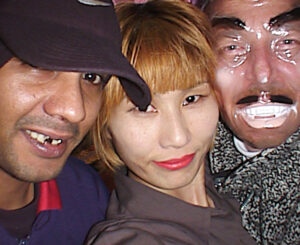
British, active 1995-2008
Mongrel was a shifting collective of multicultural artists who worked in different combinations around the world. Founded in London, they would go on to make work with townships in South Africa, rural communities in Jamaica, and the Surinam community in Amsterdam. The group emerged as a response to the racial exclusivity of the technology industry and as a way to explore the application of digital tools to artistic production. Members included Richard Pierre-Davis, mervin Jarman, Graham Harwood and Matsuko Yokokoji, and expanded to encompass Richard Wright, Matthew Fuller, and Lisa Haskell, among others.
You can see more of Mongrel’s work here: monoskop.org/Mongrel.
“What does it mean if instead of defining ourselves as black and white, or this or that, what happens when we take a critical view of ourselves and see how many different versions of ourself appear, depending on where we’re talking to the bank manager, or whether we’re talking to a friend, or whether we’re talking to a policeman?”
—Graham Harwood of Mongrel
Heritage Gold, 1997
Software program displayed on vintage CRT monitor
Courtesy of the artists and Rhizome
Colour Separation, from National Heritage, 1997–99
[reprinted]
Printed posters
Courtesy of Matsuko Yokokoji
“At the time, Photoshop was fairly new. And there was this amazing six months when people did amazing things. And then suddenly, it turned into a machine for making everyone the same. Suddenly, all the magazines, all these people, were Photoshopped, and to be Photoshopped became the standard.”
—Graham Harwood of Mongrel
Mongrel was a multi-racial collective that formed at Artec (Arts Technology Centre London), a community organization that provided mostly Black and working-class people with access to new technologies. Their shocking, sneering works force audiences to confront uncomfortable ideas about identity.
In 1997, Mongrel adopted the fake corporate name MongrelSoft™ to launch a new software program called Heritage Gold, which was part of their larger investigation of national identity called National Heritage. This hack of Photoshop 1.0, which the artists shared on floppy disks and on internet bulletin boards, allows users to adjust the class, race, and social status (among other attributes) by applying filters to photographed subjects. As if demonstrating the program’s capabilities, an accompanying image shows a urinating young Prince Charles as “Both Negro and Anglo-Saxon”—a provocative image designed to “take the piss out of” (that is, mock) the racism at the heart of British nationalism. Similarly, the program’s settings mock the idea that digital technologies allow us to change our identities—or fix prejudice and systemic oppression—with just a few clicks. In a series of related photographs called Colour Separation, the group “stitched” together the faces of members of Artec with visible sutures, suggesting that using technology to promote multiculturalism, which can celebrate diversity without committing to structural change, is itself a form of violence.
An emulated version of this work is also freely available for you to experience on your own devices.
View the interactive digital artwork here.
Join E-News
Please sign up to receive our weekly E-News, full of timely and insightful information about our exhibitions, artists, and programs.
See Them First–Spring's Most Anticipated Exhibitions Now on Sale
"Martin Wong: Chinatown USA"
"Dispossessions in the Americas"
"Statue of Athena" on long term view.