Educator Insight: Eden on Martin Wong's "Self-Portrait"
Martin Wong’s Self-Portrait (1993) stages identity as something constructed, relational, and in motion rather than fixed or inherent. In this work, we can see Martin Wong’s relationship to his “Chino-Latino” identity tag, a term that refuses stable categorization and instead insists on hybridity. Rather than describing lineage, this self-fashioning points to affiliation. An identity shaped through lived experience, proximity, and desire. In late 20th-century New York, Wong was embedded in Nuyorican cultural circles and influenced by his stepfather,[1] who was a Chinese Mexican American. This act raises questions about alignment versus appropriation, leaving open the question of how one interprets his relationship to the communities he references.
This self-fashioning resonates with José Esteban Muñoz’s concept of disidentification,[2] in which queer people of color negotiate dominant identity structures by neither fully accepting nor rejecting them but instead reworking them from within. Wong’s “Chino-Latino” identity operates in this space of tension. It exposes the instability of racial categories while also insisting on the legitimacy of self-definition as a lived and social practice. Identity here is not something to be verified, but something to be enacted.[3]
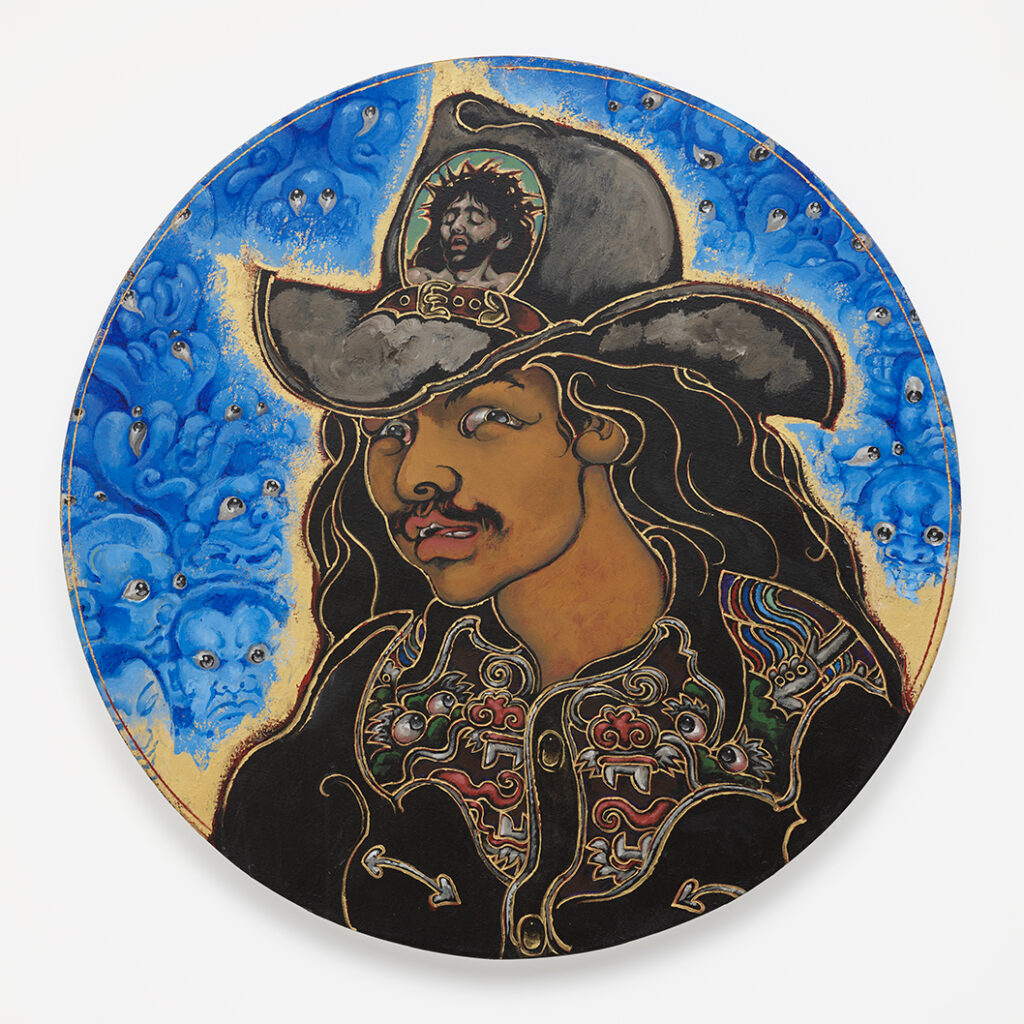
Martin Wong, "Self-Portrait", 1993, Acrylic on canvas; Collection of SFMOMA [Purchase, by exchange, through a gift of Peggy Guggenheim]; © Martin Wong Foundation. Courtesy of the Martin Wong Foundation and P·P·O·W, New York.
The visual language of Self-Portrait makes this argument materially legible. The circular composition evokes a devotional icon, reinforced by a gold-toned background that reads like a halo. Wong situates himself within a sacred visual framework, but the figure he presents resists singular meaning. His clothing combines references: an ornate garment with dragon motifs suggests Chinese artistic traditions, while the wide-brimmed hat evokes Mexican or broader Latino iconography. The hat, positioned within the center, becomes a visual marker of his metamorphosis within his identity. While simultaneously prompting reflection on cultural borrowing and the permeability of visual codes.
Within the hat, a small portrait of Christ introduces another layer of symbolism tied to Catholic imagery and martyrdom. This nested figure complicates the composition further, suggesting that identity is not only hybrid but also cumulative, built through layers of reference and association. The background intensifies this effect: a field of swirling blue populated by small, demon-like faces that seem to watch or press in on Wong. These forms suggest an external gaze that both shapes and constrains how his identity is seen and understood.
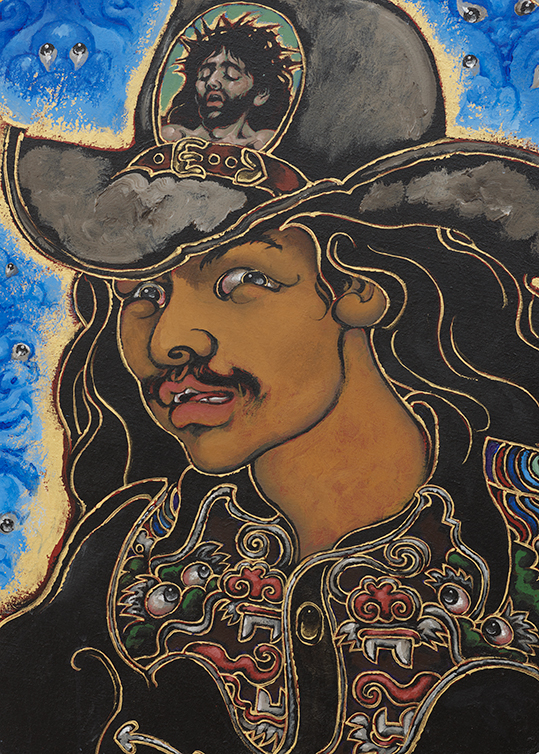
Detail of Martin Wong, "Self-Portrait", 1993, Acrylic on canvas; Collection of SFMOMA [Purchase, by exchange, through a gift of Peggy Guggenheim]; © Martin Wong Foundation. Courtesy of the Martin Wong Foundation and P·P·O·W, New York.
Wong’s own expression remains ambiguous; his gaze slightly averted, resisting confrontation with the viewer. In these visual markers, Wong’s Self-Portrait challenges the idea that identity must be singular, stable, or authentic in any fixed sense. Instead, it proposes identity as a living practice, something assembled through cultural participation, visual language, and acts of affiliation. By naming himself “Chino-Latino,” Wong not only redefines his own position, but also opens up a broader question: what does it mean to belong, and who has the authority to decide?
Endnotes:
[1] Merriam-Webster.com Dictionary, s.v. “Nuyorican,” accessed April 2, 2026, https://www.merriam-webster.com/dictionary/Nuyorican.
[2] José Esteban Muñoz, Disidentifications: Queers of Color and the Performance of Politics (Minneapolis: University of Minnesota Press, 1999), 25–30.
[3] Ibid., 32.
Bio
Eden Rodriguez is an educator at Wrightwood 659 and an emerging artist exploring queer histories and identities in contemporary art.
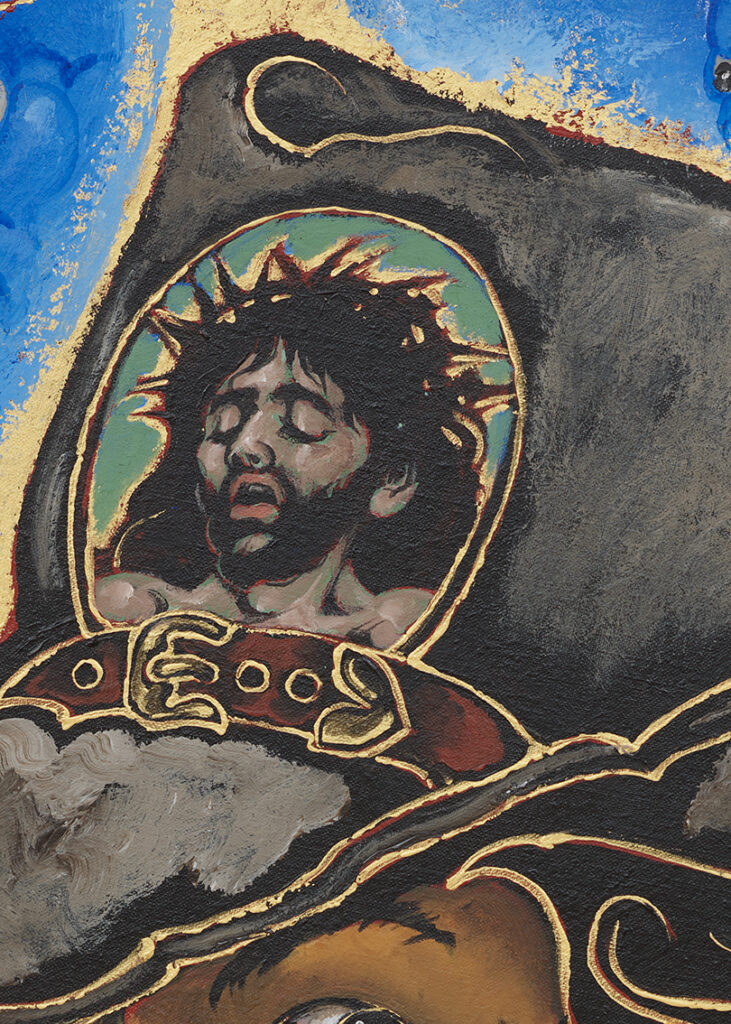
Detail of Martin Wong, "Self-Portrait", 1993, Acrylic on canvas; Collection of SFMOMA [Purchase, by exchange, through a gift of Peggy Guggenheim]; © Martin Wong Foundation. Courtesy of the Martin Wong Foundation and P·P·O·W, New York.